
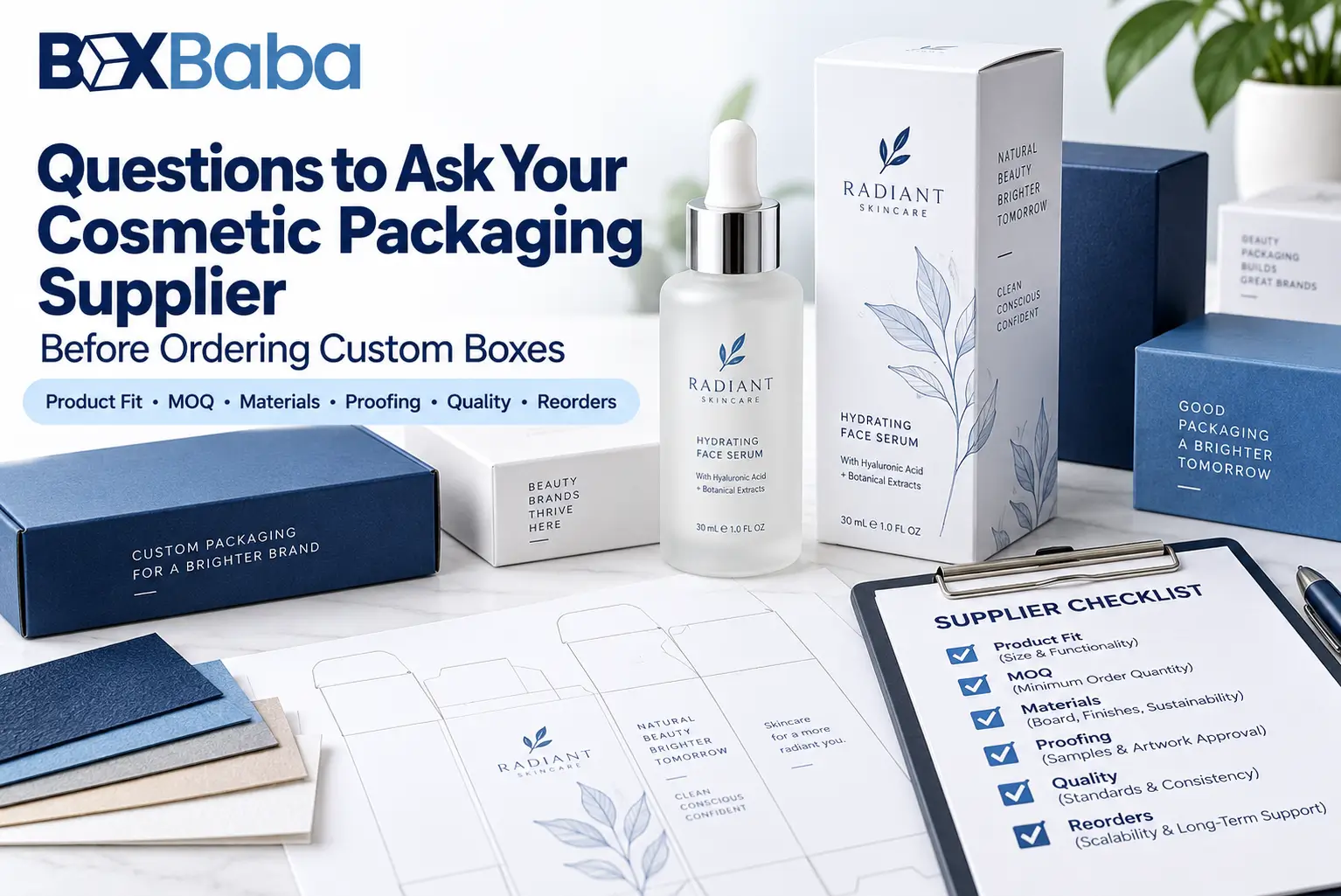
Before choosing a cosmetic packaging supplier, ask what information they need to quote the box correctly, how MOQ is calculated, what the quote includes, how product fit and SKUs are handled, what artwork and proofs are required, what quality standard controls bulk production, when lead time starts, how shipping is quoted, and how approved specifications are controlled on reorders.
The goal is not to find a supplier who says yes to every request. It is to find a supplier who can turn the finished cosmetic product into a clear, comparable packaging specification without relying on hidden assumptions.
This guide focuses on printed secondary cosmetic packaging such as folding cartons, sleeves, rigid boxes, insert-supported boxes and related paper-based packaging placed around a completed bottle, jar, tube, compact, palette or other cosmetic container. Primary packaging suppliers for bottles, pumps, droppers, closures and formula-contact components require additional questions about compatibility, dispensing, leakage and component performance.
Product → Dimensions → Structure → Material → Artwork → SKU → Proof → Production → Quality → Shipping → Reorder
Supplier Questions at a Glance
Question | What It Should Clarify | Record to Keep |
|---|---|---|
What information do you need before quoting? | Whether the supplier is quoting from actual product requirements or assumptions | RFQ / product brief |
What packaging layer do you supply? | Primary vs secondary packaging capability | Supplier scope |
How is MOQ calculated? | Whether the minimum applies per structure, size, artwork or SKU | Quote quantity breakdown |
What exactly is included? | Material, print, inserts, finishes, proofing, assembly and shipping scope | Written quotation |
What dimensions are being quoted? | Product vs internal vs external dimensions | Approved dieline/spec |
What proof are we approving? | What the proof can and cannot validate | Approved proof/version |
What controls bulk quality? | Project-specific specification and acceptance criteria | Approved specification |
When does timing start? | The actual production schedule trigger | Order confirmation |
How are reorders controlled? | Which dieline, artwork and material version will be repeated | Approved revision record |
First Confirm What Type of Packaging Supplier You Need
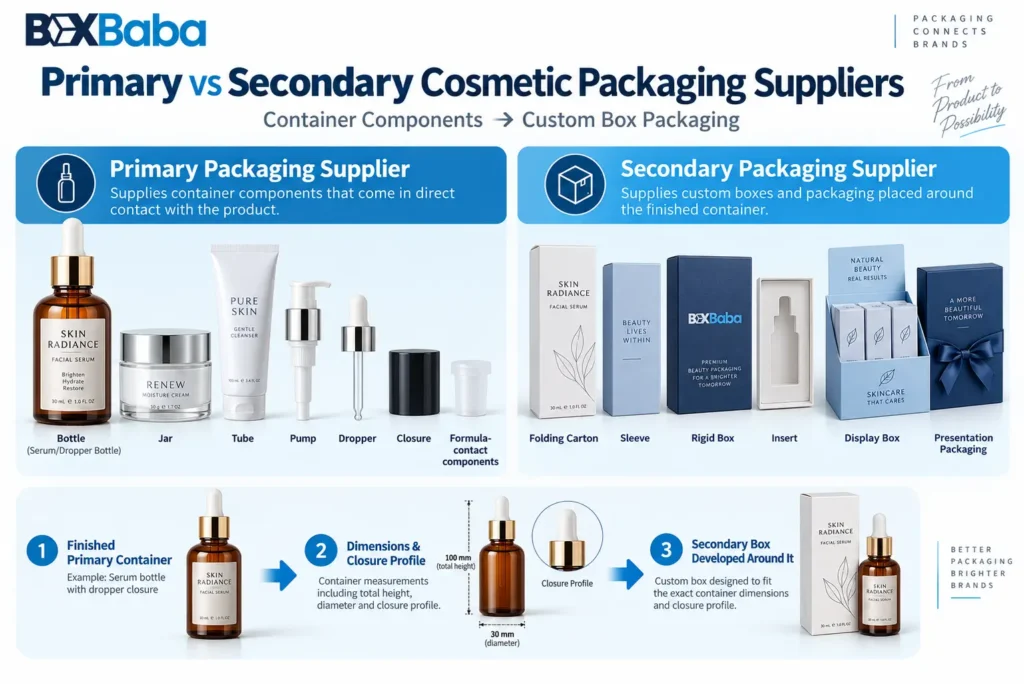
The term cosmetic packaging supplier can describe very different businesses. A primary-packaging supplier may manufacture bottles, jars, tubes, pumps, droppers, closures, lipstick cases or compacts. A secondary-packaging supplier may manufacture folding cartons, sleeves, rigid boxes, mailers, inserts, display boxes or presentation packaging.
For a primary container, the brand may need to discuss formula compatibility, closure systems, filling processes or dispensing performance. For a custom cosmetic box, the supplier needs to understand the finished primary container so the secondary packaging can be developed around it.
Before comparing quotations, make sure the shortlisted suppliers are quoting the same packaging layer and the same scope.
Questions About Product Fit and Structure
What Product Information Do You Need Before Quoting?
A useful secondary-packaging quote normally needs more than the required quantity. Depending on the project, useful inputs can include the cosmetic product type, finished container dimensions, maximum diameter, closure profile, filled weight, product orientation, quantity by SKU, artwork status, insert or window requirements, sales channel and delivery destination.
A stronger question is: What product and order information do you need to recommend the structure and prepare a comparable quote?
The answer shows whether the supplier is developing packaging from a defined specification or a set of assumptions.
Are the Quoted Dimensions Internal or External?
Distinguish product dimensions, internal carton dimensions and external carton dimensions. Board thickness and structure affect the relationship between them. This matters for product fit, inserts, retail footprints, master cases and ecommerce pack-outs.
Ask the supplier to state clearly which dimensions appear in the quote, dieline and final specification.
How Will You Evaluate Product Fit?
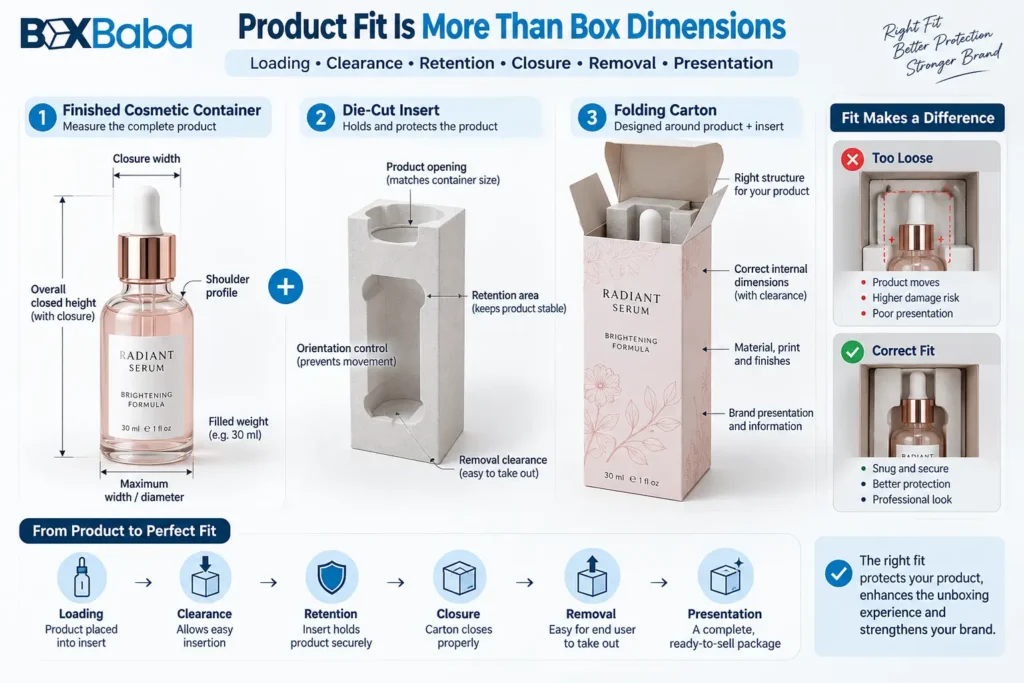
Do not treat fit as simply whether the product can be placed inside the box. Ask how the proposed package addresses loading, clearance, closure, product retention, orientation, removal, insert movement and window alignment.
Product Fit = Loading + Clearance + Retention + Closure + Removal + Presentation
If the container has an unusual closure or shape, ask whether photographs, dimensional drawings or a representative physical sample are needed before the structure is finalized.
What Structure and Insert Do You Recommend – and Why?
A useful recommendation should connect the structure to the product dimensions, weight, opening direction, product count, retail presentation, insert requirement, packing workflow and sales channel.
If an insert is recommended, ask what problem it solves: product movement, separation, presentation, orientation, fragile support or window alignment. Also clarify the insert material, loading method, removal method, whether it changes the outer-box size and whether it will be installed before delivery.
For the broader selection workflow, see How to Choose Cosmetic Packaging Boxes.
Questions About MOQ and Quote Scope
What Is the MOQ – and How Is It Calculated?
Ask whether the minimum applies to the complete order, each box size, structure, material, artwork, SKU, language version or finish variation. This is especially important for makeup and skincare ranges with several artwork versions.
For example, several lipstick shades may share one physical carton while using different shade names, barcodes and artwork. Ask whether MOQ is being applied to the shared structure or separately to each artwork variation.
Do not transfer MOQ assumptions from custom molded bottles to custom paperboard cartons. They are different manufacturing projects.
Can Several SKUs Share the Same Structural Dieline?
Several SKUs may share one structure when their physical geometry, closure profile, orientation, insert and loading requirements remain compatible.
One Lipstick Tube Geometry → One Structural Dieline → Multiple Shade Artwork Versions
A 30 mL dropper bottle and a 30 mL airless pump should not automatically be assumed to use the same carton simply because their fill capacities match. Ask the supplier to separate structural variation from artwork variation.
What Exactly Is Included – and Excluded – From the Quote?
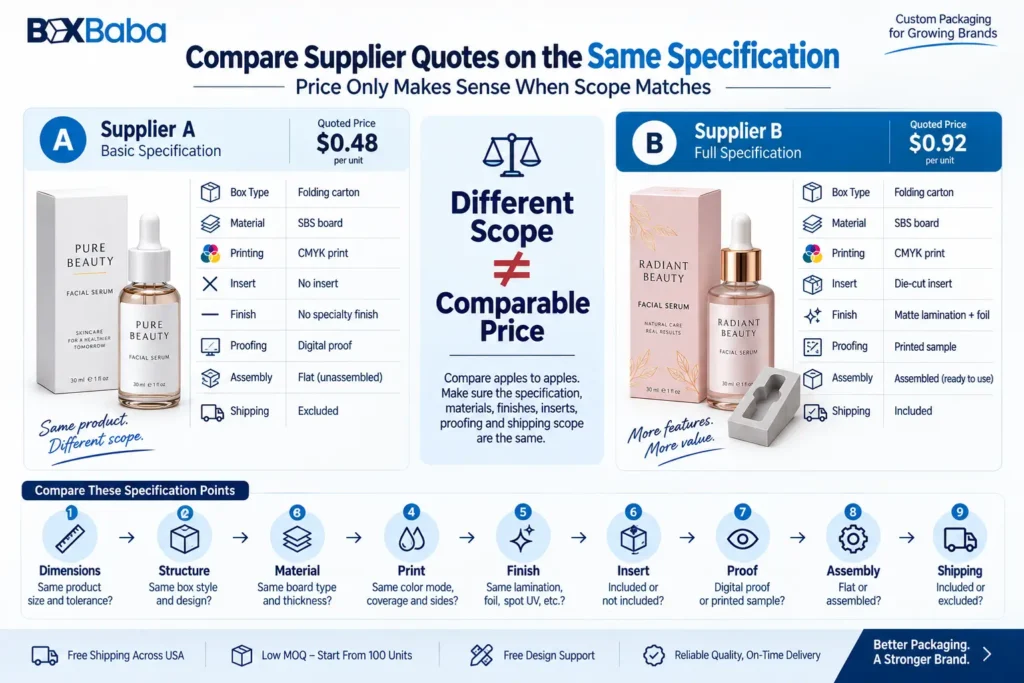
Two suppliers can quote different prices while appearing to quote the same box. Ask whether the quotation includes dieline/setup, selected board, printing, inside printing, lamination, foil, Spot UV, embossing or debossing, window cutting or film, insert, insert installation, assembly, sample/proofing, packing, master cartons and shipping.
A quotation for a plain folding carton should not be compared directly with a quotation for a carton with an insert, foil and lamination.
What Changes Would Require a Revised Quote?
Ask what happens commercially if the structure, material, quantity, artwork count, finish, insert, window, supply format or shipping destination changes after the quotation is issued.
This connects technical change control with price and timing. A quote should represent a defined packaging specification, not an open-ended promise.
Questions About Materials, Print and Finishes
What Material Is Being Quoted – and Why?
A useful supplier answer should connect material to the product weight, structure, folds and scores, printing, finishes, insert relationship, sales channel and desired presentation.
If environmental positioning matters, ask what documentation supports any specific material or sustainability claim. Do not assume a brown kraft appearance proves recycled content, recyclability, compostability or certification.
For detailed board-selection guidance, see Best Materials for Custom Cosmetic Boxes.
What Printing and Color System Will Be Used?
Ask which printing process is being quoted and whether changing quantity, material or artwork would change that process. If brand-color consistency matters, ask how colors should be specified – for example through CMYK values, Pantone/PMS references, approved printed samples or another agreed production reference.
Avoid relying only on a screen color or website reference. Screens, substrates and finishes can all change perceived color.
Which Finishes Are Compatible With This Material and Structure?
Ask which matte, gloss, soft-touch, foil, embossing, debossing or Spot UV options are appropriate for the actual board, dieline and artwork.
Selective finishes can interact with folds, cuts, windows, narrow edges, glue areas and small artwork details. The supplier should review finish placement before production artwork is released.
For finish-selection details, see Cosmetic Packaging Finishes Guide.
Questions About Artwork and Proofing
What Artwork and Dieline Setup Do You Require?
Clarify the accepted file formats, approved dieline, artwork scale, bleed, safe areas, color setup, image resolution, font handling, barcode and QR placement, finish layers, and inside/outside artwork orientation.
The suppliers project-specific dieline and prepress requirements should take priority over generic online artwork rules. Structural lines should not be resized simply to make the design fit.
What Does Your Prepress Review Cover?
A supplier prepress review may help identify technical issues such as artwork placement, dieline relationships, bleed, panel orientation and production layers. Ask what the review does not cover.
Do not automatically assume the packaging supplier provides legal approval of cosmetic claims, ingredient declarations, warnings, certification marks, environmental claims, barcodes or market-specific regulatory wording. The brand or appropriate reviewer remains responsible for final product information.
What Proof or Sample Routes Are Available?
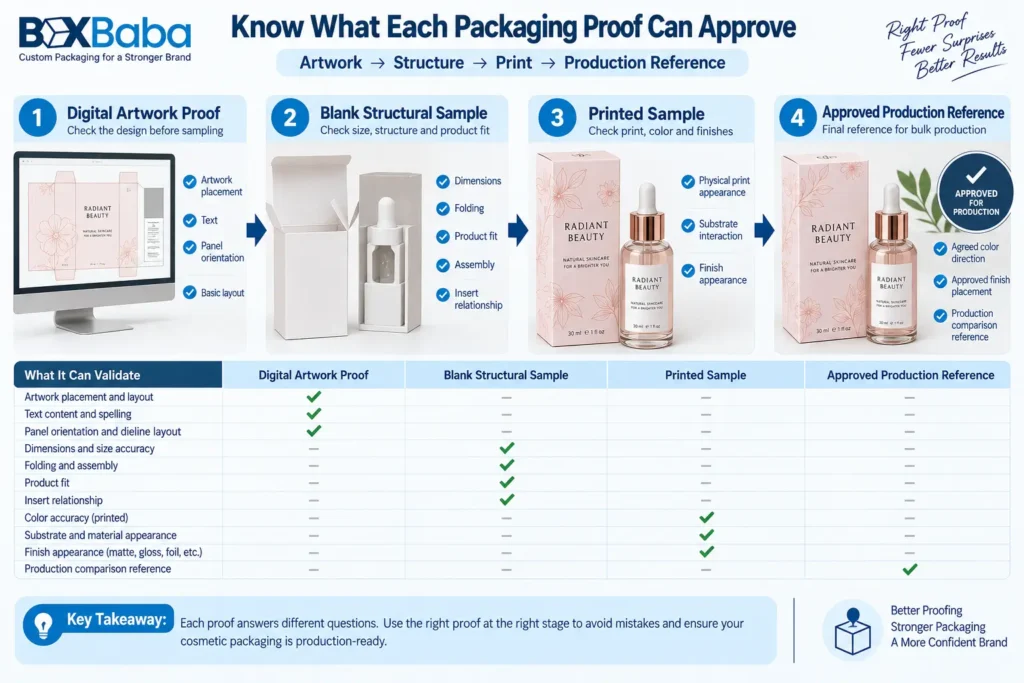
Ask which review routes are available for the actual project and what each is intended to validate. Depending on the project, these may include digital artwork proofs, 3D mockups, blank structural samples, printed samples or product-fit reviews.
A digital proof may help review artwork and panel orientation. A structural sample can help with dimensions, fit and assembly. A printed sample can help review physical artwork appearance. One review route should not be expected to validate every attribute.
What Will the Proof or Sample Not Represent Exactly?
Ask whether the sample uses actual production material, representative material, the intended print process, a different digital print process, actual finishing, simulated finishing or prototype tooling.
Then define what is being approved. For example, is the sample only a color-direction reference, or is it intended to serve as an agreed production reference?
Questions About Quality and Production
What Specifications and Acceptance Criteria Control Bulk Production?
Ask which approved attributes will control acceptance of the finished order: dimensions, material, structure, print, color reference, finish placement, artwork version, quantity and packing format.
Do not assume universal tolerances. Ask which project-specific tolerances or approved references will be used if there is a disagreement about whether the order matches the specification.
What Quality Checks Happen Before the Order Ships?
Avoid treating quality control as a vague promise. Ask what the supplier actually checks for the packaging being ordered and which approved specification the finished order is compared against.
Relevant checks may include dimensions, material, structure, print, finish placement, artwork/SKU version, quantity and packing configuration.
What Happens If Bulk Production Does Not Match the Approved Specification?
Clarify how a non-conforming issue is documented, who reviews it, whether affected production is held or corrected, what resolution options may apply, and how the issue can affect the schedule.
The objective is not to assume a particular remedy. It is to understand the suppliers issue-resolution process before a disagreement exists.
When Does Production Time Start – and What Can Change It?
Ask whether the production schedule starts after order placement, deposit, final dimensions, dieline approval, artwork approval, sample approval or complete production approval.
Also ask which changes can reset or extend timing, such as artwork revisions, SKU changes, insert revisions, material changes, specialty finishes or new sample approvals.
Can Your Capacity Support Future Volume Increases?
MOQ answers the low-volume question. Capacity answers the growth question. Ask what volume the supplier can support for the proposed structure and how a significant increase could affect production method, schedule or quality-control planning.
Are Any Critical Production Steps Subcontracted?
Outsourcing is not automatically a problem. The useful question is whether any critical printing, finishing, insert or assembly steps are performed elsewhere and how the approved specification, version control and quality requirements are carried through those stages.
Questions About Delivery, Changes and Reorders
How Will the Boxes Be Supplied and Shipping Handled?
Ask whether the packaging will be flat-packed, partially assembled, fully assembled, supplied with inserts separately or supplied with inserts installed. Supply format can affect freight volume, storage, packing labor and fulfillment.
Also clarify whether shipping is included, excluded or quoted separately; the destination and service level; the packing format; and the responsibility for duties or taxes where applicable.
How Are Specification Changes and Reorders Controlled?
Ask how the supplier identifies the approved dieline, dimensions, material, artwork version, finish, insert, SKU schedule and quantity. A repeat order should not depend on someone finding a file called final-final-revised.pdf.
If the bottle supplier, container geometry, closure, insert, material, artwork, barcode or finish changes, ask which parts of the packaging specification need to be reviewed again.
Previous Order ≠ Automatic Approval of Current Order
Supplier Comparison Scorecard
Comparison Area | What to Check |
|---|---|
Scope | Is each supplier quoting the same package and packaging layer? |
Product fit | Are dimensions, closure, filled weight and support requirements handled consistently? |
MOQ | Is the minimum total, per structure, per artwork or per SKU? |
Material | Is the board/material specification equivalent? |
Printing | Is the quoted print process comparable? |
Finishes | Are the same surface treatments included? |
Insert/assembly | Is the same insert and installation scope included? |
Proofing | What proof/sample route is included or optional? |
Acceptance criteria | What approved reference or tolerance controls bulk acceptance? |
Non-conformance | How are production deviations documented and resolved? |
Production timing | From which approval point does the schedule begin? |
Supply format | Flat-packed, assembled or insert-installed? |
Shipping | Included, excluded or quoted separately? |
SKU handling | Are quantities and artwork versions separated correctly? |
Reorders | How are approved versions controlled? |
Which Questions Matter Most for Your Situation?
Buyer Situation | Questions to Prioritize |
|---|---|
Startup | MOQ, quote scope, simpler structure, proofing, timeline, what can be simplified |
Private label | Container sample, supplier changes, shared structures, SKU quantities, artwork control |
Retail | Shelf orientation, barcode space, information area, product presentation, retailer requirements |
Ecommerce | Retail carton vs outer shipper, completed pack-out, supply format, shipping assumptions |
Multi-SKU brand | Shared dielines, artwork versions, quantity breakdown, approval ownership, reorders |
Premium / gift | Inserts, assembly, finish fidelity, proof route, supply format and handling |
Questions About Environmental Packaging Claims
If sustainability is part of the brand position, avoid asking only whether the packaging is eco-friendly. Ask what the exact material is, what documentation supports the specific claim you intend to make, and whether coatings, laminations or finishes affect how the completed package should be described.
Claims such as recycled content, recyclability, FSC certification, compostability or biodegradability should be tied to the actual specification and available documentation rather than appearance alone.
What to Send With Your RFQ
RFQ Section | Information to Provide |
|---|---|
Product | Cosmetic product type; finished dimensions; maximum diameter; closure profile; filled weight; product photos; sample availability |
Packaging | Preferred structure if known; product orientation; insert/window requirements; sales channel; flat-packed or assembled preference |
Artwork / SKUs | Artwork status; number of SKUs; quantity per SKU; inside printing; barcode/QR needs; finish preferences |
Order | Total quantity; target project date; delivery destination; proof/sample requirement |
What BoxBaba Needs for a Cosmetic Packaging Quote
Beauty brands requesting custom secondary cosmetic packaging from BoxBaba should provide the finished product information first, including the container dimensions, filled weight, closure profile, required quantity, quantity by SKU, artwork status, insert or window requirements, finish preferences, sales channel and delivery destination.
The verified minimum order quantity for custom cosmetic boxes is 100 boxes. Final order requirements can still depend on the structure, size, material, printing, finishing and SKU setup.
Proofing or sample routes should be confirmed for the actual project, and production timing should be treated as beginning only after the relevant packaging specification and approvals are sufficiently complete.
For a commercial starting point, see Custom Cosmetic Boxes. Private-label brands can also use the Private Label Cosmetic Packaging Guide to organize container, artwork and SKU information before quotation.
Final Takeaway
The best supplier question is not How cheap can you make this box? It is What information do you need to define this packaging correctly, what evidence will we approve, and what specification will control bulk production and future reorders?
A strong supplier conversation should move from capability to specification, from specification to approval, and from approval to controlled production.
Supplier Capability → Defined Specification → Comparable Quote → Proof / Approval → Bulk Quality → Delivery → Reorder Control
Before committing to a custom cosmetic box order, clarify the product, dimensions, structure, material, insert, artwork, SKU breakdown, finishes, proofing, acceptance criteria, production timing, shipping scope and reorder process. The clearer the specification, the easier it is to compare suppliers on the same basis.
Frequently Asked Questions
What should I ask a cosmetic packaging supplier first?
Start by asking what information they need to prepare an accurate quotation, what packaging layer they supply, how MOQ is calculated, what the quote includes, what proofing route applies, what acceptance criteria control production and when the production schedule begins.
What information should I send for a cosmetic box quote?
Provide the finished product dimensions, filled weight, closure profile, quantity, quantity by SKU, artwork status, sales channel, insert or window requirements, finish preferences and delivery destination. Product photographs or a representative sample can help when the container has an unusual shape.
What should I ask about cosmetic packaging MOQ?
Ask whether MOQ applies to the total order or separately to each size, structure, artwork, color or SKU. Several SKUs may share one structure while still requiring separate artwork and quantity control.
How do I compare cosmetic packaging supplier quotes?
Give each supplier the same product and packaging specification. Compare dimensions, structure, material, print, finishes, inserts, MOQ, proofing, acceptance criteria, supply format, production scope and shipping assumptions.
What should I ask about packaging samples?
Ask which proof or sample is appropriate for the risk you need to review and what it does not validate. Digital proofs, structural samples and printed samples answer different questions.
What quality-control questions should I ask?
Ask which approved specification controls bulk production, which attributes are checked, what project-specific tolerances or references apply and what happens if production does not match the approved specification.
When does cosmetic packaging production lead time start?
Ask for the exact trigger. Depending on the project, production may begin only after dimensions, structure, artwork, quantity, proofing or other approvals are complete. Separate production time from development, proofing and shipping.
What should I ask before a reorder?
Confirm whether the primary container, dimensions, closure, structure, insert, artwork, barcode, material and finish are unchanged. If anything changed, ask which part of the packaging specification must be reviewed again.
How do I know if a packaging quotation is complete?
You should be able to identify the dimensions, structure, material, printing, finishes, insert, quantities by SKU, proofing scope, supply format, shipping responsibility and the approval conditions required before production.