
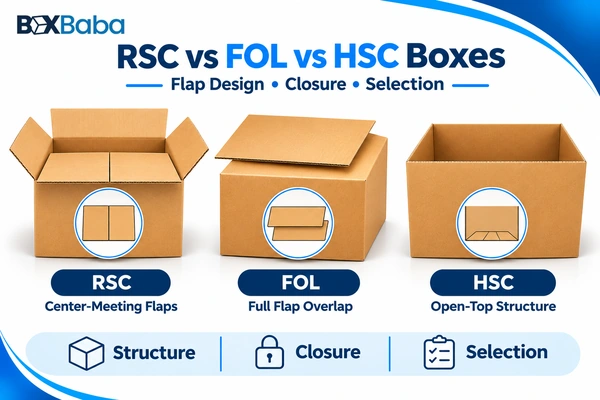
RSC, FOL and HSC shipping boxes are three slotted corrugated-carton structures distinguished by their flap configurations. A Regular Slotted Container (RSC) has top and bottom flaps whose outer flaps meet at the center. A Full-Overlap Container (FOL) uses extended outer flaps that overlap completely. A Half-Slotted Container (HSC) has flaps at one end and is open at the other unless a separate cover or another suitable closing arrangement is used.
These differences influence material use, assembly, loading and sealing. The appropriate choice depends on the complete packed product, required closure and fulfillment operation—not the flap design alone. This guide compares the three structures and explains what buyers should confirm before ordering.
RSC vs FOL vs HSC: Key Structural Differences
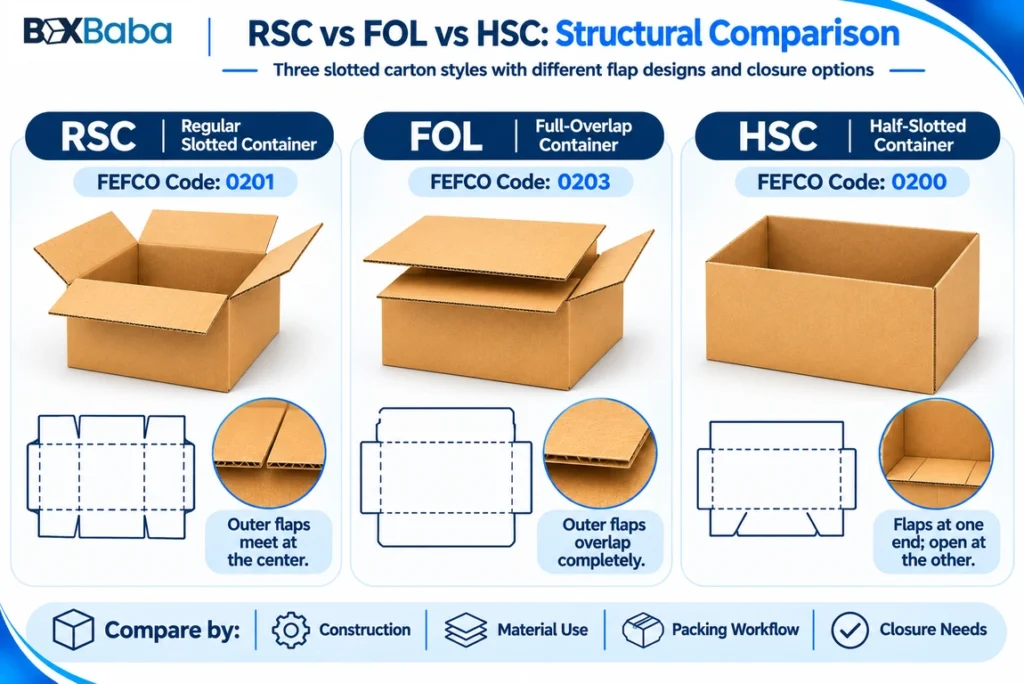
The three constructions belong to the slotted corrugated-box family. Their standard designs are identified in the FEFCO packaging design-code system.
Feature | RSC | FOL | HSC |
Full name | Regular Slotted Container | Full-Overlap Container | Half-Slotted Container |
Conventional FEFCO code | 0201 | 0203 | 0200 |
Construction | One-piece slotted carton | One-piece slotted carton with extended outer flaps | Carton body with flaps at one end |
Closed top | Outer flaps meet at the center | Outer flaps overlap completely | Requires a separate cover or other suitable closure |
Closed bottom | Outer flaps meet at the center | Outer flaps overlap completely | One set of flaps forms the base in the usual upright arrangement |
Main structural distinction | Conventional center-meeting flaps | Complete outer-flap overlap | One open end |
Packing consideration | Conventional case erection and sealing | Extended-flap folding and sealing | Open-top loading and any required cover application |
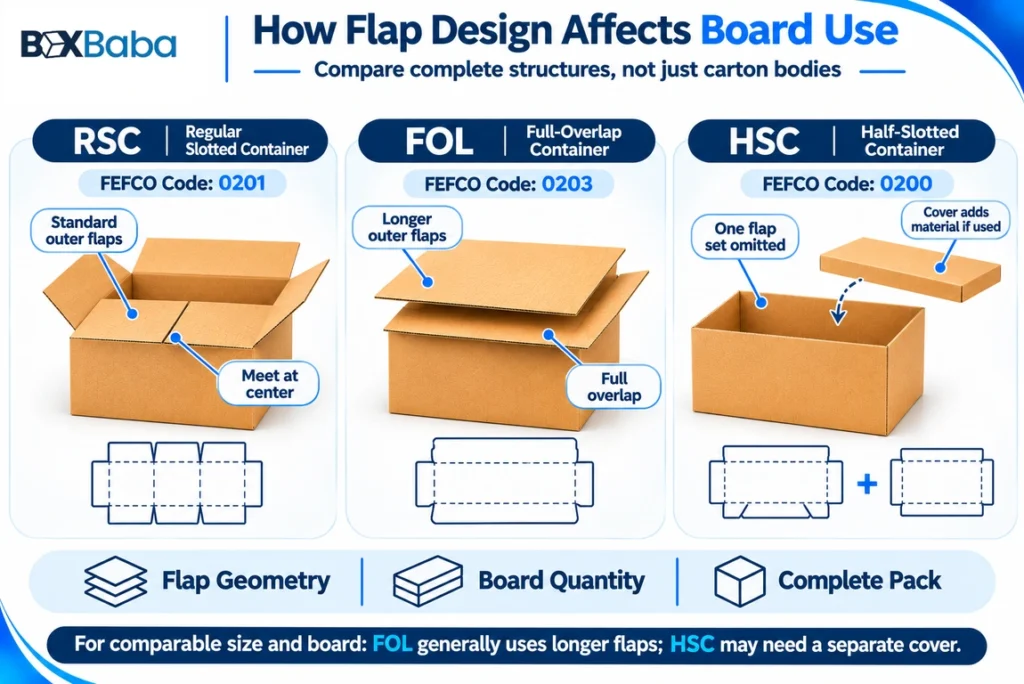
Material consideration | Standard outer-flap length | Longer outer flaps generally require more board | One flap set omitted; a separate cover adds material |
Typical application to evaluate | Conventional enclosed parcels and distribution cases | Enclosed cartons requiring full flap overlap | Open-top packing or a suitable separate-cover system |
The FEFCO code identifies a design, not a material grade, maximum load capacity or certification of the completed package.
What Is an RSC Shipping Box?
A Regular Slotted Container is a conventional corrugated carton with four side panels and sets of top and bottom flaps.
In the standard design, the outer flaps meet at the center when closed. The carton can generally be supplied flat, erected for packing and sealed using an appropriate method.
RSC construction and closure
An RSC is usually erected by forming its side panels and folding the bottom flaps into position. The bottom is sealed before the products and any protective components are loaded.
After packing, the top flaps are folded closed and secured.
This conventional sequence can suit repeatable packing operations, but equipment compatibility depends on the actual carton dimensions, material and sealing process.
When to consider an RSC
An RSC may be considered when the shipment requires a conventional enclosed carton with top and bottom slotted flaps.
For example, a wholesaler shipping several identical retail packages can establish the required quantity per case and their intended arrangement, then specify an appropriate carton size.
The correct board, protective components and sealing method depend on the complete loaded case and its distribution conditions.
For custom sizing and ordering information, explore BoxBaba RSC Corrugated Shipping Boxes.
What Is an FOL Shipping Box?
A Full-Overlap Container is a slotted corrugated carton with extended outer flaps that overlap completely when the box is closed.
Unlike an RSC, whose outer flaps meet at the center, an FOL outer flaps extend across the complete opening. The conventional design provides two overlapping outer-flap layers across its closed top and bottom.
What changes when the flaps overlap?
The extended flaps change the carton blank, the amount of board used and the folding and sealing arrangement.
For equivalent internal dimensions and the same board specification, an FOL generally requires more material in its outer flaps than a conventional RSC.
Its closing operation must also accommodate the longer panels.
The additional overlap may be relevant when the packaging design calls for complete top or bottom outer-flap coverage.
When to consider an FOL
An FOL may be worth evaluating when the required shipping configuration benefits from extended outer flaps.
For example, a proposed carton may need a particular closing-panel arrangement because of the packed load or handling requirements.
The buyer should establish why complete overlap is relevant, then review the proposed design together with the board specification, loaded weight, protective components and sealing method.
An FOL should not be selected solely because a general packaging description calls it stronger than an RSC.
Does full overlap guarantee better protection?
No. Full-overlap construction creates additional outer-flap coverage, but it does not independently establish a universal strength rating or guarantee protection during shipping.
An unsuitable board, inadequate cushioning or an inappropriate closure can still compromise the completed package.
The structural design must be evaluated as one part of the full packaging specification.

What Is an HSC Shipping Box?
A Half-Slotted Container is a corrugated carton with one set of end flaps.
In its conventional upright configuration, those flaps form the base, leaving the top open.
An HSC can be used where open-top access is part of the intended packing or handling process. When a fully enclosed package is required, the open end needs a separately specified cover or another suitable closing arrangement.
How an HSC changes the packing process
Unlike an RSC or FOL, a conventional HSC has no attached upper flaps.
This allows products to be loaded through the unobstructed top after the bottom has been assembled and secured.
The absence of upper flaps also means that the finished package top closure must be considered separately when enclosure is necessary.
When to consider an HSC
An HSC may be relevant for suitable open-top loading, product grouping, warehouse handling or packaging systems that use a separate cover.
For example, a business may place products into open-top cartons and apply an approved cover during a later packing operation.
Whether that configuration is appropriate depends on the products, loaded weight, handling requirements and the exact cover design.
An uncovered HSC should not automatically be treated as a complete enclosed parcel shipper.
HSC cartons with separate covers
An HSC may form part of a two-component packaging system that includes a separately manufactured lid or cover.
That cover needs its own dimensional and material specification. The complete design should establish how the cover fits, closes and remains secured during the intended handling process.
An HSC with a separate lid is not automatically equivalent to an RSC, FOL or adjustable telescopic carton.
The actual two-piece design must be reviewed before manufacturing.
How to Choose Between RSC, FOL and HSC Cartons
The appropriate structure depends on the required package and how it will be packed.
Shipment requirement | Structure to investigate | What to confirm |
Conventional enclosed shipping case | RSC | Board, internal dimensions, protective components and sealing |
Enclosed case requiring full outer-flap overlap | FOL | Purpose of overlap, extended-flap closure and material specification |
Open-top packing or handling | HSC | Required loading access and whether the package may remain open |
Open-top loading followed by a separate cover | HSC with approved cover | Cover dimensions, board, fit and securing method |
Existing automated RSC packing line | RSC or another equipment-compatible design | Machine compatibility before changing structures |
Heavy or fragile product | Any suitable approved structure | Complete packed load, protection, material, closure and relevant evaluation |
These are structural starting points, not fixed recommendations for particular weights or product categories.
Start with the required enclosure
Establish whether the package needs to be fully enclosed during distribution.
If a conventional enclosed case meets the intended requirements, an RSC may be considered. If complete outer-flap overlap is a relevant design requirement, evaluate an FOL.
If the operation requires an open top during loading, an HSC may be relevant. Where the finished shipment must be enclosed, specify the cover or other approved closing system.
Consider the packing operation
A structure must work with the business actual erection, loading and sealing procedures.
Changing from an RSC to an FOL affects flap folding and possibly the sealing arrangement. Changing to an HSC with a separate cover introduces another component and an additional closing operation.
The carton dimensions and board must also be compatible with any packing equipment.
Review the completed product load
The product weight and shape may influence the appropriate material and internal protection.
A carton with complete outer-flap overlap is not a substitute for suitable product restraint. Similarly, an open-top configuration does not establish whether the finished package is appropriate for parcel delivery.
Evaluate the entire packed shipment before approving the structure.

How Flap Design Affects Board and Material Use
RSC, FOL and HSC identify carton constructions. They do not independently specify corrugated-board thickness, flute profile or strength rating.
The amount and arrangement of flap material differ between them.
A conventional RSC uses center-meeting outer flaps. An FOL uses extended outer flaps, which generally require additional board compared with an equivalent RSC. An HSC omits one set of flaps, although a separately specified cover may add material to the completed system.
These differences can influence the manufacturing blank and quotation.
Full overlap is not double-wall board
Full overlap describes the geometry of a carton outer flaps.
Double-wall describes corrugated-board construction: two fluted mediums between three liner sheets.
An FOL made from single-wall board remains a single-wall carton, even though its closed ends have overlapping outer-flap layers.
The appropriate board grade should be selected independently of the flap design, based on the complete shipment and intended distribution conditions.
For the broader material and transit-packaging options, explore BoxBaba Corrugated Shipping Boxes.
How Carton Style Affects Assembly and Sealing
Carton design and packing-line requirements should be reviewed together.
RSC packing operations
An RSC follows a conventional process of erection, bottom sealing, loading and top sealing.
Manual operations and automated equipment may be configured around this sequence.
However, an RSC designation alone does not guarantee compatibility with a particular case erector or sealing machine. The equipment accepted dimensions, board specification and closure requirements still apply.
FOL packing operations
An FOL must be folded and sealed according to its extended outer-flap design.
A sealing operation configured for center-meeting RSC flaps may need adjustment or different equipment to accommodate the overlapping panels.
Before substituting an FOL for an existing RSC, review the actual machine specifications and closing procedure.
HSC loading and cover application
An HSC can be loaded through its open top after its bottom is assembled.
If a cover is required, the packing process must include fitting and securing that separate component.
The complete operation depends on the actual cover design and whether loading and closing are performed manually or with equipment.

Internal Dimensions and Protective Components
The three structures may be developed around the same general product dimensions, but their finished packaging configurations are not necessarily interchangeable.
Begin with the products in their intended shipping condition.
For multi-unit shipments, establish the number of products, their arrangement and complete loaded weight. Include the dimensions of any partitions, fitted inserts, pads or cushioning.
Internal length, width and height determine usable space within the assembled carton.
External dimensions must also be reviewed because board construction and, for an HSC system, the separate cover may affect the finished package.
For detailed measurement instructions, read our How to Measure a Box Dimension guide.
Protection must suit the product
Internal protection should be specified around the actual merchandise rather than the carton style alone.
An RSC may need dividers for multiple products. An FOL may still require cushioning around fragile contents despite its extended flaps. An HSC with a cover must accommodate the products and protective components without interfering with the fitted lid.
Flap coverage does not replace the need to evaluate product movement, suitable contact points and the closure.
How RSC, FOL and HSC Affect Packaging Cost
The cost of a carton depends on more than its structural code.
For equivalent internal dimensions and board specifications, an FOL generally requires more material in its extended outer flaps than an RSC.
An HSC omits one set of flaps, but a complete system with a separately manufactured cover must include the cost and material requirements of that component.
Other relevant variables include the board grade, carton size, printing, protective inserts, tooling, order quantity and packing procedure.
When comparing quotations, establish identical product and distribution requirements. Include all components needed for the completed package.
Do not compare an uncovered HSC body with a fully enclosed RSC as though they provide the same finished packaging configuration.
Printing and Dieline Considerations
Each structure has a different flat layout, so its artwork must be developed around the approved structural dieline.
An RSC may include suitable logos, product information, case quantities, barcodes or handling graphics.
An FOL can also carry compatible printing, but its extended flaps change the areas affected by folding and sealing.
An HSC may have printed body panels. If a separate cover is included, it requires its own applicable design and artwork specifications.
The available printing methods and surface treatments depend on the selected corrugated material and approved manufacturing process.
Reserve appropriate surfaces for shipping labels and avoid placing essential information in unsuitable sealing areas.
For production-file fundamentals, read our Dieline in Packaging guide.
Review a Structural Sample Before Changing Box Style
A proposed change in flap construction should be checked using the intended packed products.
When changing from RSC to FOL, review the longer outer flaps, required sealing method and compatibility with the existing packing process.
When changing from RSC to HSC, establish whether the package needs a cover and how that component will be fitted and secured.
A physical structural sample can help assess dimensions, product fit, assembly and closure. A digital proof supports artwork and panel-layout review.
Neither a structural sample nor an artwork proof automatically establishes the completed package performance during distribution.
Fragile, heavy or particularly demanding shipments may require appropriate additional evaluation.
Three Illustrative Carton-Selection Scenarios
These examples demonstrate the decision process. They are not verified customer projects or guaranteed manufacturing specifications.
A repeatable wholesale shipping case
A distributor packs a fixed number of completed retail products into each case.
Its operation requires a conventional enclosed carton with a compatible top and bottom sealing process.
An RSC may be investigated using the actual case quantity, packed arrangement, loaded weight and board requirements.
A shipment requiring complete outer-flap overlap
A manufacturer has a packaging specification requiring full outer-flap coverage at the closed ends.
An FOL may meet that structural requirement.
The longer flaps, material consumption, sealing method and actual packed-package requirements should be reviewed before substituting it for an RSC.
Open-top loading with a separate cover
A warehouse operation requires unobstructed access while products are loaded into a carton.
An HSC may provide the intended opening. If the completed package must be enclosed, the cover must be specified as part of the packaging system.
The buyer should include the cover material, dimensions, fit and closing operation in the quotation.
Common Mistakes When Comparing Slotted Cartons
The most consequential mistakes are confusing flap construction with board strength, assuming that an HSC is already enclosed and changing carton styles without reviewing the existing packing operation.
An FOL overlapping flaps do not make its single-wall board into double-wall board. An uncovered HSC does not provide the same enclosure as a completed RSC. And a packing machine designed for one flap arrangement may not accept another without adjustment.
Another mistake is comparing the prices of incomplete configurations—for example, an HSC body without its required cover against a fully enclosed RSC.
Define the complete package before comparing the structures.
RSC, FOL and HSC Selection Checklist
Before requesting a quotation, confirm:
- Finished product dimensions, quantity per carton and complete loaded weight.
- Whether the finished package must be fully enclosed.
- Whether full outer-flap overlap is a genuine structural requirement.
- Whether open-top loading is needed.
- The required board, inserts, partitions and protective components.
- The actual carton-erection, loading and sealing workflow.
- Any separate cover and its required fit and closure.
- Structural-sample requirements, artwork status and intended order quantity.
Discuss Custom Slotted Shipping Boxes With BoxBaba
RSC, FOL and HSC cartons should be considered according to the package required flap arrangement, the complete shipment and the packing operation.
BoxBaba provides RSC Corrugated Shipping Boxes and a wider range of Custom Shipping Boxes. For a full-overlap design, an HSC or a separate-cover configuration, confirm the available manufacturing options and project-specific requirements before ordering.
Share your finished product dimensions, quantity per case, complete loaded weight, preferred flap construction, protective components and relevant packing-equipment requirements. If your project requires an HSC cover, include its intended design and closure.
BoxBaba standard MOQ starts at 100 units. Production typically takes 5–9 business days after final artwork, proof and order specifications are approved, subject to the confirmed quotation and excluding carrier transit. Free samples are available on request, with initial sample-shipping charges reimbursed on the first bulk order. Custom-printed samples are quoted separately, and free USA shipping applies under the published terms.
Request a custom quote by calling +1 305 574 4357 or emailing sales@boxbaba.com.
Frequently Asked Questions About RSC, FOL and HSC Boxes
What are the FEFCO codes for these three cartons?
The conventional codes are 0201 for RSC, 0203 for FOL and 0200 for HSC. These identify carton designs; they do not specify board grade or certified shipping performance.
Is an FOL always stronger than an RSC?
No universal strength conclusion follows from flap overlap alone. An FOL has additional outer-flap coverage, but the completed package suitability also depends on its board grade, packed load, protection and closure.
Is an HSC suitable for shipping without a lid?
An uncovered HSC leaves one end open. Whether that configuration is appropriate depends on the intended handling and distribution requirements. When an enclosed shipment is necessary, an approved cover or other suitable closing arrangement must be specified.
Does an HSC with a lid become a telescopic carton?
Not automatically. The combination forms a two-component system, but a telescopic construction must have the specific overlapping geometry required by its approved design.
Does a full-overlap box use double-wall corrugated board?
Not necessarily. Full overlap describes the extended outer flaps. Single-wall and double-wall describe the board internal construction and must be specified separately.
Can one case-sealing machine handle all three structures?
Not necessarily. Each design has different folding and closure requirements. Confirm compatibility with the actual case erector, sealing equipment and any separate cover-application operation.
Does an FOL always cost more than an RSC?
For equivalent dimensions and board specifications, an FOL generally uses additional material in its outer flaps. However, total project cost also depends on manufacturing, sealing, inserts, printing, quantity and other specifications. Compare complete quotations rather than assuming a universal price difference.
What should be checked when replacing an RSC with an FOL or HSC?
Review the intended packed products, internal dimensions, board, protective components, assembly sequence and closure. For an HSC, establish whether a separate cover is required. A physical sample may help verify the changed configuration before bulk production.