
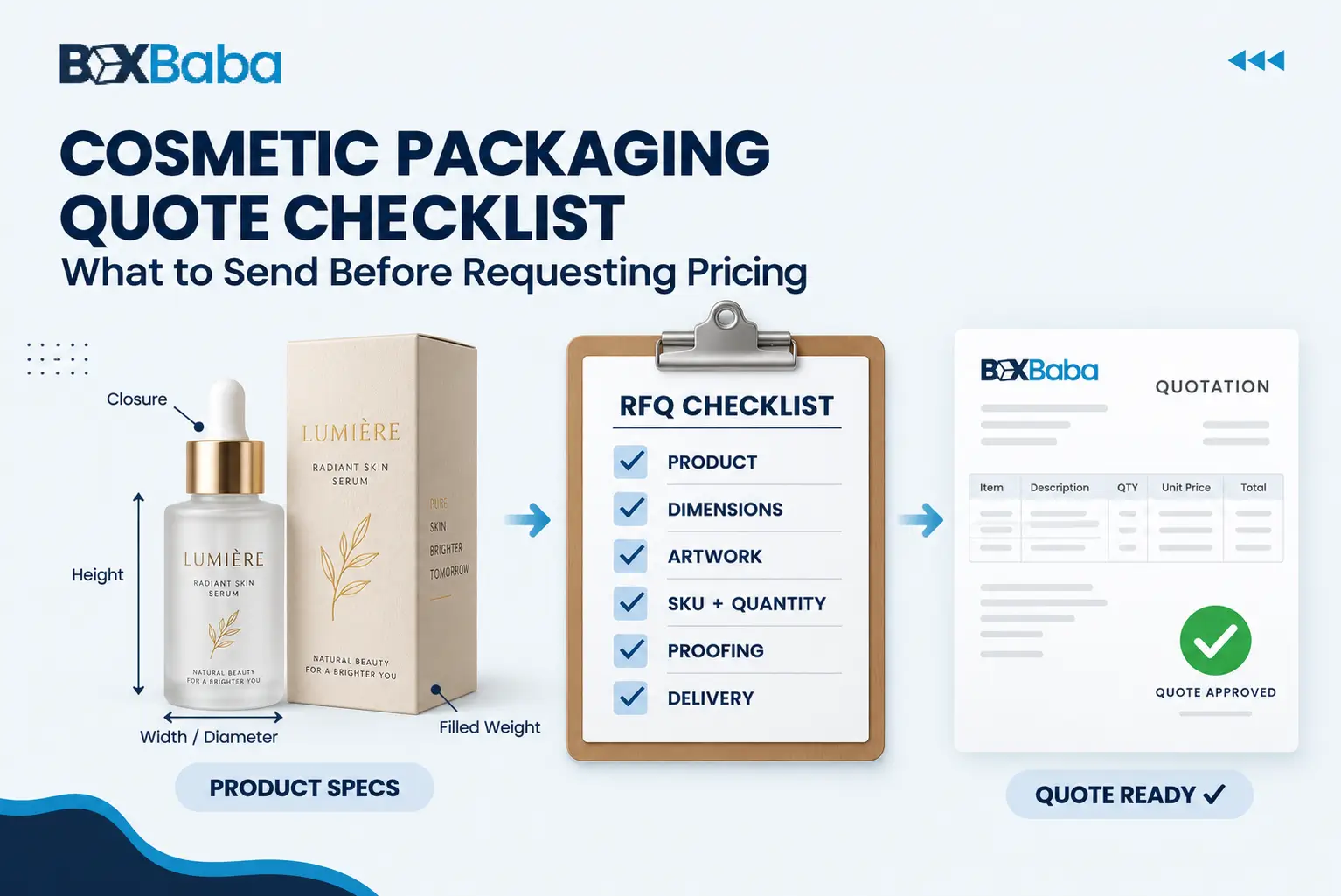
A useful cosmetic packaging quote starts with a clear project brief. The supplier needs enough verified information to understand what is being packed, which physical versions exist, what the packaging must do, how many units are required and what is included in the requested price.
You do not need to know every technical packaging answer before requesting pricing. If the box structure, material or insert is still open, say so. What should not be missing are the finished product details, quantity, SKU/version breakdown, intended use, artwork status, timing and delivery scope.
Use this sequence: Finished Product -> Physical Specification -> Packaging Function -> Structure / Material Direction -> Artwork + SKU Matrix -> Quantity -> Proofing -> Delivery Scope -> Comparable Quote
If the overall packaging system is still undecided, begin with How to Choose Cosmetic Packaging Boxes. Brands ready to discuss a project-specific quotation can review Custom Cosmetic Boxes.
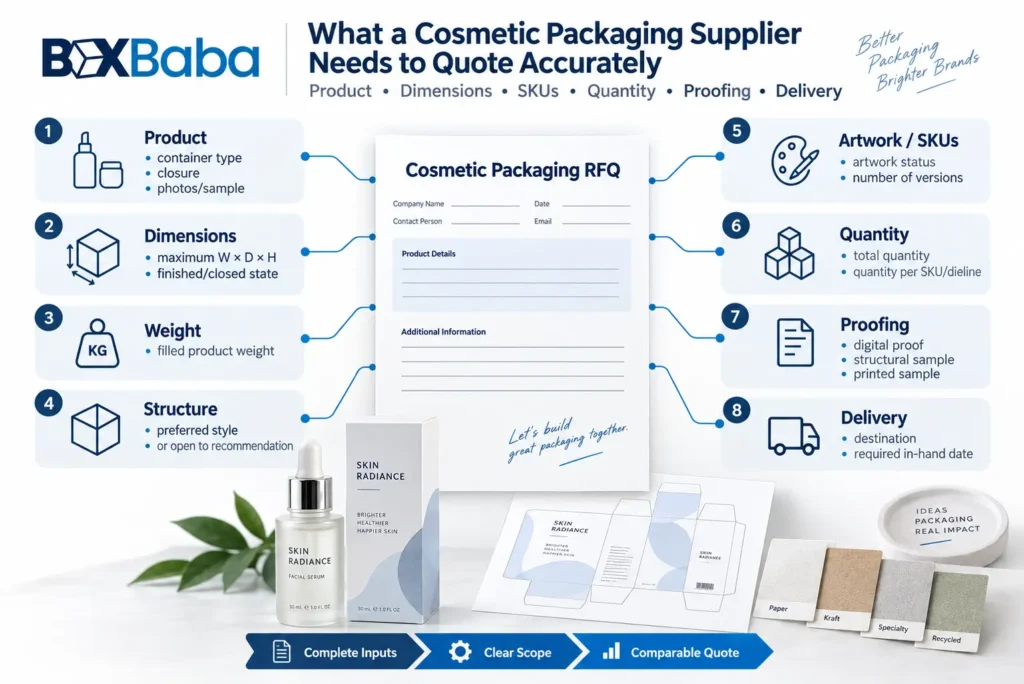
Quick Answer: What Should You Send for a Cosmetic Packaging Quote?
- Product type and complete finished container format.
- Maximum product dimensions and filled / packed weight.
- Product photographs, drawings or sample availability.
- Units per box and intended product orientation.
- Preferred box structure, or open to recommendation.
- Insert, divider, platform or window requirement if known.
- Material and printing direction if already decided.
- Finish requirements or finish references.
- Artwork status and number of artwork versions.
- Total quantity and quantity by SKU, size and structural version.
- Sales channel and any retailer / pack-out constraints.
- Proof or sample requirement if already known.
- Delivery destination and required in-hand date.
- Whether the quote should include outer packing, freight, assembly or other services.
Cosmetic Packaging RFQ Checklist at a Glance
RFQ Area | Question to Answer | What to Provide |
|---|---|---|
Product | What is being packed? | Product type, container, closure, photos, sample availability |
Dimensions | What physical envelope must the package accommodate? | Maximum W x D x H or diameter x H; finished/closed state |
Weight | What load does the package carry? | Filled product or completed set weight |
Pack configuration | How many products and how are they arranged? | Units per box, orientation, accessories, removal direction |
Structure | What kind of box is expected? | Preferred style or open to recommendation |
Internal support | Is positioning/separation required? | Insert, divider, platform, cavity, or undecided |
Material | Is a substrate already specified? | Paperboard, rigid, corrugated, kraft-style direction, or open |
Print / finish | What visual treatments are required? | CMYK/spot color direction, lamination, foil, UV, embossing, etc. |
Artwork | How ready are the files? | Ready artwork, dieline needed, design support, SKU count |
Quantity | How much of each version? | Total + quantity by SKU / size / dieline |
Proofing | What needs validation? | Digital proof, structural sample, printed sample, fit review |
Timing | When must the packaging be available? | Required in-hand date + launch constraints |
Delivery | What destination and scope should be priced? | Country/city, freight basis, flat/assembled packing, outer cases |
Identify the Packaging Layer First
The phrase cosmetic packaging can refer to the primary bottle or jar, the secondary retail carton, or the outer ecommerce / distribution package. A supplier cannot quote accurately if the packaging layer is unclear.
Packaging Layer | Examples | What the Quote Should Clarify |
|---|---|---|
Primary packaging | Bottle, jar, tube, compact, pump, dropper | Whether this is supplied by the buyer or included in the project |
Secondary packaging | Folding carton, sleeve, rigid box, box with insert | Usually the main scope of a custom cosmetic box quotation |
Distribution / ecommerce | Mailer, shipping carton, master case | Whether outer shipping packaging is included or quoted separately |
If you are requesting only a custom secondary box, say so explicitly. Do not ask the carton supplier to infer whether the bottle, label, fulfillment or master case is also part of the requested scope.
Send the Finished Product Dimensions - Not Only the Fill Volume
A supplier needs the outside dimensions of the complete product that will enter the box. A 30 mL serum bottle, 30 mL airless pump and 30 mL cream jar can all need different cartons.
Measure the complete retail-ready product with the cap, pump, dropper, applicator, lid, label, sleeve or other permanent component installed.
For the full measurement method, use the Cosmetic Box Size Guide.
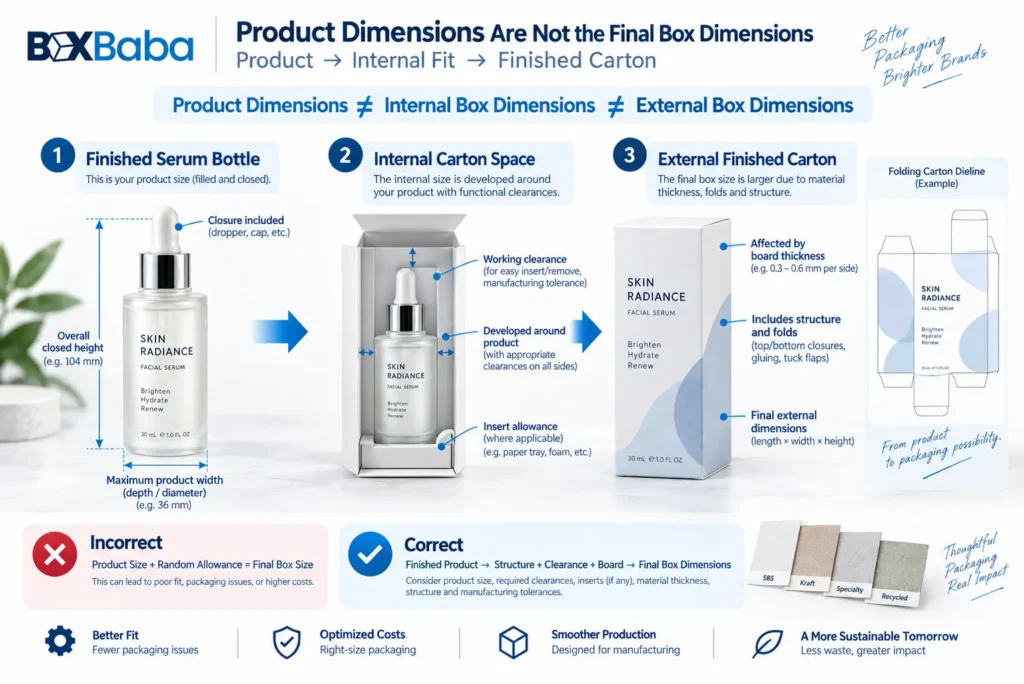
Product Dimensions Are Not the Final Box Dimensions
The buyer should provide the finished product dimensions. The packaging supplier then develops the usable internal carton dimensions and finished external dimensions around the selected structure, board, clearance and insert.
Finished Product Dimensions != Internal Box Dimensions != External Box Dimensions
Do not invent a final box dimension by adding an arbitrary allowance to the product.
Include Filled or Packed Weight
Weight can affect structure, board direction, insert design, closure behavior and pack-out. Provide the weight of the actual filled product rather than the empty bottle where practical.
For a multi-product set, provide the completed load: products + accessories + leaflets + internal components where already defined.
Describe the Primary Container and Closure
Dimensions alone do not always communicate the geometry that matters. Identify whether the product uses a jar lid, pump, dropper bulb, wand cap, sprayer, overcap, twist mechanism, hinge or other closure.
- Container material where relevant to handling or weight
- Closure type
- Shoulders / neck / collar
- Cap or lid overhang
- Decorative projections
- Label or surface areas that should avoid concentrated contact
State the Intended Orientation and Removal Direction
The same product can create a different box footprint when packed upright, horizontally or within a presentation tray. Orientation also affects windows, inserts, panel hierarchy and opening direction.
If orientation is undecided, state the retail or presentation goal and ask the supplier to recommend a practical configuration.
For Sets, Send Every Product and Accessory
A gift set, skincare routine, makeup kit or PR package should not be quoted from the largest product alone. The supplier needs the complete arrangement.
- Every product dimension and weight
- Product count
- Accessories
- Printed cards / leaflets
- Preferred arrangement
- Removal sequence
- Total loaded weight
- Any products that must remain separated
State the Box Structure - or Say Open to Recommendation
If you already know the structure, identify it clearly: straight tuck, reverse tuck, auto-lock bottom, sleeve-and-tray, two-piece, rigid setup box, mailer, display or another approved style.
If you do not know the structure, do not guess. Open to supplier recommendation based on product dimensions, quantity, channel and presentation is a valid RFQ input.
A quote that assumes one structure is not directly comparable with a quote built around a different structure.
Separate Requirements From Preferences
A stronger RFQ distinguishes what must be included from what is merely preferred.
Type | Example | Why It Helps |
|---|---|---|
Requirement | Box must fit 50 mL glass jar and remain under retailer shelf-height limit | Supplier knows what cannot change |
Preference | Prefer kraft-style visual direction | Supplier can recommend alternatives if the structure/print needs conflict |
Open decision | Insert material not yet selected | Supplier can quote or recommend viable routes |
This reduces the risk of paying for a specification that was never actually required.
Give the Insert / Divider Requirement - If It Is Known
Do not write only with insert unless the function is understood. State what the insert must do: position one bottle, separate several products, hold an accessory, align a product with a window, elevate a set or create removal access.
If the material is open, state the function and ask for an appropriate route. If the insert is unnecessary, say no separate insert requested.
Define Any Window Requirement
Internal and external box dimensions are not interchangeable. Board caliper, folds, scores, wrap layers and structural construction influence the relationship between usable internal space and the outside size of the package.
If the material changes after a fit has been approved, the structural relationship should be reviewed rather than assuming the old internal fit remains identical.
For outer-material selection and board context, review Best Materials for Custom Cosmetic Boxes.
Direct-Fit Cartons and Inserted Boxes Need Different Clearance Logic
If a window is required, identify what part of the product should be visible and whether an open cutout or clear-film window is preferred. Product orientation and alignment should be part of the quote brief.
Do not ask only for a large window. The visible product area, remaining information space and structural border matter.
Provide Material Direction Without Over-Specifying
If an approved substrate is already part of the brand system, include it. Otherwise, describe the intended package type, product weight, print/finish direction and sales channel and allow the supplier to recommend a suitable board route.
Avoid treating GSM alone as a universal strength specification across different board grades and constructions.
Specify Printing and Color Requirements
State whether the package uses process printing, spot colors, inside printing or a limited-color direction. If a brand color is critical, provide the agreed color reference or Pantone / spot-color information where applicable.
Do not assume a screen PDF alone defines a final production color target.
List Finishes Separately
Finishes can materially change quotation scope. List each required treatment instead of writing only premium finish.
- Matte lamination
- Gloss lamination
- Soft-touch lamination
- Foil stamping
- Spot UV
- Embossing / debossing
- Aqueous or other coating where specified
If the finish is still undecided, review the Cosmetic Packaging Finishes Guide and send the supplier the shortlisted direction rather than several contradictory finish combinations.
Tell the Supplier the Artwork Status
Artwork Status | What to Say in the RFQ | Likely Next Step |
|---|---|---|
Ready artwork on approved dieline | Files are complete; provide version IDs | Supplier checks technical readiness / proof route |
Artwork ready but no final dieline | Artwork concept exists; structural file needed | Structure and dieline first, then artwork adaptation |
Logo / brand assets only | Design support required | Supplier / designer needs scope before production files exist |
Reference image / concept only | Packaging direction not yet production-ready | Quote may remain budgetary until structure/artwork is defined |
Also state the number of artwork versions, languages, shade variants and barcodes. One physical box structure can still require many artwork files.
Build an SKU / Structural Version Matrix
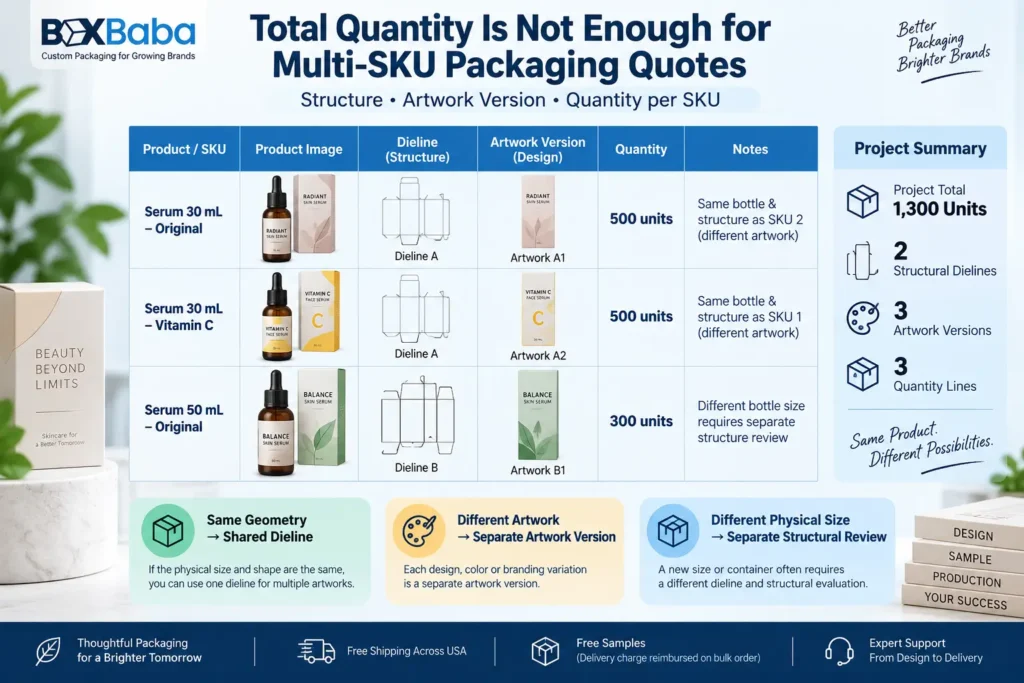
This is one of the most important quote-preparation steps for cosmetic ranges. Total project quantity is not enough when several physical or artwork versions exist.
Version | Physical Structure | Artwork | Quantity |
|---|---|---|---|
Serum 30 mL – Original | Dieline A | Artwork A1 | 500 |
Serum 30 mL – Vitamin C | Dieline A | Artwork A2 | 500 |
Serum 50 mL – Original | Dieline B | Artwork B1 | 300 |
In this example, the project total is 1,300 units, but the supplier must still understand that there are two structural dielines and three artwork versions.
Send Total Quantity and Quantity by Version
State the total planned quantity and the quantity required for each SKU, size, artwork or structural version. If you want price breaks, ask for defined quantity tiers using the same specification.
Do not assume the supplier will automatically split one quoted MOQ across unlimited artwork versions or dielines. Ask how the quoted minimum applies to your actual version matrix.
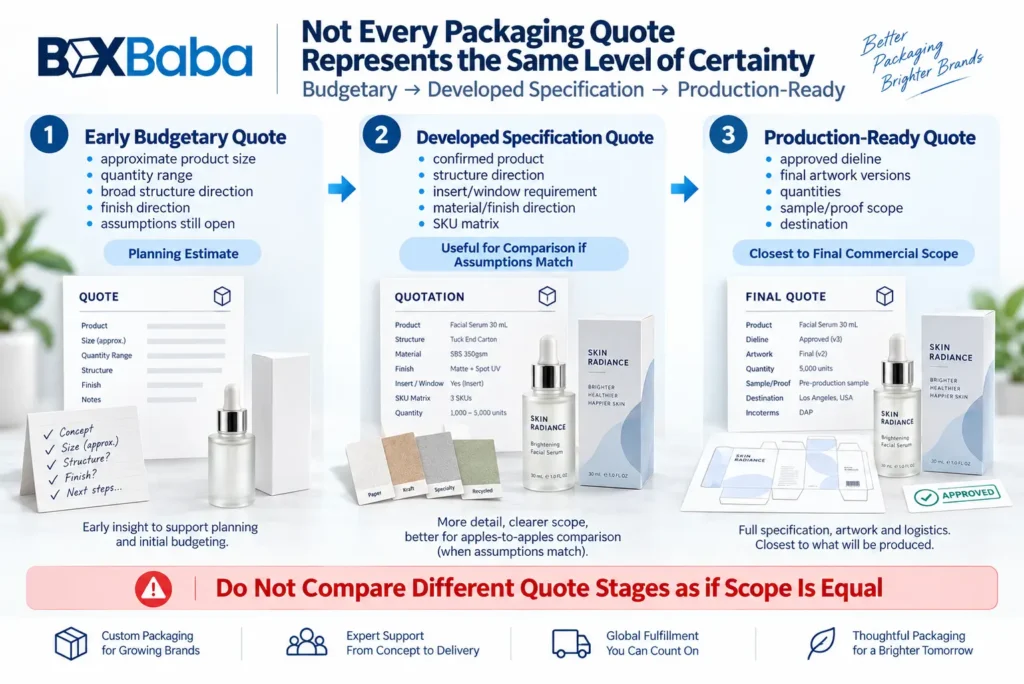
State Whether You Need a Budgetary or Production-Ready Quote
Quote Stage | Typical Information Available | How to Treat the Price |
|---|---|---|
Early budgetary | Approximate product size, quantity range, broad structure/finish direction | Planning estimate; assumptions may change |
Developed specification | Confirmed product, structure direction, insert/window, material/finish, SKU matrix | Useful for supplier comparison if assumptions match |
Production-ready | Approved dieline/specification, artwork versions, quantities, proof/sample scope, destination | Closest to final commercial scope before order acceptance |
A supplier can often provide early guidance before every detail is finalized, but do not compare a budgetary estimate with a fully specified production quotation as if they represent the same scope.
Define What Proofing or Sampling Should Be Included
A quote may or may not include a digital proof, blank structural sample, printed sample, insert sample or production-representative route. State what needs to be validated and ask the supplier to identify any sample cost, timing or limitation separately.
For proofing definitions and acceptance criteria, see Cosmetic Packaging Samples and Proofing.
Give the Required In-Hand Date - Not Only the Launch Date
A launch date is not enough for production planning. State when the packaging must physically arrive at your warehouse, fulfillment partner, contract packer or other destination.
Required In-Hand Date -> Backward Planning for Shipping -> Production Completion -> Proof / Sample Approval -> Artwork / Dieline Readiness
Do not assume production time includes proofing, transit, customs, fulfillment transfer or buyer-side approval delays unless the quotation states that scope.
Specify the Delivery Destination and Shipping Scope
Provide the destination country and city or warehouse region so the supplier can identify what delivery scope the quotation assumes. If exact freight is not included, ask whether the quote is ex-works, delivered, or based on another stated shipping term / scope.
Also state whether the packaging should arrive flat, pre-assembled, packed in inner bundles, master cartons or another specified pack-out.
Clarify Outer Packing and Master-Case Requirements
The individual cosmetic box and the master shipping case are different packaging entities. If the quote should include master cartons, dividers, case labels, bundle quantities or pallet-related packing, say so explicitly.
Do not assume a unit-carton quote automatically includes ecommerce mailers or wholesale master cases.
Share Retailer or Market Constraints Without Asking the Supplier to Assume Compliance
If a retailer has shelf-size, hang-tab, barcode, case-pack, labeling-area or display requirements, send those requirements as inputs. If a target market has copy or document requirements controlled by your regulatory / responsible team, identify the required information areas and approved content.
A packaging quotation does not automatically constitute regulatory or claims approval unless that service is explicitly included and supported.
Add Reference Images Carefully
Reference images can communicate opening style, presentation or finish direction, but they are not a substitute for dimensions and specification.
Write what you like about the reference: drawer opening, small front window, gold foil logo, or three-product side-by-side arrangement. This is more useful than asking the supplier to copy another brand or competitor package.
What Can Remain TBD?
You can request useful supplier guidance before every specification is locked. Mark open decisions clearly rather than leaving them ambiguous.
Can Be Marked TBD | What Must Still Be Provided |
|---|---|
Exact box structure | Finished product dimensions, weight, channel, opening / presentation goal, quantity |
Insert material | Required positioning / separation function and product geometry |
Board grade | Product load, structure direction, print / finish needs |
Finish shortlist | Brand direction, artwork status, budget / timing constraints |
Final freight method | Destination and required in-hand date |
The supplier can recommend around an open decision only when the underlying project requirements are clear.
How to Compare Cosmetic Packaging Quotes Correctly
The cheapest unit price is not meaningful if the suppliers have quoted different structures, materials, quantities, proofing routes or shipping scopes.
Comparison Area | Supplier A | Supplier B | Supplier C |
|---|---|---|---|
Box structure | Confirm | Confirm | Confirm |
Finished size basis | Confirm | Confirm | Confirm |
Material / board | Confirm | Confirm | Confirm |
Printing / colors | Confirm | Confirm | Confirm |
Finishes | Confirm | Confirm | Confirm |
Insert / window | Confirm | Confirm | Confirm |
Quantity by SKU | Confirm | Confirm | Confirm |
Tooling / setup included? | Confirm | Confirm | Confirm |
Proof / sample included? | Confirm | Confirm | Confirm |
Packing / master cartons | Confirm | Confirm | Confirm |
Shipping scope | Confirm | Confirm | Confirm |
Production timing basis | Confirm | Confirm | Confirm |
Normalize the scope first. Then compare unit price, setup charges, sample/tooling charges, delivery scope, timing and commercial terms.
Worked Example: Six Mascara Artwork SKUs on One Physical Tube
Six mascara shades use the same physical tube, cap, dimensions and carton structure. The project total is 3,000 boxes, divided as 500 units per artwork SKU. The buyer should state both 3,000 total and 500 per artwork version.
Same Physical Geometry -> One Structural Dieline -> Six Artwork Files -> Six Quantity Lines
The supplier can then confirm whether the quoted minimum, print setup and production method apply per artwork version or across the total run.
Worked Example: Skincare Gift Set With Open Structure Choice
A brand has a 30 mL serum, 50 mL cream jar and 15 mL eye product. The products and weights are confirmed, but the buyer is deciding between a rigid two-piece box and a sleeve-and-tray presentation. Instead of requesting two vague premium box prices, the RFQ can ask the supplier to quote both structures around the same product arrangement, insert function, artwork direction, quantity and destination.
This creates a meaningful structure comparison rather than comparing unrelated packages.
Common Cosmetic Packaging Quote Mistakes
Mistake | Why It Creates a Weak Quote | Better Direction |
|---|---|---|
Sending only fill volume | Supplier does not know the finished container geometry | Send complete external dimensions and closure |
Sending only product dimensions and calling them box size | Internal/external carton dimensions still need structural development | Label them as product dimensions |
Requesting luxury or premium with no specification | Term does not define structure/material/finish | State the intended features or keep them open |
Giving only total quantity | SKU / dieline allocation is hidden | Send quantity by structural and artwork version |
Mixing requirements and preferences | Supplier may overbuild the quote | Label must-have vs preferred vs open |
Not stating artwork status | Design/dieline work is omitted or assumed | State exactly what files exist |
Not defining shipping scope | Quotes may include different freight assumptions | Provide destination and ask what is included |
Comparing different materials or finishes on unit price | Scope is not normalized | Compare the same specification |
Ignoring sample/tooling charges | First-order project cost is understated | Separate setup and sample/tooling |
Giving a launch date only | No buffer for transit or approvals | Provide required in-hand date |
Assuming supplier handles compliance | Service scope may not include regulatory review | Provide approved copy / requirements and confirm services |
Sending reference photo only | Supplier has no verified dimensions or quantity matrix | Use images only as supporting references |
Cosmetic Packaging RFQ Template
- Brand / company:
- Product type:
- Primary container / closure:
- Finished product dimensions:
- Filled / packed weight:
- Product photos / technical drawing / sample availability:
- Units per box:
- Product orientation:
- Preferred box structure (or open to recommendation):
- Insert / divider / platform requirement:
- Window requirement:
- Material preference (or open):
- Printing / color requirements:
- Finishes:
- Artwork status:
- Number of structural dielines:
- Number of artwork SKUs:
- Quantity by SKU / size / structural version:
- Proof / sample requirement:
- Sales channel:
- Outer packing / master case requirement:
- Delivery destination:
- Required in-hand date:
- Quote should include / exclude:
- Open questions or supplier recommendations requested:
Final Pre-Quote Checklist
- Finished product, not only formula volume, identified
- Product dimensions labeled clearly as product dimensions
- Filled / loaded weight supplied
- Closure and external projections identified
- Product orientation stated or marked open
- Every product / accessory in a set listed
- Structure requirement or open to recommendation stated
- Insert / window function stated where applicable
- Material / finish requirements separated from preferences
- Artwork status and number of artwork versions confirmed
- Total quantity and quantity by SKU / size / dieline provided
- Proof / sample scope requested or left for supplier recommendation
- Required in-hand date provided
- Destination and shipping scope stated
- Outer packing / master-carton scope stated
- Reference images explained rather than copied
- All suppliers receive the same scope for price comparison
From Product Brief to Comparable Packaging Quote
- Confirm the Finished Cosmetic Product
- Measure Maximum External Dimensions + Filled Weight
- Confirm Units, Orientation and Accessories
- Define Requirements vs Preferences vs Open Decisions
- Confirm Structure / Insert / Window Direction
- Prepare Artwork + SKU / Dieline Matrix
- Provide Quantity by Version
- Define Proofing / Sampling Scope
- Provide Destination + Required In-Hand Date
- Ask What the Quote Includes and Excludes
- Normalize Supplier Scopes
- Compare Price, Setup, Timing and Commercial Terms
Brands with a completed quote brief can review BoxBabas Custom Cosmetic Boxes and share the product specification, quantity matrix, artwork status and delivery requirements for project-specific pricing.
Frequently Asked Questions About Cosmetic Packaging Quotes
What should I send when requesting a cosmetic packaging quote?
Send the finished product type, external dimensions, filled weight, product photos, units per box, structure direction, insert/window needs, artwork status, finishes, quantity by SKU, proofing needs, destination and required in-hand date.
Do I need to know the exact box size before requesting a quote?
No. Provide the complete finished product dimensions. The supplier can develop the internal and external box dimensions around the approved structure and clearance.
Can I request a quote if I do not know the box structure?
Yes. State the product, dimensions, weight, quantity, sales channel and presentation goals, then mark the structure as open to supplier recommendation.
Should I send product volume such as 30 mL or 50 mL?
Yes, as product information, but volume does not replace the finished container dimensions. Two products with the same fill capacity can require different boxes.
Should I provide the filled product weight?
Yes where possible. Filled weight can affect structure, material direction, inserts and pack-out, especially for glass containers and multi-product sets.
What if I have several cosmetic SKUs?
Provide a version matrix showing which SKUs share the same physical container or dieline and the quantity required for every artwork, size and structural version.
Is total quantity enough for a quote?
Not for multi-SKU projects. State both the total project quantity and the quantity by SKU, artwork version, size and structural dieline.
Do I need finished artwork before requesting pricing?
Not always. State whether artwork is ready, in progress, limited to brand assets or requires design support. The quote should make any design or dieline assumptions clear.
Should I include reference packaging photos?
Yes as supporting references, but explain which feature matters and do not use the image as a substitute for measurements, quantity and specification.
Should I ask for sample pricing in the quote?
If a physical sample or proof is needed, ask the supplier to identify the available route, cost, timing and what the sample is intended to validate.
How do I compare packaging quotes from different suppliers?
Give each supplier the same specification and quantity matrix, then compare structure, material, finishes, setup/tooling, sample scope, packing, freight basis, production timing and commercial terms before comparing unit price.
What is a budgetary packaging quote?
It is an early estimate based on incomplete or assumed project information. Treat it as planning guidance until the product, structure, material, artwork, quantities and delivery scope are sufficiently defined.
Should I provide my launch date or delivery date?
Provide the required in-hand date at your warehouse or packing location. A launch date alone does not show how much time is available for proofing, production and transit.
Does a cosmetic packaging quote include shipping?
Not automatically. Ask what delivery or freight scope is included and provide the destination so quotes can be compared on the same basis.
Does requesting a quote mean the supplier approves my cosmetic labeling or claims?
No. Regulatory, labeling and claims review should be treated as a separate responsibility or service unless the supplier explicitly provides and documents that scope.