
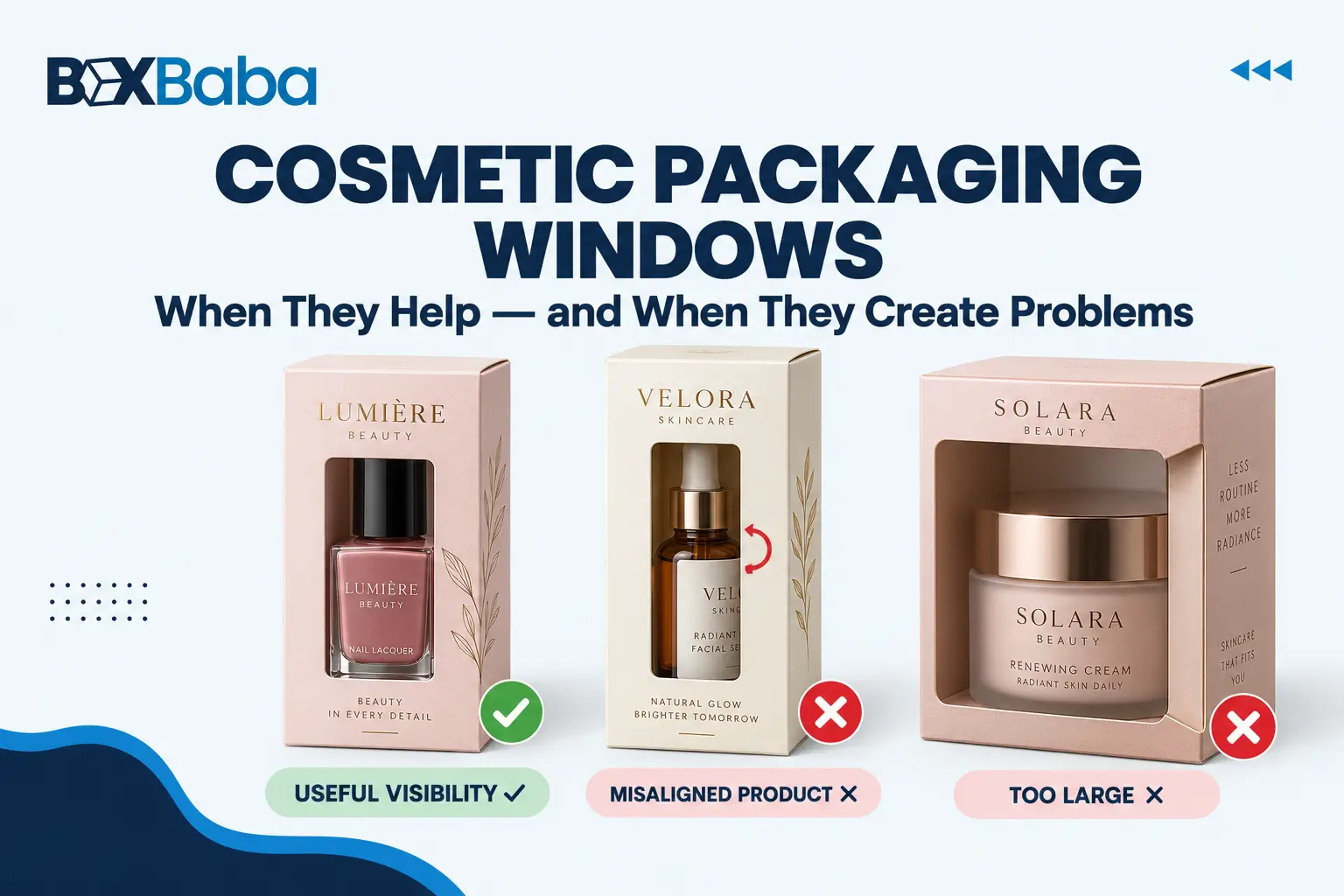
A cosmetic box window can reveal a product, shade, bottle profile, applicator or internal arrangement before the carton is opened. But a window is not only a graphic feature. It removes part of a paperboard panel, may introduce a clear film, changes the available artwork area and can make product alignment more important.
The useful question is therefore not simply, Should this cosmetic box have a window? It is: What should the customer see, and can the package reveal that area without creating a structural, artwork, packing or information-layout problem?
Use this sequence: Finished Cosmetic Product -> Intended Visible Area -> Product Orientation -> Direct Fit / Support Requirement -> Open or Film Window -> Remaining Structural Border -> Dieline -> Artwork -> Proof / Fit Review
Brands still choosing the overall box system should begin with How to Choose Cosmetic Packaging Boxes. For a project-specific commercial route, review Custom Cosmetic Boxes.
What Is a Cosmetic Packaging Window?
A cosmetic packaging window is a die-cut opening in a carton or paper-based package that reveals part of the finished product or internal presentation.
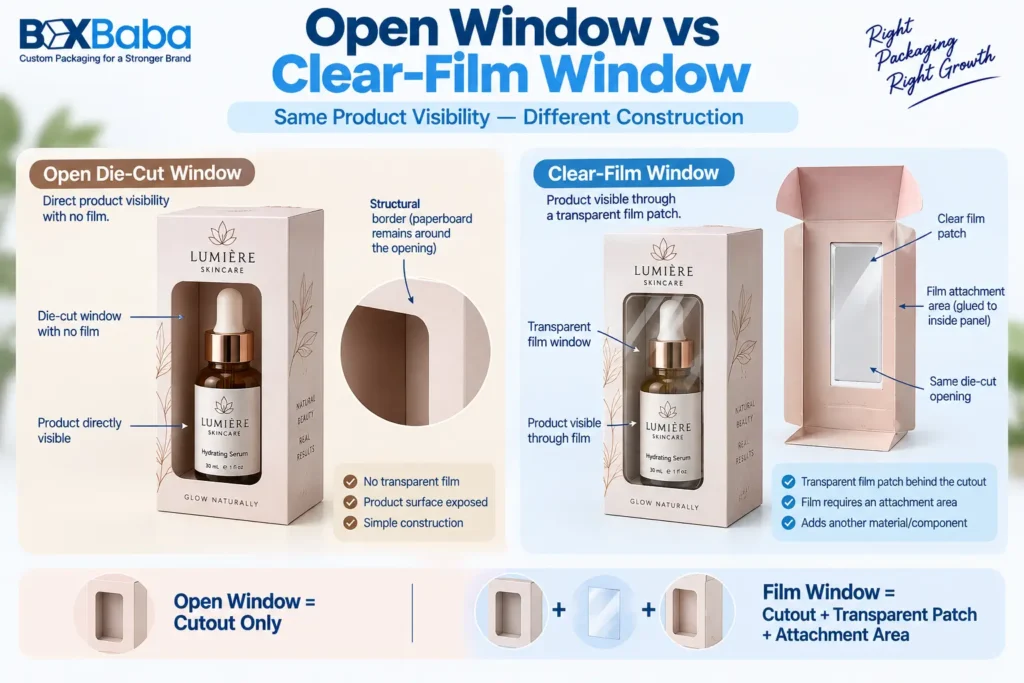
The opening may remain uncovered, creating an open die-cut window, or it may be backed with a transparent or translucent film attached to the inside of the carton.
These two constructions should not be treated as identical because an open cutout directly exposes the primary package surface through the opening, while a film-backed window maintains a continuous transparent panel across the cutout.
Open Die-Cut Window vs Clear-Film Window
Window Type | Construction | What It Changes | What to Review |
|---|---|---|---|
Open die-cut window | No film spans the opening | Simpler material set; product surface is directly exposed through the cutout | Confirm product suitability, handling, retail requirements and remaining structure |
Clear-film window | Transparent film is attached behind the opening | Keeps the window visually closed while showing the product | Confirm film type, clarity, attachment area, scuff/haze expectations and material-disposal implications |
Neither option should automatically be described as tamper-evident, hygienic, moisture-proof or distribution-ready. Those are separate package requirements that need their own evidence and specification.
When a Cosmetic Window Can Be Useful
A window is most useful when the visible product itself communicates information that printed artwork alone does not communicate as directly.
- A nail-polish bottle where the actual lacquer color is intended to be visible.
- A lip gloss tube or pot where the shade or finished primary package is part of the retail presentation.
- A serum or fragrance bottle whose shape, finish or label design is deliberately part of the visual identity.
- A palette, compact or set where a controlled portion of the internal arrangement is intended to be seen.
- A multi-product presentation where the window confirms the arrangement or product count.
The window should have a specific visual job. If the visible area communicates nothing important, the cutout may consume structural and artwork space without adding useful information.
When a Window May Add Little Value
A window may be unnecessary when the product area behind it is visually repetitive, heavily labeled, mostly opaque, frequently misaligned or already communicated clearly by shade codes and artwork.
It may also be a weak choice when the front panel is already crowded with branding, product information, barcode or retailer-required content, or when the package structure needs more uninterrupted board area.
Cosmetic Window Decision Matrix
Packaging Condition | Likely Direction | What to Check |
|---|---|---|
Actual product color or distinctive primary pack is a buying cue | Window may be useful | Confirm which exact area must remain visible |
Product can rotate freely inside the carton | Window may create alignment problems | Review direct fit, integrated support or insert |
Front panel already carries dense information | Window may reduce usable artwork space | Rebalance panel hierarchy |
Product is irregular or changes position during packing | Window may be inconsistent | Define orientation before dieline |
Package needs a large opening near folds or locking features | Structural review required | Do not set the window from artwork alone |
Sustainability is a major packaging objective | Review open window vs film carefully | Avoid unsupported recyclability claims |
Window is requested only because it looks premium | Question the purpose | Define the actual visual or merchandising function |
Start With the Visible Product Area, Not the Window Shape
A common design mistake is choosing a circle, oval, arch or custom shape before confirming what the customer is supposed to see.
The correct order is: Product Orientation -> Visible Product Area -> Window Position -> Window Shape -> Structural Review -> Artwork.
For example, if the goal is to reveal the colored body of a lip gloss tube, the opening should be positioned around that product zone. If the cap is the visual focus, the geometry changes. The artwork should follow the selected structural opening rather than forcing the opening into an already completed front panel.
Product Orientation Must Be Confirmed First
The same cosmetic product can present differently depending on whether it stands upright, lies horizontally, sits on an angle or is held within a tray.
Orientation can affect the window height, width, vertical position, visible label area, barcode placement and required internal support.
If the product orientation changes after the window has been positioned, the dieline and artwork may both need revision.
A Rotating Product Can Make a Good Window Look Wrong
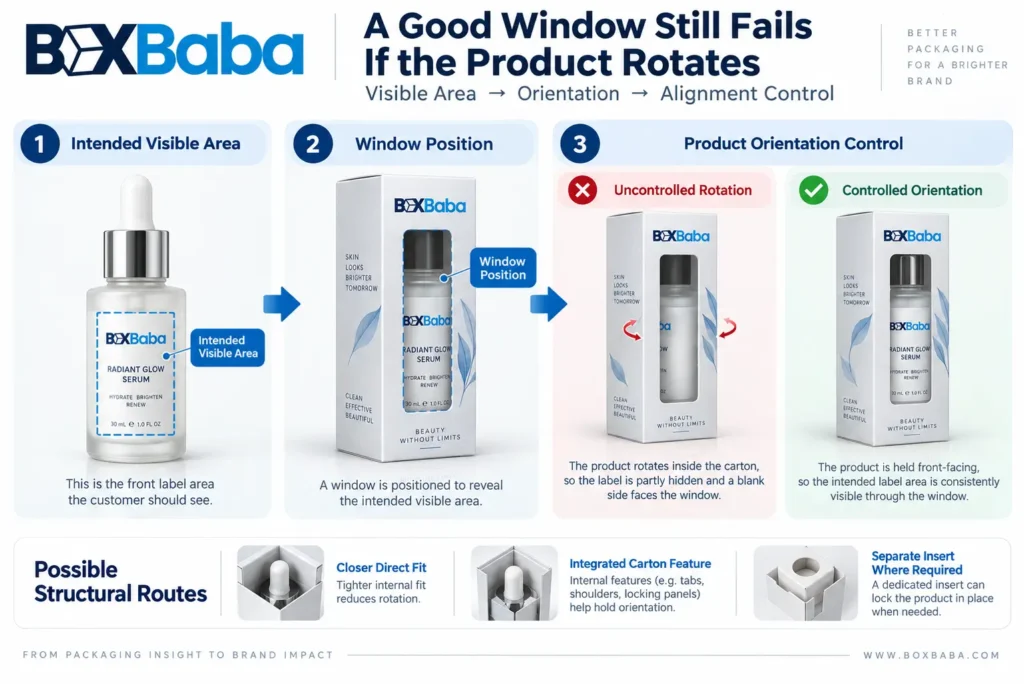
Round bottles and tubes can rotate inside a carton when the internal fit allows movement. If the package depends on a logo, shade label or front-facing graphic lining up with the window, uncontrolled rotation can make the visible area inconsistent.
This is not primarily an artwork problem. It is a product-positioning problem.
Possible routes include a closer direct fit, an integrated carton feature or a separate insert where a defined orientation is actually required.
For the broader support decision, see When Do Cosmetic Boxes Need Inserts?.
Does a Window Mean the Box Needs an Insert?
No. A window does not automatically require a separate insert. A product that already sits in the intended orientation inside an accurately developed carton may not need another component.
An insert becomes more relevant when the visible area must remain aligned and the outer structure alone cannot reliably control the product position.
Window Requirement -> Required Product Alignment -> Direct Fit / Integrated Support / Separate Insert.
There Is No Universal Window-to-Box Ratio
There is no production rule that every cosmetic window should occupy a fixed percentage of the front panel. The usable opening depends on the carton style, board, product dimensions, folds, locking features, film attachment area, required artwork and intended visible product zone.
A larger window removes more paperboard from the panel and also reduces printable space. The appropriate balance should therefore be reviewed with the complete structure.
Keep Windows Away From Critical Structural Areas
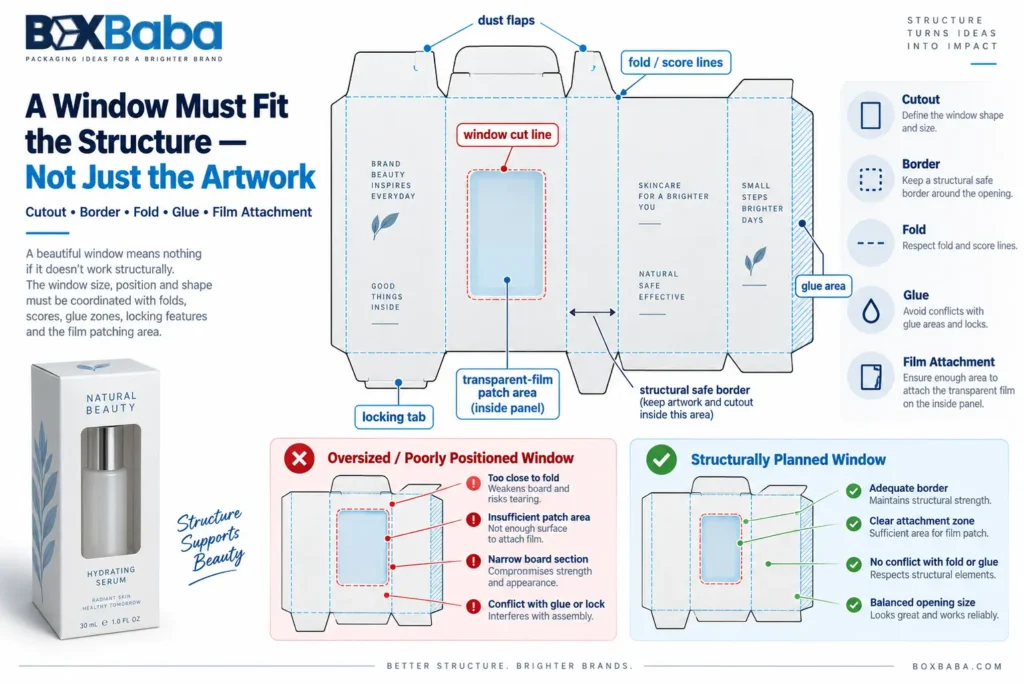
Window cutouts should be coordinated with score lines, folds, glue areas, locking tabs, dust flaps, tuck features and other structural components.
Do not place a production window solely from the front artwork view. The flat dieline is needed to understand how close the opening sits to folds and how much uninterrupted board remains around it.
The exact minimum border or distance from a crease is project-specific and should be confirmed for the chosen board, carton style and production method.
Clear-Film Windows Need Attachment Area
When a transparent film is used, it is normally attached to the inside of the carton around the die-cut opening. That construction requires usable board around the window for the selected attachment method.
A visually large cutout may leave too little practical patching area or may interfere with nearby folds and glue zones. Window geometry should therefore be approved as part of the structural dieline rather than treated as a last-minute artwork edit.
Film Type Should Be Confirmed During Quotation
Transparent window films can differ in material, clarity, stiffness, surface appearance and manufacturing compatibility. The appropriate option should be confirmed with the packaging supplier for the actual structure and project requirements.
Do not assume that a film is automatically recyclable, biodegradable, compostable or preferable simply because it is transparent or described by a particular resin name. Any environmental claim should be supported by the selected material documentation and the relevant recovery context.
A Window Can Reduce Artwork and Information Space
Removing part of a panel also removes printable surface. This can matter on small cosmetic cartons where the same panel may need a brand name, product name, shade identifier, barcode or other required information.
Before approving the opening, map: Brand Area -> Product Information -> Shade / SKU Identification -> Barcode / Required Copy -> Window -> Structural Safe Areas.
If everything does not fit clearly, the solution may be a smaller window, a different panel, a different orientation or no window at all.
Plan the Dieline Before Final Artwork
The window cut line is part of the structural file. Final artwork should therefore be built around the approved dieline rather than designing the front panel first and adding the window afterward.
Critical logos, text, shade names, barcodes and decorative elements should not unintentionally cross the die-cut opening or sit too close to structural features.
The same logic applies to bleed, cut lines and artwork safe areas: the final production file should follow the suppliers approved dieline and artwork specifications.
How Windows Interact With Matte, Gloss, Foil and Spot UV
A cosmetic carton can combine a window with surface finishes, but the finish layout and die-cut opening should be reviewed together.
For example, a foil border or Spot UV detail may visually frame a window, while lamination may cover the surrounding paperboard. However, specialty effects should not be positioned across the cut line as if the removed area will remain available.
Exact finish-to-window tolerances and manufacturing feasibility depend on the artwork, board, finishing method and production process.
For finish selection outside the window area, use the Cosmetic Packaging Finishes Guide.
Window Shape Should Support the Product, Not Compete With It
Rectangular, oval, circular and custom-shaped windows can all be considered, but the shape should follow the visible product area, brand system and structural constraints.
A complex decorative cutout can create a stronger visual motif, but it can also consume more panel area or create narrow paperboard sections. A simple window may communicate the product more clearly when the primary package itself is already visually distinctive.
Product-to-Window Clearance Matters
The product may sit close to the window plane, behind an insert or deeper inside the carton. That depth affects how much of the product is visible and whether the product can contact the film or opening edge.
There is no universal product-to-window clearance. Review the complete internal geometry, product variation, label-sensitive surfaces, insert thickness and packing method.
Window Packaging for Lipstick and Lip Products
A lipstick, lip gloss or lip balm window can reveal the tube, shade area or primary-packaging design. The main questions are whether the intended product zone stays aligned and whether the opening leaves enough front-panel area for shade identification and branding.
For cylindrical products, rotation is especially important when only one label face should remain visible.
Window Packaging for Nail Polish
Nail polish is a clear example where the actual bottle and color may be the intended visible feature. The window should be positioned after the finished bottle, shoulders, cap, orientation and internal position are confirmed.
A large opening is not automatically better. The carton still needs suitable board around the product and enough printable area for the remaining design.
Window Packaging for Serum and Skincare Bottles
Serum and skincare cartons may use windows to reveal a bottle profile, pump, dropper or label treatment. But a window can add little value if the visible area is mainly a plain sidewall or if the bottle rotates away from the intended front.
For skincare, confirm whether the window supports the brand hierarchy or simply removes information space from an already compact carton.
For product-family context, review Skincare Packaging.
Window Packaging for Makeup Boxes and Palettes
Makeup packaging may use a window to show a compact, palette, lipstick tube, mascara or other finished item. The visible area should be selected from the actual product and intended shelf orientation.
For commercial makeup-box configurations, review Makeup Boxes.
Windows and Multi-SKU Cosmetic Lines
Different cosmetic SKUs can sometimes share one windowed dieline when the physical container geometry, product orientation, visible product zone, insert or direct-fit configuration and box structure remain compatible.
Same Physical Geometry + Same Window Position -> Shared Structural Dieline -> Multiple Artwork SKUs.
A new review is appropriate when one SKU changes bottle height, label location, cap profile, internal orientation, insert, window-visible area or other physical condition that affects the opening.
A Window Is Not a Substitute for Shade Identification
Even when the actual color is visible, the packaging may still need clear printed shade, SKU or variant identification. The window and the printed information should work together rather than forcing the customer or warehouse team to rely only on the visible product.
A Window Is Not Automatically Tamper Evidence
An open die-cut window or clear film patch does not automatically prove that the product has not been opened or altered. Tamper-evident requirements should be specified separately where they apply.
Likewise, a film-backed window should not be described as sealing the cosmetic formulation. The primary container remains responsible for containing the product.
Retail Window Packaging vs Ecommerce Shipping
A window is mainly a unit-carton presentation decision. It does not replace the need to evaluate the completed ecommerce or distribution package.
Retail: Finished Cosmetic Product -> Windowed Retail Carton. Ecommerce: Completed Retail Carton(s) -> Outer Mailer / Shipping Carton where required.
The outer shipping package should be evaluated around the completed order, not around the visual window feature.
For the full channel distinction, see Retail vs Ecommerce Cosmetic Packaging.
Worked Example: Windowed Nail Polish Carton
Consider a hypothetical nail-polish carton where the brand wants the bottle body and lacquer color visible but wants the cap hidden behind the printed top section.
The useful process is: Finished Bottle Measurement -> Confirm Upright Position -> Define Visible Bottle-Body Zone -> Confirm Product Alignment -> Set Window Opening -> Retain Structural Border and Information Space -> Build Artwork Around the Approved Dieline.
The window size should not be copied from another nail-polish carton because the bottle body, cap, shoulders and front-panel proportions may be different.
Worked Example: Serum Bottle That Rotates
Consider a round serum bottle with a front label that the brand wants centered behind a narrow vertical window. If the bottle can rotate freely inside the carton, the label may not consistently face the opening.
The problem is not solved by moving the artwork. The package first needs a defined product orientation. Depending on the actual geometry, this may be achieved through closer fit, an integrated structural feature or an insert.
Worked Example: One Windowed Dieline Across Six Lip Gloss Shades
Suppose six lip gloss shades use the same tube, cap, dimensions, orientation and window-visible area. The physical carton and window may share one structural dieline while the shade names, color accents and barcodes change by artwork SKU.
If one shade moves to a different tube or label position, that SKU should be reviewed separately before the shared window is assumed to remain compatible.
Proofing a Cosmetic Window Before Production
A digital proof or 3D mockup can help review the window location relative to artwork, but it cannot by itself prove the physical fit of the finished product inside the carton.
Where physical alignment is critical, review the final product dimensions, dieline, window position, product orientation and any relevant sample or fit-check route available for the project.
For a clear-film window, also review the expected visual appearance of the film, attachment area and how the finished product sits behind it.
Common Cosmetic Window Packaging Mistakes
Mistake | Why It Creates a Problem | Better Direction |
|---|---|---|
Choosing the window shape before the visible product area | The opening may reveal the wrong part of the product | Define the product-facing area first |
Making the window as large as possible | More board and artwork area are removed | Balance visibility with structure and information space |
Placing the window from artwork only | Folds, glue areas or locks may be missed | Use the full structural dieline |
Ignoring product rotation | Logos or labels may not stay aligned | Control orientation where alignment matters |
Assuming every window needs an insert | May add unnecessary material | Identify the actual positioning requirement |
Assuming clear film provides tamper evidence | Different packaging function | Specify tamper evidence separately |
Calling the film automatically eco-friendly | Environmental claims need documentation/context | Verify the selected material and recovery route |
Putting critical copy across the cut line | Text or graphics can be lost | Use approved safe areas |
Ignoring barcode / shade space | Front-panel information becomes crowded | Map information before final opening |
Using one window across changed bottle geometry | Visible area may shift | Recheck every structural change |
Treating retail window as shipping protection | Different packaging layer | Review ecommerce outer packaging separately |
Finalizing finishes before window geometry | Foil/UV/lamination plan may conflict with the opening | Approve the dieline first |
Cosmetic Window Packaging Quote Checklist
- Finished product dimensions and product format.
- Complete product photos or supplier drawing where available.
- Intended product orientation inside the carton.
- Exact area of the product that should remain visible.
- Open die-cut window or clear-film window preference, if already decided.
- Window shape preference, if any.
- Need for defined product alignment.
- Direct fit, integrated support or separate insert requirement if known.
- Label, decoration or surface areas that should not contact the window or film.
- Required barcode, shade, SKU and information-panel areas.
- Preferred box structure and material if already selected.
- Finish requirements around the window area.
- Quantity by SKU / artwork version.
- Whether several SKUs are expected to share the same dieline.
- Retail, ecommerce, wholesale or mixed sales channel.
- Artwork status and whether a structural dieline is already approved.
From Product Visibility to the Final Windowed Box
- Finished Cosmetic Product
- Intended Visible Product Area
- Product Orientation
- Alignment / Support Requirement
- Open or Film Window Decision
- Window Size + Shape
- Remaining Structural Border
- Internal / Insert Review
- Structural Dieline
- Artwork + Finish Placement
- Proof / Fit Review
- Production Approval
Brands ready to develop a project-specific windowed carton can review BoxBabas Custom Cosmetic Boxes and provide the finished product dimensions, intended visible area, orientation, quantity and artwork status.
Frequently Asked Questions About Cosmetic Packaging Windows
What is a cosmetic packaging window?
It is a die-cut opening in a cosmetic carton or paper-based package that reveals part of the finished product or internal arrangement. The opening may remain uncovered or be backed with a transparent film.
What is the difference between an open window and a clear-film window?
An open window leaves the die-cut opening uncovered. A clear-film window has a transparent panel attached behind the opening. They have different material and production considerations.
Do cosmetic boxes need clear plastic over every window?
No. Some projects use open die-cut windows, while others use film-backed windows. The choice depends on the product, handling, structure, presentation and project requirements.
Do window boxes automatically protect cosmetics better?
No. A window is primarily a product-visibility and structural design feature. Product protection and distribution performance depend on the complete package configuration.
Is a clear window tamper-evident?
Not automatically. A transparent film patch should not be treated as tamper evidence unless the complete package has been specifically designed and validated for that function.
Do cosmetic window boxes always need inserts?
No. An insert is useful only when the product requires defined positioning, separation, organization or another internal function that the outer carton cannot provide adequately.
How large should a cosmetic box window be?
There is no universal percentage or standard opening size. The window should be based on the intended visible product area while retaining suitable structure and enough space for artwork and required information.
Can a window be placed near a fold or score line?
That requires structural review. The allowable distance depends on the board, carton style, window geometry and production method, so it should be confirmed on the approved dieline.
Can foil or Spot UV be used around a cosmetic window?
Potentially, where the artwork and production method are compatible. The finish should be planned around the approved cutout rather than positioned across an area that will be removed.
Can several cosmetic shades share one windowed box dieline?
Yes, when the physical container geometry, orientation, visible product area and relevant internal configuration remain compatible. Artwork changes alone do not necessarily require a new structural dieline.
What if the product rotates behind the window?
If a specific label or face must stay visible, the packaging needs a defined orientation. Review direct fit, integrated structural support or a separate insert depending on the actual product and carton.
Are clear window films recyclable?
Do not assume this from the film name alone. Material recovery depends on the selected film, the complete package, local collection and processing systems, and any separation requirements.
Should the window be added before or after artwork?
The structural window should be established with the dieline before final production artwork is completed. Artwork then follows the approved opening and safe areas.
Is a window useful for ecommerce cosmetic packaging?
It can remain part of the individual retail carton, but it does not replace the need to evaluate the completed ecommerce outer package or shipping configuration.