
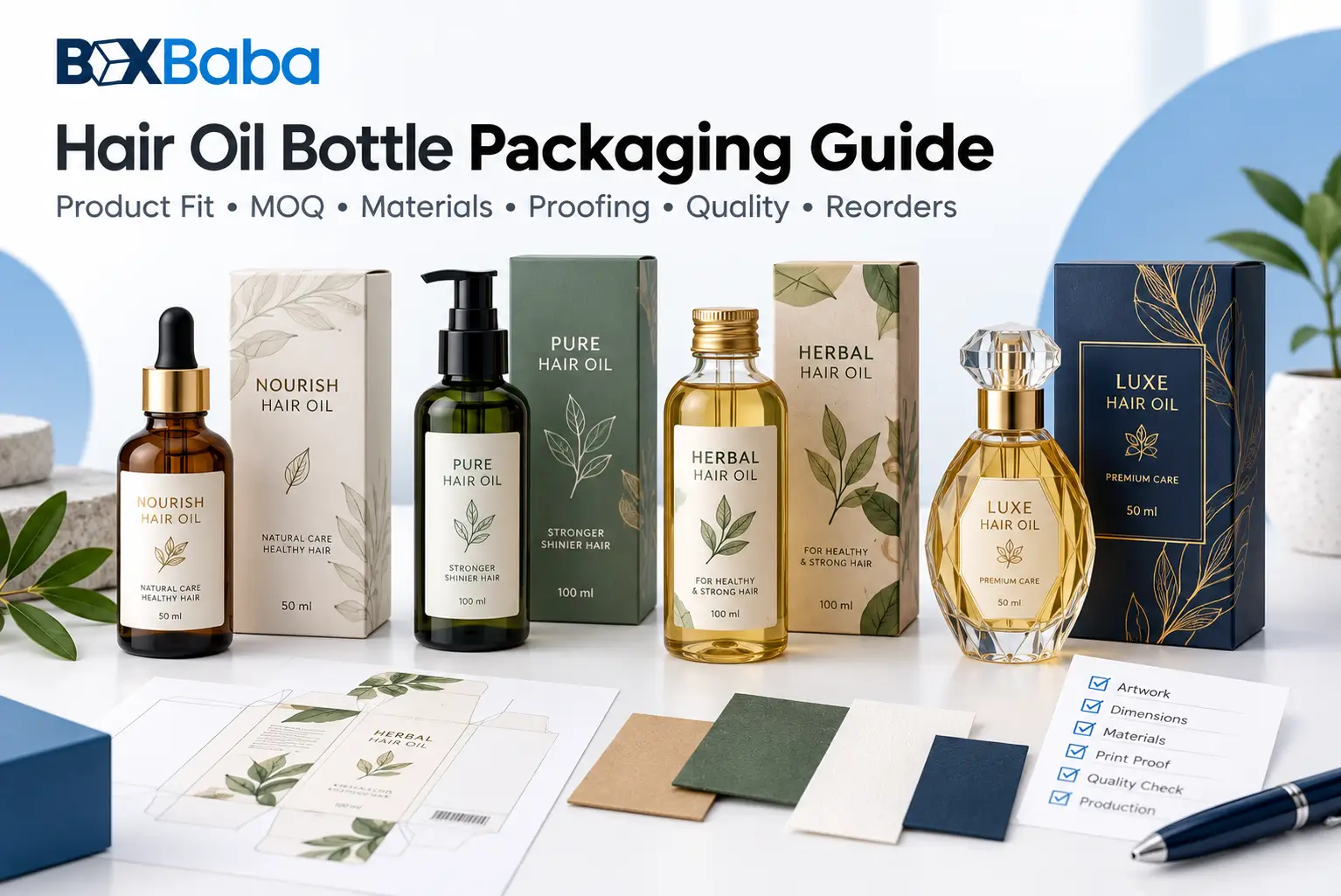
Choosing hair oil packaging should begin with the finished bottle, not with a preferred box style, material or finish. A 30 ml glass dropper bottle, a 100 ml plastic pump bottle and a 200 ml screw-cap bottle can all contain hair oil, but they create different carton dimensions, closure clearances, weight distribution and sales-channel requirements.
This guide focuses on secondary paper-based packaging placed around a completed hair oil bottle. The bottle and its closure remain responsible for containing the formula. Formula compatibility, leak testing and primary-container engineering require separate evaluation.
Use this decision sequence: Finished Bottle -> Maximum Product Envelope -> Closure Profile -> Filled Weight -> Orientation -> Required Internal Function -> Sales Channel -> Box Structure + Material -> Dieline -> Artwork -> Proof / Approval
Brands ready to request made-to-size cartons can review Hair Oil Packaging Boxes. For the broader product-to-box workflow, see How to Choose Cosmetic Packaging Boxes.
Start With the Packaging System, Not Just the Product Name
Hair oil is the formula. The bottle or primary container holds that formula. The printed carton is secondary packaging. An ecommerce mailer or shipping case may form another outer layer.
Hair Oil Formula -> Primary Bottle + Closure -> Secondary Retail Carton -> Optional Ecommerce / Wholesale Outer Package
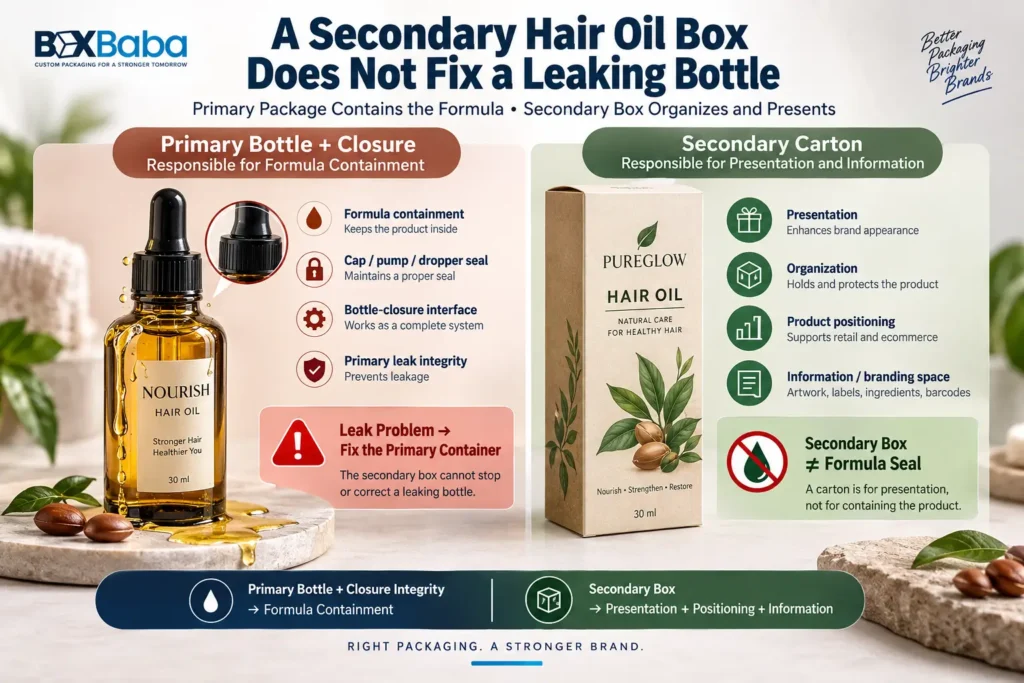
This distinction prevents a common packaging mistake: expecting the secondary box to solve a problem that belongs to the primary container. A paperboard carton can organize, present and support a finished bottle, but it does not replace a correctly specified bottle, cap, pump or dropper.
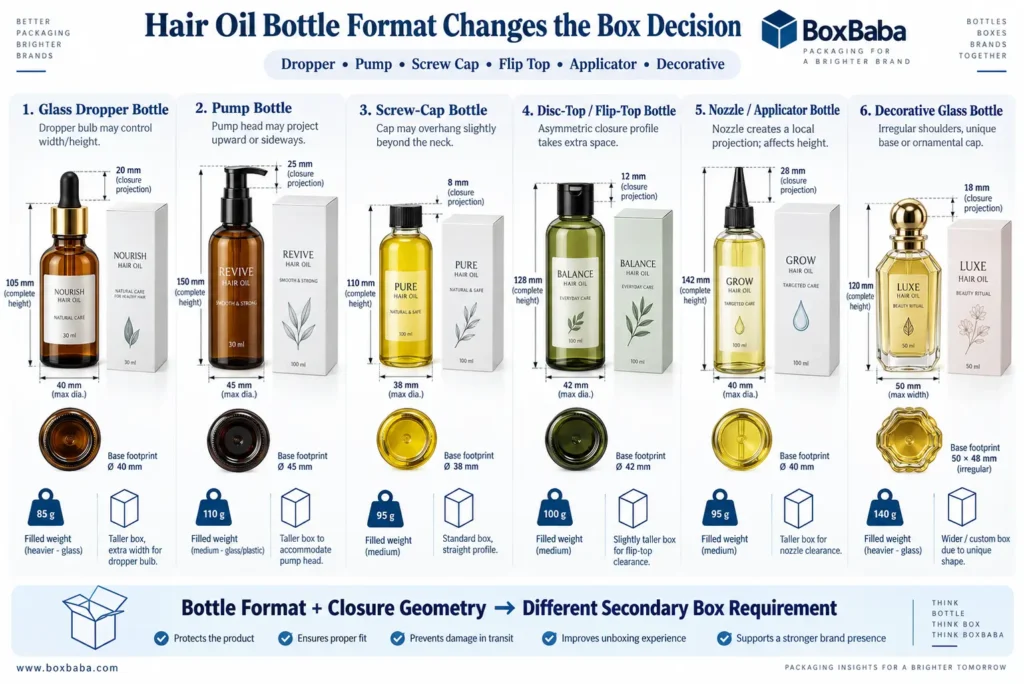
Which Hair Oil Bottle Formats Change the Box Decision?
Bottle / Closure Format | What Changes for the Secondary Box | Key Information to Provide |
Glass dropper bottle | Bulb or cap may control height/width; glass increases loaded weight | Maximum bottle dimensions, complete dropper height, bulb/cap width, filled weight |
Pump bottle | Pump head may project above or sideways; taller proportions can affect orientation | Complete closed height, pump-head width/depth, lock position, filled weight |
Screw-cap bottle | Usually simpler profile, but cap can overhang body | Bottle W/D or diameter, cap profile, complete height, filled weight |
Disc-top / flip-top bottle | Closure can create a wider or asymmetric top profile | Maximum closure projection, complete closed dimensions |
Nozzle / applicator bottle | Long or narrow applicator can affect height and local clearance | Maximum projection, cap/cover, bottle body, intended orientation |
Decorative glass bottle | Irregular shoulders, thick base or ornamental cap can control geometry | Maximum W/D/H, base footprint, closure, filled weight, decorated surfaces |
Multi-bottle set | Arrangement becomes a system-level sizing problem | Every bottle dimension, count, order, spacing/support, total loaded weight |
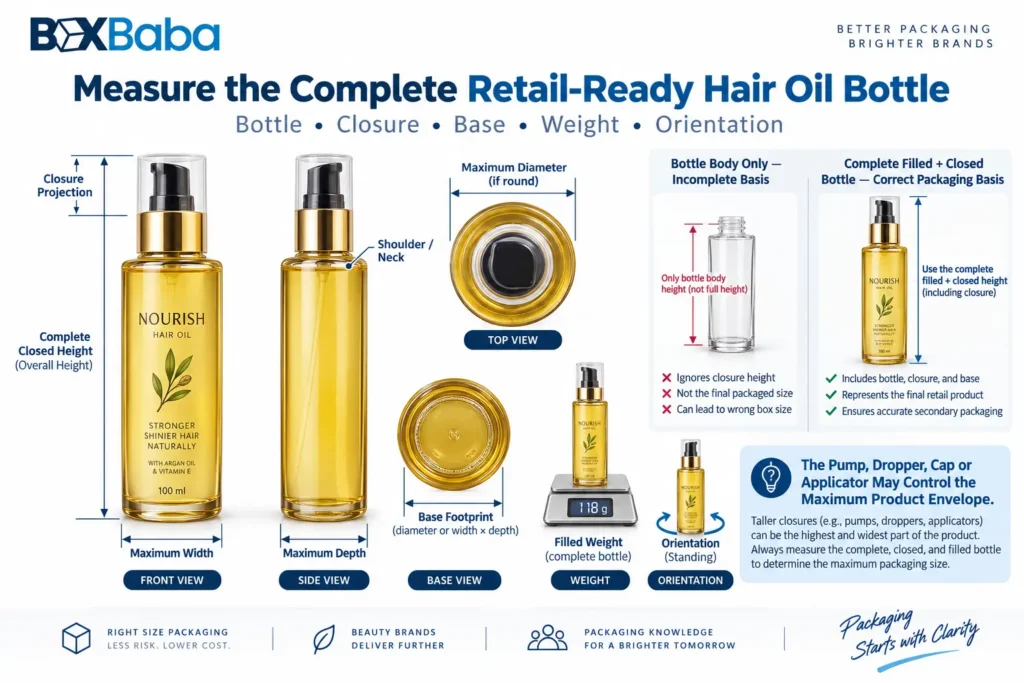
Measure the Complete Retail-Ready Bottle
Do not size the carton from nominal capacity alone. Measure the bottle fully assembled, filled, closed, labeled and decorated as it will enter the box. The widest or tallest point may be the closure rather than the bottle body.
Measurement | What to Record |
Maximum width | Widest finished point across body, closure or decoration |
Maximum depth | Deepest finished point for rectangular, oval or irregular bottles |
Maximum diameter | For a truly round finished profile |
Complete closed height | Base to the highest point of the installed closure |
Closure projection | Pump, dropper, cap, applicator, collar or nozzle |
Shoulder / neck | Any part wider than the main body |
Base footprint | Actual standing footprint |
Filled weight | Formula + bottle + closure + label / permanent decoration |
Orientation | Upright, horizontal or another planned position |
Products per package | Single bottle, duo, kit or collection |
For a complete cross-category measurement method, use the Cosmetic Box Size Guide.
Why Fill Volume Does Not Determine the Box Size
Fill volume tells you how much product is inside the bottle. It does not define the external width, depth, diameter, complete height or closure geometry. Two 100 ml bottles can be short and wide, tall and narrow, cylindrical, rectangular or fitted with very different pumps or caps.
Hair Oil Capacity != Finished Bottle Dimensions != Secondary Box Dimensions
Capacity can remain useful product information, but it should not replace the physical bottle measurements used for packaging development.
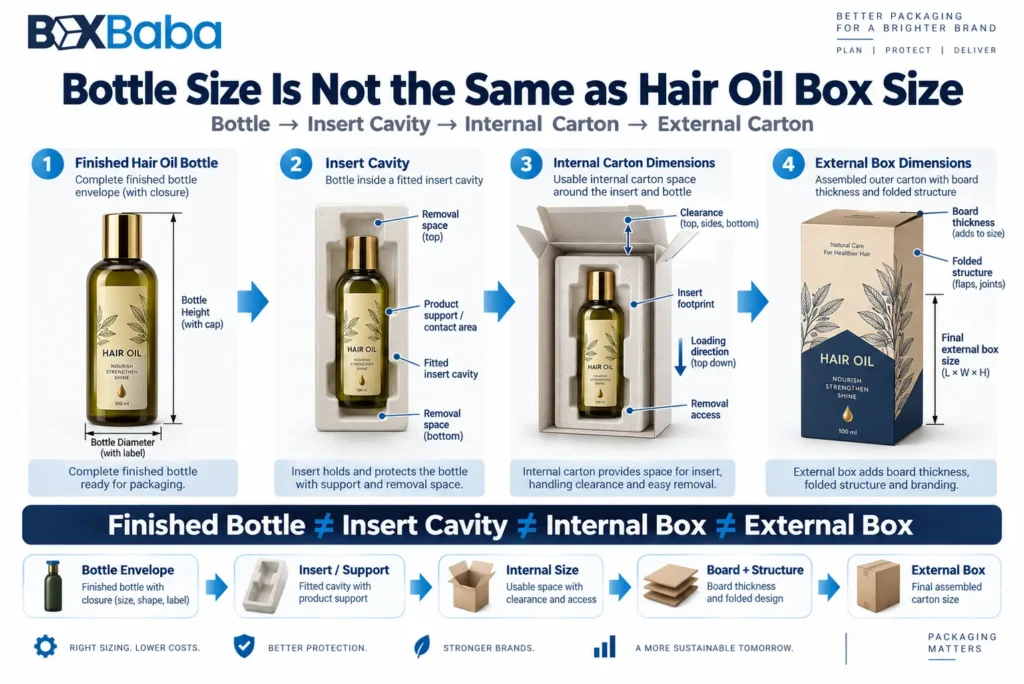
Bottle Dimensions, Internal Box Dimensions and External Dimensions Are Different
The finished bottle has one set of dimensions. The usable space inside the carton has another. The outside of the assembled carton has another. If an insert is used, the insert cavity and completed insert footprint add further dimensional layers.
Finished Bottle != Insert Cavity != Internal Box != External Box
The bottle establishes the starting envelope. Internal dimensions can also account for product variation, loading direction, required clearance, removal access and any structural insert. Material thickness and folded construction then influence the finished external dimensions.
Closure Type Is a Structural Input
The closure is not only a dispensing feature. It can control the package geometry and affect how the product is oriented or supported. A dropper bulb may be wider than the glass body. A pump head may extend to one side. A flip-top cap may create a non-circular top profile.
Before selecting the box structure, confirm whether the closure is fully closed or locked during packing, whether it projects beyond the body, whether concentrated pressure on the closure should be avoided and whether the customer needs easy access around the top of the bottle.
The Secondary Box Does Not Fix a Leaking Primary Container
A secondary carton should not be described as preventing formula leakage by itself. If a bottle leaks because of an unsuitable cap, pump, dropper, seal or bottle-closure interface, the primary packaging system needs separate correction.
Primary Bottle + Closure Integrity -> Formula Containment
Secondary Box -> Presentation + Organization + Product Positioning + Information Space
If a leakage risk has already been identified, resolve the primary-container issue before relying on the outer carton design.
Filled Weight Matters as Much as Geometry
Two bottles with similar dimensions can impose different loads on the carton because one uses heavier glass or contains more product. Record the complete filled product weight rather than estimating from the empty bottle.
Filled weight can influence bottom construction, board selection, insert requirement, multi-product arrangement and the way the completed package is handled. Weight alone does not automatically determine one material or structure, but it should be included in the structural review.
Choose Orientation Before Finalizing the Box
An upright hair oil bottle creates a different carton footprint from the same bottle laid horizontally. Orientation can also affect window alignment, insert geometry, opening direction, printed panel proportions and removal access.
Confirm whether the product will be packed upright, horizontally, within a drawer or as part of a multi-product presentation before the dieline is locked.
Match the Bottle and Use Case to a Box Direction
Packaging Condition | Possible Direction to Evaluate | Why It May Fit the Context |
Lightweight single bottle, simple closure | Straight tuck or reverse tuck folding carton | Compact retail secondary package |
Heavier bottle requiring stronger bottom support | Locking-bottom / auto-lock folding carton | Bottom construction can be reviewed around the loaded product |
Premium single bottle / controlled presentation | Sleeve-and-tray, two-piece or selected rigid format | Presentation and opening sequence can be prioritized |
Multiple bottles or bottle + accessory | Compartment carton, divider or insert-supported structure | Organizes the completed arrangement |
Retail display requirement | Individual retail carton plus separate display unit | Unit package and display capacity are separate sizing tasks |
Ecommerce order | Retail carton plus outer mailer / shipping carton | Distribution package is measured around the completed order |
These are starting directions rather than universal rules. Final suitability depends on the exact product dimensions, filled weight, construction, quantity, packing method and distribution environment.
When Does a Hair Oil Box Need an Insert?
A hair oil bottle does not automatically need a separate insert simply because it is glass, liquid or premium. A well-fitted single bottle may work with direct fit or integrated carton support when the selected structure already provides the required arrangement.
A separate insert becomes more relevant when the package needs a defined bottle position, multiple products separated, a presentation layout, accessory organization, additional removal control or a specific relationship between the bottle and a window.
Required Internal Function -> Direct Fit / Integrated Support / Separate Insert
Use the full decision framework in When Do Cosmetic Boxes Need Inserts?.
Insert Contact Areas Need Deliberate Planning
The widest part of the bottle is not automatically the best place for an insert to hold it. A pump, dropper bulb, collar or decorated label area may be a poor contact point even when it controls the maximum product envelope.
Maximum Bottle Envelope != Preferred Insert Contact Area
Identify suitable support areas, surfaces where concentrated pressure should be limited and the space required for the customer to remove the bottle. A mathematically tight cavity is not automatically a practical insert.
Choose Material After Bottle, Structure and Weight Are Known
Material selection is more reliable after the product dimensions, filled weight, structure and sales channel are understood. Paperboard, kraft, corrugated and rigid-board constructions solve different packaging and presentation requirements, and their suitability depends on the complete project rather than the product name alone.
For a broader material framework, see Best Materials for Custom Cosmetic Boxes.
Avoid treating material labels such as eco-friendly, biodegradable or recyclable as automatic claims. Environmental statements should match the actual substrate, coatings, local recovery system and supplier documentation.
How Retail Hair Oil Packaging Differs From Ecommerce Packaging
The retail carton is normally planned around one finished bottle or set. The ecommerce outer package is planned around the completed retail package or packed order. Those layers have different measurement bases.
Retail -> Finished Hair Oil Bottle -> Individual Retail Carton
Ecommerce -> Completed Retail Carton(s) -> Outer Mailer / Shipping Carton
A presentation carton should not automatically be assumed to perform as the parcel-shipping package. Conversely, the retail carton should not be oversized simply because the product will also be sold online.
For the full channel model, see Retail vs Ecommerce Cosmetic Packaging.
Wholesale and Case Packing Add Another Packaging Layer
Wholesale distribution can add master-case requirements after the individual hair oil carton is complete. Confirm units per case, SKU arrangement, completed case weight, orientation, dividers where required and case-label or barcode requirements.
Bottle -> Retail Carton -> Master Case
The dimensions of the individual retail carton become an input into master-case planning rather than being replaced by it.
Single Hair Oil Bottle vs Multi-Bottle Set
A single bottle carton is developed around one finished product. A multi-bottle set is developed around the complete arrangement. Do not multiply one bottle width by the number of products and treat the result as the finished set size.
Set Variable | What to Confirm |
Bottle count | Exact units per package |
Bottle formats | Whether every SKU uses the same physical bottle |
Closure types | Dropper, pump, screw cap, applicator or mixed |
Orientation | Vertical, horizontal or mixed |
Spacing / separation | Open space, divider, cavity or platform requirement |
Removal sequence | How customers access each bottle |
Accessories | Comb, applicator, card, sachet or other packed items |
Total loaded weight | All bottles + accessories + internal components |
Artwork SKUs | Whether different oils share one physical configuration |
Can Several Hair Oil SKUs Share One Dieline?
Yes, when the physical bottle configuration remains compatible. Different formulas, scents, variants, labels or artwork can share a structural dieline if the finished bottle dimensions, closure profile, orientation, insert, window and relevant loaded weight remain within the approved packaging specification.
Same Physical Bottle Configuration -> Shared Structural Dieline -> Multiple Artwork SKUs
A new structural review is appropriate when a SKU changes from dropper to pump, uses a wider cap, changes bottle height or diameter, adds an accessory, changes the insert or moves to a different product count.
Hair Oil Packaging vs Hair Color Packaging
Hair oil is usually a bottle-centered secondary-packaging problem. Hair color can be a multi-component kit containing tubes, developer bottles, gloves, sachets, applicators and instructions. The two should not be forced into the same page or sizing model.
For multi-component dye systems, use Hair Color Packaging as the commercial destination.
Window Packaging Needs Product Alignment
A window can reveal the bottle, oil color, label or decorative profile, but it adds an alignment requirement. Confirm bottle orientation, visible product area, remaining structural border, window-to-product clearance, artwork safe zones and whether any film is part of the design.
Do not position the window from approximate bottle dimensions. Final bottle geometry and the approved internal arrangement should come first.
Artwork Should Follow the Structural Dieline
The carton provides space for branding, directions, ingredients, barcodes and other approved product information, but panel sizes depend on the final structure. Confirm the dieline before completing detailed artwork so logos, text, barcodes, windows and decorative elements do not conflict with folds, glue areas or structural features.
Bottle + Structure -> Dieline -> Artwork -> Proof / Approval
Worked Example: 30 ml Glass Dropper Hair Oil
Consider a hypothetical 30 ml hair oil bottle with a 1.18 in glass-body diameter, a 1.26 in dropper-bulb diameter, a 1.22 in base footprint and a 4.05 in complete assembled height. The complete filled bottle weighs 3.9 oz.
The starting product envelope is 1.26 in maximum diameter x 4.05 in complete height because the dropper bulb is the widest finished point. These are product dimensions, not final carton dimensions.
The next sequence is: Product Envelope -> Closure / Contact Review -> Orientation -> Internal Support Decision -> Internal Carton -> Board + Structure -> External Carton
Worked Example: 100 ml Pump Bottle
Consider a hypothetical rectangular pump bottle measuring 1.75 in wide x 1.20 in deep x 6.10 in complete locked height. The pump head projects to 1.52 in at its deepest point, so the maximum finished depth is 1.52 in rather than the 1.20 in body depth.
The starting product envelope becomes 1.75 in W x 1.52 in D x 6.10 in H. The pump geometry should also be reviewed when choosing support areas and loading direction.
What If the Final Bottle Is Not Available Yet?
Use the most reliable approved dimensional reference available and clearly mark the dimensions as preliminary. This may be a supplier drawing, specification sheet or production-equivalent sample.
Preliminary Bottle Dimensions -> Final Filled Bottle -> Measurement Confirmation -> Structural Approval
If the bottle supplier changes the pump, cap, dropper, glass profile, label thickness or decorative component, recheck the secondary carton before production.
Common Hair Oil Packaging Mistakes
Mistake | Why It Creates a Weak Specification | Better Direction |
Choosing a box from 30 ml / 100 ml capacity | Volume does not define exterior geometry | Measure the complete finished bottle |
Measuring only the bottle body | Pump, dropper or cap may control size | Include the complete closure |
Expecting the carton to prevent leakage | Formula containment belongs to the primary package | Resolve bottle/closure integrity separately |
Ignoring filled weight | Empty bottle weight understates the loaded package | Provide complete filled weight |
Choosing material before structure | Substrate suitability depends on product and construction | Confirm bottle, load and structure first |
Adding an insert automatically | Extra internal material may not solve a defined function | Identify the unresolved internal task |
Holding the bottle at the widest point automatically | Maximum envelope may be a sensitive closure | Define appropriate insert contact areas |
Using one box across different closures | Pump and dropper geometry can change fit | Compare every physical SKU |
Using retail carton as parcel shipping box | Different packaging layers | Coordinate a separate outer package where needed |
Finalizing artwork before dieline | Panel and window positions can change | Approve structure before final artwork |
Hair Oil Packaging Quote Checklist
- Finished bottle type and nominal fill volume.
- Maximum width and depth or maximum diameter.
- Complete closed / locked height.
- Pump, dropper, cap, applicator, collar or nozzle dimensions.
- Base footprint and bottle shape.
- Filled product weight.
- Label, sleeve or decoration that changes the finished profile.
- Preferred orientation and removal direction.
- Number of bottles or accessories per package.
- Insert / divider / window requirement if known.
- Preferred structure and material direction if already selected.
- Number of formula or artwork SKUs and quantity per SKU.
- Artwork status and proofing requirements.
- Retail, ecommerce, wholesale, gift or mixed channel.
- Delivery destination and requested timeline.
This gives a packaging supplier a stronger basis for quotation than a request such as, I need 1,000 boxes for 100 ml hair oil.
From Finished Hair Oil Bottle to Final Secondary Box
- Finished Hair Oil Bottle
- Maximum External Envelope
- Closure Profile
- Filled Weight + Orientation
- Required Internal Function
- Retail / Ecommerce / Wholesale Channel
- Internal Carton Specification
- Material + Box Structure
- External Dimensions
- Structural Dieline
- Artwork
- Proof / Fit Confirmation
Brands ready to develop the commercial packaging can review BoxBaba Hair Oil Packaging Boxes. For wider beauty packaging programs, browse Custom Cosmetic Boxes.
Frequently Asked Questions About Hair Oil Bottle Packaging
What is hair oil bottle packaging?
In this guide, hair oil bottle packaging means the secondary paper-based box developed around a completely assembled, filled and closed hair oil bottle. The bottle and closure remain the primary package that contains the formula.
Is there a standard hair oil box size?
No. The correct carton depends on the finished bottle dimensions, closure, filled weight, orientation, internal support and selected structure rather than fill volume alone.
Does 100 ml determine the hair oil box size?
No. A 100 ml bottle can be tall, short, round, rectangular, pump-fitted or screw-capped. Measure the actual finished bottle.
How do I measure a hair oil bottle for a box?
Measure the complete filled and closed product at its maximum width and depth or diameter, complete height, closure projection and base footprint. Also record the filled weight and intended orientation.
Should the pump or dropper be included in the measurement?
Yes. The complete closure is part of the finished retail product and may determine the maximum height, width or depth.
Can a paper carton prevent a hair oil bottle from leaking?
A secondary carton should not be relied on to correct a leaking primary container. Formula containment depends on the bottle, closure and related primary-packaging system.
Do glass hair oil bottles always need inserts?
No. Glass alone does not determine insert need. Evaluate the complete bottle geometry, filled weight, orientation, box structure, product count and required internal function.
Do hair oil boxes need to be larger for ecommerce?
Not automatically. The retail carton and ecommerce outer package are separate layers. Ecommerce packaging should be planned around the completed retail package or packed order.
Can dropper and pump bottles use the same box?
Only if their complete finished dimensions, closure profiles, orientation and internal requirements remain compatible. A closure change often requires structural review.
Can several hair oil formulas use one dieline?
Yes, when the physical bottle configuration remains compatible. Different artwork or formula names alone do not necessarily require a new structural dieline.
How do I package several hair oil bottles in one set?
Measure each finished bottle and accessory, then confirm count, order, orientation, spacing or separation, removal access and total loaded weight before finalizing the internal arrangement.
Should I choose the material before the box style?
Usually the product dimensions, filled weight, basic structure and sales channel should be understood first. Material can then be evaluated against the approved construction and print requirements.
What information should I send for a hair oil packaging quote?
Provide complete finished bottle dimensions, closure profile, filled weight, orientation, units per package, insert or window requirements, quantity by SKU, artwork status, sales channel and delivery destination.