

Multi-SKU cosmetic packaging becomes easier to manage when brands standardize the parts that are genuinely compatible and separate the parts that are not. The goal is not to force every lipstick, serum, cream, mascara or fragrance into one box. The goal is to identify which SKUs can share a structural system without creating poor fit, incorrect windows, unsuitable inserts or uncontrolled artwork versions.
A useful rule is: Standardize Shared Physical Requirements -> Separate Product-Specific Requirements -> Control Every Artwork and Production Version.
For most secondary cosmetic packaging projects, evaluate in this order: Finished Product Geometry -> Closure / Packed State -> Weight -> Orientation -> Box Size -> Structural Dieline -> Insert / Window -> Artwork Version -> SKU Quantity -> Proof / Approval
Brands planning a broader cosmetic packaging range can review Custom Cosmetic Boxes. If the structure itself has not yet been selected, start with How to Choose Cosmetic Packaging Boxes.
What Does Multi-SKU Cosmetic Packaging Standardization Mean?
Packaging standardization means deliberately reusing compatible structural, material, print or artwork systems across several products while maintaining the differences each SKU still requires. It is not the same as making every package identical.
A beauty range may share a brand hierarchy, typography and finish direction across many products while using several different box sizes. A lipstick shade range may go further and share one exact structural dieline across every shade. A skincare family may share one outside carton size but use different internal insert versions only when the products remain compatible with that outer structure.
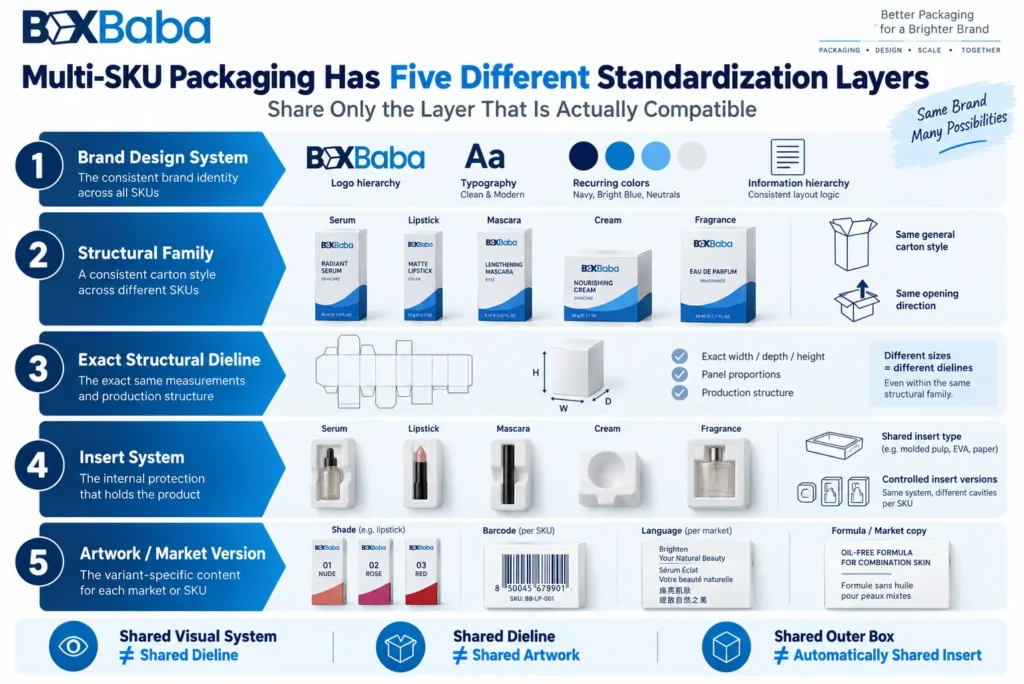
Five Different Layers Can Be Standardized
Layer | What Can Be Shared | What Still May Vary |
|---|---|---|
1. Brand design system | Logo hierarchy, typography, recurring colors, information hierarchy | Product name, shade, formula, claims, barcode, required copy |
2. Structural family | Same general carton style or opening direction | Exact width, depth, height and panel proportions |
3. Exact structural dieline | Same finished box geometry and production structure | Artwork version and SKU information |
4. Insert system | Same insert type or shared outer box with controlled insert versions | Cavity geometry, removal access, product contact points |
5. Artwork / market version | Master artwork template and panel logic | Shade, fragrance, barcode, language, market copy, quantity |
These layers should not be collapsed into one decision. Two SKUs can share a visual system without sharing a dieline. Two SKUs can share a dieline without sharing artwork. One outer box can sometimes support more than one insert version, but only after the complete internal relationship is checked.
Start With a Multi-SKU Packaging Master Sheet
Before deciding what can be standardized, create one packaging schedule containing every SKU. This turns a product line into comparable physical and production data rather than a list of marketing names.
Field | Why It Matters |
|---|---|
SKU / product name | Identifies the commercial variant |
Primary container reference | Separates truly identical containers from similar-looking ones |
Finished dimensions | Establishes the product envelope |
Closure / packed state | Captures pumps, droppers, caps, wands, hinges and applicators |
Filled weight | Supports structural and insert review |
Orientation | Changes box footprint, window and removal direction |
Finished box dimensions | Identifies possible shared sizes |
Dieline version | Controls exact structural production file |
Insert version | Separates outer structure from internal fitment |
Window / hang-tab version | Captures structural features that affect the dieline |
Material / caliper | May affect structural fit and production review |
Finish specification | Separates shared visual treatment from SKU-specific effects |
Artwork version | Identifies the correct print file |
Barcode / QR / market copy | Controls SKU-specific information |
Quantity per SKU | Prevents total-project quantity from hiding individual demand |
For reliable dimensions, measure the actual finished containers using the method in the Cosmetic Box Size Guide.
Can Different Cosmetic SKUs Share the Same Box Size?
Sometimes, but matching the outside box dimensions is only the first test. Several products may fit within the same nominal internal volume while still creating different requirements for orientation, closure clearance, insert design, window alignment or product removal.
A shared finished box size is most plausible when the following remain compatible:
- maximum finished product dimensions or a deliberately approved internal layout
- closure profile and packed closure state
- product orientation
- filled weight and weight distribution
- required internal clearance or support
- window position and visible product area where used
- opening and removal direction
- selected box structure and material relationship
Same Box Size does not automatically mean Same Dieline, Same Insert or Same Artwork. Those are separate decisions.
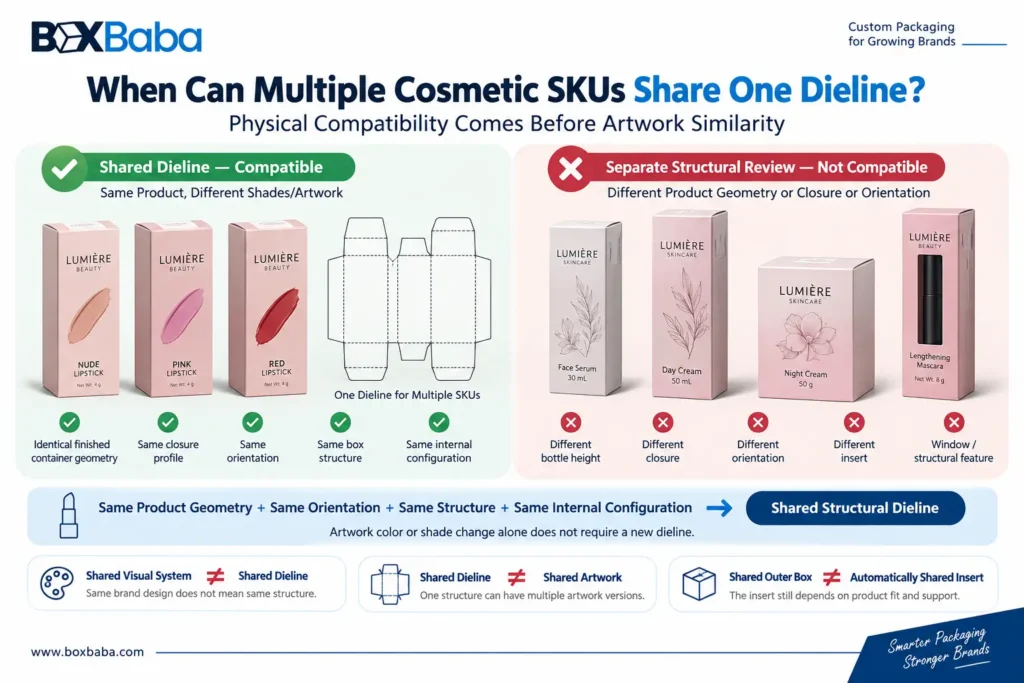
Can Different SKUs Share the Exact Same Structural Dieline?
Yes, when the finished box geometry and production-critical structure are genuinely the same. This is common in shade or fragrance ranges that use the same physical primary container.
Example: twelve lipstick shades use the same closed lipstick case, the same orientation, the same folding-carton dimensions, no insert and the same box structure. One structural dieline may support twelve separate artwork files.
Use the stricter relationship:
Same Product Geometry + Same Orientation + Same Structure + Same Internal Configuration -> Shared Structural Dieline
If the board caliper, closure method, window, hang tab, locking feature, insert relationship or panel proportions change, the dieline should be reviewed rather than assumed to remain identical.
Different Artwork Does Not Automatically Require a New Dieline
Cosmetic SKU ranges frequently change visual or informational content without changing the physical carton. Shade name, formula, fragrance, color identifier, ingredients, barcode, QR destination or market copy can all vary while the structure stays the same.
The correct relationship is: Shared Structural Dieline -> Controlled Artwork Family -> Individual SKU Artwork Versions.
Every artwork version still needs its own content check. Structural approval does not approve a shade name, barcode or ingredient panel for another SKU.
Can One Outer Box Use Different Insert Versions?
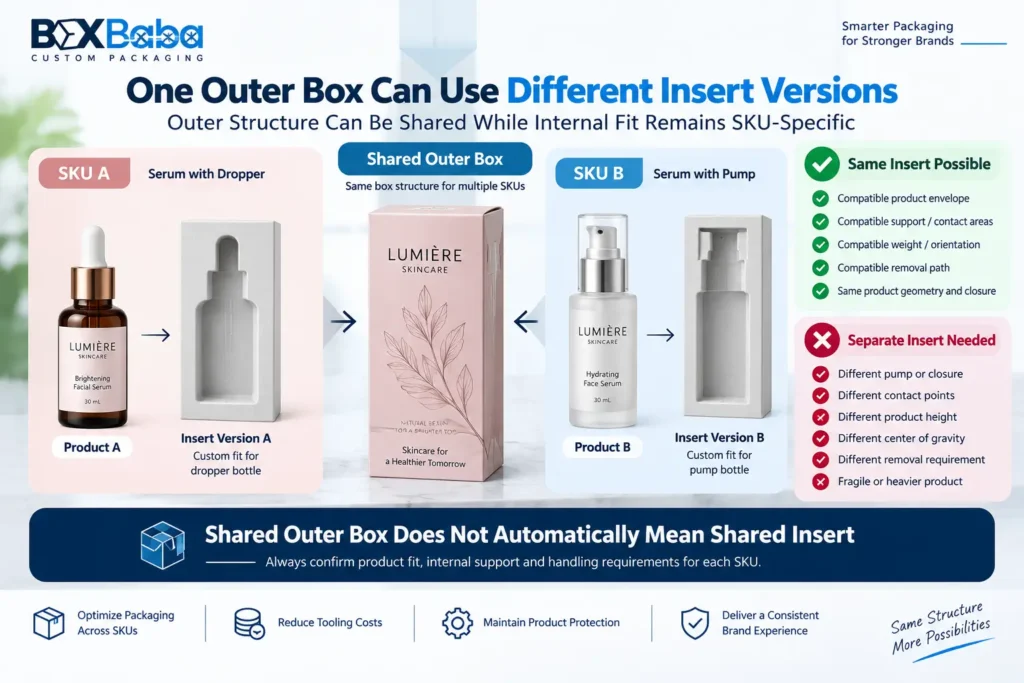
Sometimes. A shared outer carton with different insert versions can be useful when several products are intentionally standardized to the same outside package but need different internal positioning. This should be a designed system, not a workaround for products that are physically incompatible.
A shared outer box is more plausible when:
- the selected outer dimensions suit every approved SKU without excessive unused space
- the loaded weight remains appropriate for the common outer structure
- each insert can be loaded and removed through the same opening
- the window, if any, remains compatible with every product or is not product-specific
- insert thickness and cavity position do not interfere with closure or artwork panels
- the different insert versions can be clearly identified and controlled during packing
For commercial insert options, review Printed Boxes with Inserts. The need for a shared or separate insert should still be based on the complete product-to-box relationship.
When Can Different SKUs Share the Same Insert?
Sharing the same insert requires a closer physical match than sharing a visual design system. The cavity geometry, contact points, loaded orientation and removal path all need to remain compatible.
Two bottles with similar outside dimensions can still need different insert treatment if one has a projecting pump, fragile decoration, label-sensitive surface, different center of gravity or a closure that changes the preferred support points.
Use: Compatible Product Envelope + Compatible Contact Areas + Compatible Weight / Orientation + Compatible Removal -> Possible Shared Insert.
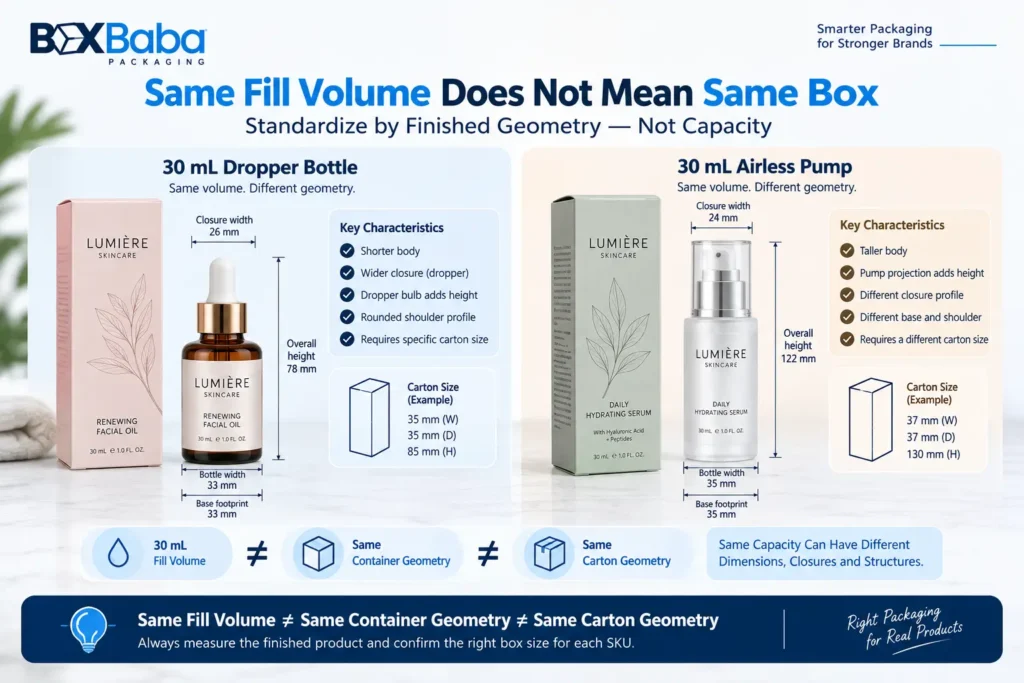
Same Fill Volume Is Not a Standardization Rule
A 30 ml dropper bottle and a 30 ml airless pump are both 30 ml products, but capacity does not define their outside geometry. One may be shorter and wider; the other may be tall with a projecting dispenser. They should not share a box simply because the formula volume is identical.
Fill Volume != Container Geometry != Carton Geometry.
Product-Family Examples: What Usually Can and Cannot Be Shared
Cosmetic Range | Likely Standardization Opportunity | What Triggers Separate Review |
|---|---|---|
Lipstick shade range | One dieline across shades when the case is identical | Different case, refill mechanism, decorative cap or liquid-lip format |
Mascara variants | One dieline when tube and closure geometry stay identical | Different tube length, dual-ended product or cap profile |
Eyeliner shades | Shared dieline for the same pen/pencil case | Pencil vs felt-tip pen vs pot/gel format |
Foundation shade range | Shared dieline when bottle/pump/compact is identical | Different bottle, pump, cap, compact or travel size |
Serum formulas | Shared dieline when the same bottle/closure is used | Dropper vs airless, different bottle height or closure width |
Cream / moisturizer range | Shared dieline for the same jar and lid | Different jar diameter, lid overhang or pump format |
Fragrance variations | Shared dieline when the same bottle/cap/insert remains | Different bottle profile, cap, filled weight or insert |
Palette editions | Shared dieline when compact/palette geometry is unchanged | Different pan count, mirror, hinge, latch or palette size |
A Shared Brand System Does Not Require One Box Shape
A coordinated beauty range can look like one family even when lipstick, serum, mascara and cream each need different structures. Standardize the visual hierarchy across product-specific geometry rather than forcing unrelated products into one carton size.
Shared Brand System + Product-Specific Dielines -> Coordinated Packaging Family.
This is especially useful for cross-category ranges. BoxBabas Makeup Boxes and Skincare Packaging already separate structural packaging from shade, formula and artwork variation.
Travel Size and Full Size Usually Need Separate Structural Versions
Travel and full-size products can share typography, color system, finish direction and panel hierarchy, but a meaningful change in finished product dimensions normally requires a separate structural review. Do not scale a dieline proportionally without checking the real finished container.
Shared Visual System -> Yes. Shared Exact Dieline -> Only if the physical geometry truly remains the same.
Weight Can Break an Otherwise Shared Structure
Two products can fit the same internal dimensions but have materially different filled weights. Weight does not automatically require a larger box, but it can change the suitability of the board, bottom construction, insert or loading direction.
Similar Dimensions + Different Loaded Weight -> Structural / Support Review.
Windows, Hang Tabs and Visible Product Areas Must Stay Compatible
A window is tied to the actual position of the product inside the carton. If one SKU is shorter, rotated differently or uses a different closure, the same window may reveal the wrong area even when the outside box size remains unchanged.
Hang tabs also depend on completed package weight, hanging direction and panel construction. Treat them as structural features, not artwork-only elements.
Material and Board Changes Can Require Dieline Review
A dieline should not be treated as independent from material. Changing board type or caliper can affect folds, fit, panel relationships and assembled dimensions. A visual artwork template may survive the change, but the structural production file should be reviewed.
Same Artwork Layout + Different Board Specification -> Structural Review Before Reuse.
Finish Standardization Can Build Consistency Without Forcing One Structure
A brand may standardize matte lamination, one foil color, Spot UV logic or another approved finish across several box sizes. This can create a consistent family while allowing each product to retain the structure it actually needs.
Selective finishes should still be checked on every dieline because folds, windows, glue areas and panel proportions change from one structural version to another.
Plan Shade and SKU Identification Around Retail Orientation
When several cosmetic SKUs share one structural carton, shoppers and retail staff still need a reliable way to distinguish them. Decide which panel will remain visible when the package is displayed, shelved or replenished.
Retail Orientation -> Visible Panel -> Shade / SKU Identification Position.
The shade name, number, color indicator, barcode or product code may belong on a front, side, top or bottom panel depending on the actual merchandising orientation.
Regional and Retailer Artwork Versions Need Separate Control
A product can share the same structure across markets while carrying different languages, barcodes, retailer codes, QR destinations or other approved copy. That is an artwork-version problem, not automatically a structural problem.
Maintain a clear naming system that identifies SKU, market, artwork revision and approved dieline. Do not overwrite one master file with untraceable regional changes.
Quantities Should Be Planned Per SKU and Per Structural Version
A multi-SKU order should not be described only by one combined quantity. Separate the total project volume from the number required for each artwork SKU and each structural version.
Total Project Quantity != Quantity Per Dieline != Quantity Per Artwork SKU.
This distinction becomes important when a range contains many slow-moving shades, a few high-volume core products and more than one structural size.
Proofing Strategy for Shared Structures and Multiple Artworks
Structural approval and artwork approval are separate. When several SKUs genuinely share one physical structure, one appropriate structural review may support the common geometry. Each artwork version should still be checked for the correct product name, shade, formula, barcode, QR destination, panel orientation and quantity.
For proof levels and acceptance criteria, review Cosmetic Packaging Samples and Proofing.
Shared Structure Approval != Approval of Every Artwork SKU.
Version Control Matters More as the SKU Count Grows
A multi-SKU range should identify the approved relationship between the product, dieline, insert and artwork rather than relying on filenames such as final, final2 or latest.
Controlled Item | Example Version Field |
|---|---|
Product / container | Container C-01 |
Dieline | DL-01 Rev B |
Insert | IN-01 Rev A |
Artwork | SKU-LIP-ROSE Rev 4 |
Barcode / market file | US UPC version |
Proof approval | Approved date / approver |
Production quantity | Quantity tied to the approved version |
Multi-SKU Standardization Decision Matrix
Question | If Yes | If No |
|---|---|---|
Are finished product dimensions compatible? | Continue to closure / packed-state review | Separate size or structural review |
Is the closure / packed state compatible? | Continue to orientation / weight | Separate review |
Is orientation the same? | Continue to internal configuration | Recheck box and window geometry |
Is the insert / internal support compatible? | Possible shared internal system | Create a separate insert or structure |
Is the window / hang-tab relationship unchanged? | Possible shared dieline | Separate structural version may be required |
Is the material / board specification unchanged? | Continue to artwork | Review structural file |
Is only artwork / shade information changing? | Use controlled artwork variants on the shared dieline | Identify the physical change and reclassify |
Worked Example 1: Twelve Lipstick Shades
A brand sells twelve lipstick shades. Every shade uses the same capped lipstick case, identical dimensions, the same folding carton, no insert and the same display orientation.
Result: One Structural Dieline -> Twelve Artwork / Barcode Versions.
The brand can standardize the structure while controlling each shade name, color identifier and barcode separately.
Worked Example 2: Two 30 ml Serum Products
SKU A uses a 30 ml glass dropper bottle. SKU B uses a 30 ml airless pump. Their formula volume is identical, but the airless bottle is taller and the pump creates a different closure profile.
Result: Same Capacity -> Different Finished Geometry -> Separate Structural Review.
The artwork may share the same brand system, but capacity alone is not enough to justify one dieline.
Worked Example 3: Same Outer Carton, Two Insert Versions
A skincare brand has two finished products that both fit an approved presentation carton. The external structure, opening direction, loaded weight range and artwork panels remain compatible, but each product needs a different paperboard cavity to maintain the intended position.
Result: One Outer Structural Dieline -> Insert Version A / Insert Version B -> Separate Artwork SKUs.
This approach should only be used after checking fit, removal, window relationships and packing identification for both insert versions.
Worked Example 4: Travel and Full-Size Foundation
A travel foundation and full-size foundation use the same logo, typography, color system and pump style but different bottle heights and widths.
Result: Shared Brand / Artwork System -> Separate Dielines by Product Geometry.
The range can still look standardized without forcing the small and large products into one inefficient box size.
When Standardization Becomes Over-Standardization
Standardization is weak when it solves an internal procurement preference by creating a worse physical package. Forcing incompatible products into one box can create excessive unused space, awkward inserts, poor product access, misaligned windows, unnecessarily large retail footprints or complex packing instructions.
Over-Standardization Mistake | Why It Creates Risk | Better Direction |
|---|---|---|
One box for every 30 ml product | Different containers have different geometry | Group by actual finished product dimensions |
One insert for similar-looking bottles | Contact points and closures may differ | Validate cavity, weight and removal for each product |
One window for several heights | Visible area may shift by SKU | Align the window to the actual product position |
One dieline across different board calipers | Fold / fit relationships may change | Review the structural file with the material change |
One carton for travel and full size | Creates unnecessary void or poor proportions | Use a shared visual system with separate structures |
One artwork file duplicated manually | Raises barcode / copy version risk | Maintain controlled SKU-specific artwork files |
One total quantity for the whole range | Hides actual SKU demand | Quote and plan quantities by SKU and structural version |
Multi-SKU Cosmetic Packaging Quote Checklist
- Complete SKU list and product names.
- Primary container reference for every SKU.
- Finished product dimensions and filled weight for every physical format.
- Closure type and packed closure state.
- Preferred product orientation.
- Proposed box structure and finished box size where already known.
- Which SKUs are expected to share one structural dieline.
- Insert requirement and insert version by SKU.
- Window, hang-tab or structural feature by SKU.
- Material / board specification.
- Printing and finish specification.
- Artwork file name / revision for each SKU.
- Barcode, QR, market or retailer version.
- Quantity per SKU and quantity per structural version.
- Proofing or sample requirement.
- Sales channel and delivery destination.
A Practical Standardization Workflow
- List Every Cosmetic SKU
- Group SKUs by Actual Primary-Container Geometry
- Confirm Closure, Packed State, Weight and Orientation
- Compare Finished Box-Size Requirements
- Identify Shared Structural Families
- Confirm Which SKUs Can Share an Exact Dieline
- Develop Shared or Separate Insert Versions
- Build the Master Artwork / Shade System
- Assign Barcode, Market and SKU-Specific Content
- Set Quantity by SKU and Structural Version
- Proof the Shared Structure and Every Artwork Version at the Required Level
- Record the Approved Production Version for Reorders
Brands ready to organize a multi-product beauty range can begin with the Custom Cosmetic Boxes category and provide the complete SKU schedule rather than one generic box request.
Frequently Asked Questions About Multi-SKU Cosmetic Packaging
Can several cosmetic SKUs use the same box?
Yes, when the finished product geometry, closure, packed state, orientation, weight, internal support and structural requirements remain compatible. Similar product names or fill volumes alone are not enough.
Can different cosmetic shades share one dieline?
Often yes when every shade uses the same physical primary container and the same box structure. Shade names, color indicators, barcodes and artwork still need controlled SKU-specific files.
Does different artwork require a different dieline?
No. Artwork variation does not automatically change the structure. A new dieline is driven by a structural or dimensional change, not simply a new shade, fragrance or formula name.
Can 30 ml serum products share the same box?
Only if their complete finished containers are physically compatible. A 30 ml dropper and a 30 ml airless pump can have different heights and closure profiles, so capacity alone does not justify a shared box.
Can one outer cosmetic box use different inserts?
Sometimes. The outer carton must remain appropriate for every approved product, and each insert version must provide compatible loading, closure, removal and window relationships.
Can several SKUs use the same insert?
Only when product envelope, support/contact areas, weight, orientation and removal path remain compatible. Similar dimensions alone do not guarantee one insert will suit every SKU.
Can travel and full-size cosmetics use the same dieline?
Usually not when the primary-container dimensions are different. They can still share a visual design system, typography, colors and finish direction.
Does a board or material change affect the dieline?
It can. Different board types or calipers can change fold, fit and assembled relationships, so the structural production file should be reviewed before reuse.
How should multi-SKU artwork be organized?
Use a master visual system but maintain separate controlled files for each SKU, shade, formula, barcode, market or retailer version. Tie every artwork file to the correct approved dieline.
Do all artwork SKUs need separate structural samples?
Not necessarily when the physical structure is genuinely identical. One appropriate structural review may support the shared geometry, while every artwork version still needs its own content approval at the required proof level.
How should quantities be provided for a multi-SKU packaging quote?
Provide total project quantity, quantity by structural version and quantity by artwork SKU. A combined total alone can hide how production is actually divided.
Can lipstick, mascara and serum boxes all share one brand system?
Yes. A consistent logo hierarchy, typography, colors, finish direction and information system can connect different box shapes without forcing unrelated product geometries into one dieline.
What is the biggest mistake in cosmetic packaging standardization?
Forcing physically incompatible products into one box simply to reduce the number of packaging versions. Standardize only where the complete product-to-package relationship remains suitable.
What should be tracked in a multi-SKU packaging master sheet?
Track SKU name, container reference, finished dimensions, closure, packed state, weight, orientation, box size, dieline version, insert version, artwork version, barcode or market version and quantity.