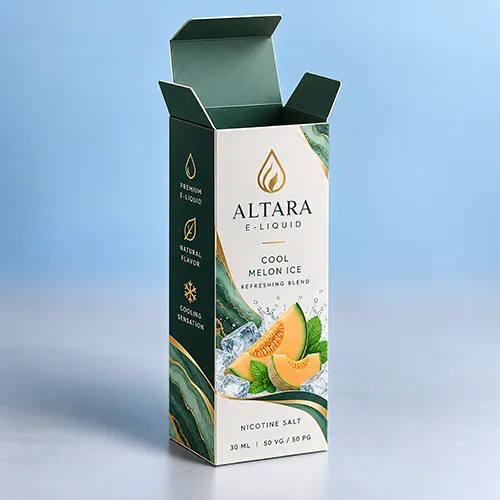
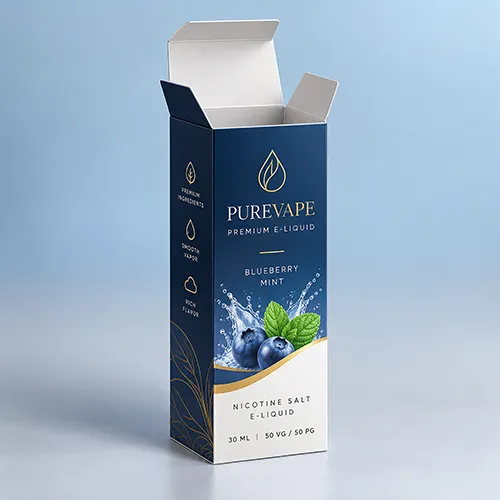
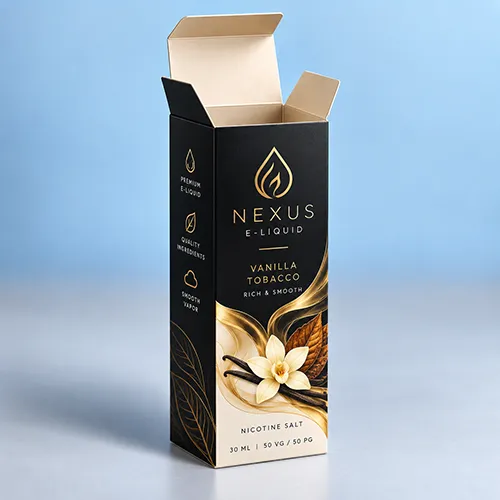
Custom Tuck-End E-Liquid Boxes for Bottle Packaging
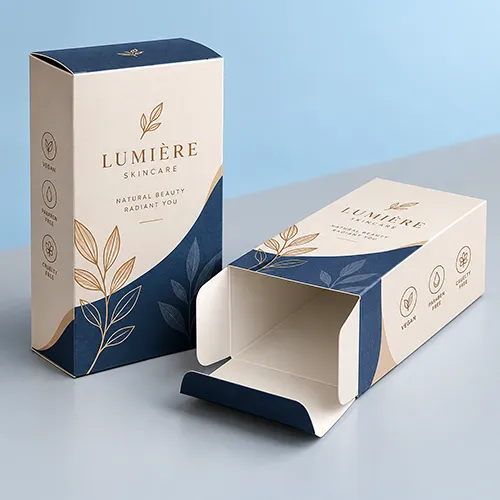
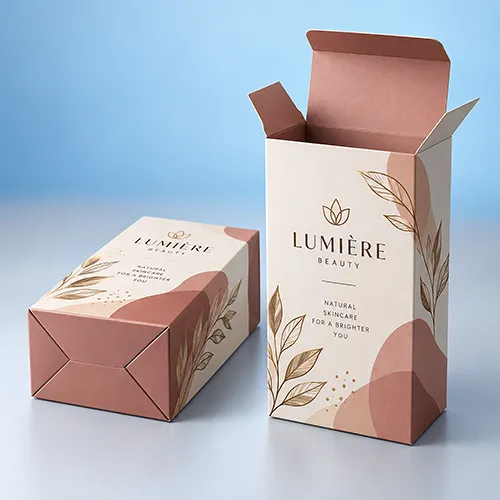
Custom Tuck-End E-Liquid Boxes combine an e-liquid bottle application with a Tuck End secondary carton.
The defining relationship is:
Tuck-End E-Liquid Box → Finished E-Liquid Bottle + Tuck-End Closure
The bottle determines the required internal fit.
The selected Tuck End structure determines how the paperboard carton loads, opens and closes.
The carton should therefore be developed around the complete closed bottle, not only its stated liquid capacity.
Use:
Finished E-Liquid Bottle → Maximum Closed-Bottle Envelope + Filled Weight → Tuck-End Requirement → Flap Orientation → Internal Fit / Support → Required Label Space → Board + Dieline → Artwork → Physical Validation → Quote
For the broader structural family, explore Custom Tuck Boxes.
What Is a Tuck-End E-Liquid Box?
A Tuck-End E-Liquid Box is a folding paperboard carton developed around an individual bottled e-liquid product.
It combines two packaging decisions:
Finished Bottle Fit
and:
Tuck-End Carton Structure
The bottle remains the primary liquid container.
The Tuck End box is the secondary printed carton surrounding it.
This distinction matters because the paperboard carton provides product fit, presentation and printable panel area, but it does not replace the functional responsibilities of the bottle and closure.
Tuck-End E-Liquid Boxes vs General E-Liquid Boxes
E Liquid Boxes is the broader e-liquid packaging page.
It should own the decision between different possible e-liquid box structures and packaging directions.
This page should remain narrower.
It owns:
Finished E-Liquid Bottle → Tuck-End Folding Carton
Use the broader E Liquid Boxes page when the structural format has not yet been chosen.
Use this page when a compact Tuck End secondary carton is already the intended direction.
Tuck-End E-Liquid Boxes vs E-Cigarette Boxes
Bottled e-liquid and complete vaping devices are different packaging entities.
A Tuck-End E-Liquid Box is developed around:
Bottle + Dispensing Closure + Installed Cap / Overcap
Device packaging may instead need to accommodate:
For device-focused packaging rather than bottled liquid, explore Custom E Cigarette Boxes.
For the wider product family, review Custom Vape Boxes.
Bottle Capacity Does Not Determine Carton Size
E-liquid bottles can be described by capacities such as:
or another volume.
Capacity does not establish the bottle exterior dimensions.
Use:
Liquid Capacity ≠ Bottle Dimensions ≠ Carton Dimensions
Two bottles containing the same volume can have different:
The Tuck End carton should be developed around the bottle actually being packed.
Measure the Complete Closed E-Liquid Bottle
Use the finished sale-ready bottle as the measurement entity.
For a round bottle, measure:
Maximum Diameter × Complete Closed Height
For a square, rectangular, oval or irregular bottle, measure:
Maximum Width × Maximum Depth × Complete Closed Height
Then compare the maximum external dimensions of the:
Bottle Body → Shoulder → Neck / Collar → Dispensing Closure → Cap / Overcap
The component projecting furthest can become the controlling carton dimension.
Include the Nozzle, Closure and Cap
Do not measure the bottle body alone.
The final packed product may include a:
Use:
Bottle Body Height ≠ Complete Closed Bottle Height
The carton should fit the bottle in the same closed condition in which the product will be sold.
Bottle Shape Changes the Fit Requirement
Round Bottles
Measure the maximum exterior diameter and complete closed height.
Check whether the shoulder, cap or closure exceeds the central body diameter.
Square or Rectangular Bottles
Measure maximum width and depth separately.
A front-facing measurement does not necessarily represent the complete footprint.
Oval Bottles
Record separate width and depth axes.
Tapered or Irregular Bottles
Use the maximum finished exterior envelope rather than the central bottle body alone.
Which Tuck End Configuration Should You Use?
“Tuck-End E-Liquid Box” describes the application and closure family.
It does not automatically mean Straight Tuck or Reverse Tuck.
Two common configurations are:
Straight Tuck End → Primary Top and Bottom Tuck Flaps Close in the Same General Direction
and:
Reverse Tuck End → Primary Tuck Closures Use Opposing Orientation
Select the configuration according to:
Bottle + Loading Direction + Panel Layout + Artwork + Packing Workflow
For same-direction flap orientation, review Straight Tuck End Boxes.
Where opposing flap orientation better suits the carton, compare Reverse Tuck Boxes.
Neither structure should be described as universally safer, stronger or more compliant.
How to Size a Tuck-End E-Liquid Box
Provide the complete finished bottle measurements:
-
maximum width and depth or diameter;
-
complete closed height;
-
shoulder profile;
-
nozzle / dispensing closure dimensions;
-
maximum cap or overcap dimensions;
-
base footprint;
-
permanent projections;
-
filled product weight;
-
and intended packed orientation.
Do not assume:
Bottle Dimensions = Finished Carton Dimensions
The carton must also account for:
Use:
Finished Bottle → Required Internal Space → Tuck-End Geometry → Complete Dieline
How Much Clearance Does an E-Liquid Bottle Need?
There is no universal clearance number that should be applied to every e-liquid bottle carton.
Too little clearance can make loading or product removal difficult.
Too much clearance can allow unnecessary bottle movement.
The suitable fit depends on:
Bottle Geometry + Closure Profile + Board + Tuck Structure + Internal Support + Packing Method
For close-fitting bottles, physical structural validation is more useful than applying one generic clearance allowance.
Filled Weight Affects Structural Review
Two bottles with similar outside dimensions can still differ in packed weight because of:
-
bottle material;
-
wall thickness;
-
base construction;
-
closure weight;
-
and amount of liquid.
Use:
Bottle Dimensions + Filled Weight → Board / Structural Review
A heavier bottle does not automatically need a larger carton.
It means the board, closure, bottom relationship and any support feature should be reviewed around the actual product.
Does Every E-Liquid Bottle Need Internal Support?
No.
A regularly shaped bottle may fit directly inside a properly developed folding carton.
Internal support becomes more relevant where the project includes:
-
an unstable or narrow bottle base;
-
irregular bottle geometry;
-
excess internal space;
-
controlled window positioning;
-
several bottles;
-
or another defined presentation requirement.
Use:
Bottle Geometry + Fit Requirement → Direct Fit / Support Decision
If support is required:
Bottle → Support Geometry → Required Internal Space → Tuck-End Outer Carton
Primary Bottle and Secondary Carton Have Different Jobs
The bottle is the primary liquid container.
The paperboard Tuck End box is secondary packaging.
Therefore:
Tuck End Carton ≠ Leakproof Primary Container
Tuck End Carton ≠ Liquid Barrier
Tuck End Carton ≠ Child-Resistant Liquid Container
Tuck End Carton ≠ Automatic Tamper-Evident System
Leakage control, dispensing performance, closure functionality, child-resistant functionality where applicable and other primary-container requirements must be specified and validated through the appropriate packaging components.
The secondary carton can be developed around those components, but it does not replace them.
Plan Required Product Information Before Artwork
E-liquid products can have market-specific warning, product-information and labeling requirements.
These should be treated as artwork inputs.
Before finalizing the carton design, identify the panel space needed for buyer-approved information such as:
-
applicable warning text;
-
product identity;
-
liquid quantity;
-
nicotine strength where applicable;
-
ingredients or other required information;
-
manufacturer or distributor information;
-
barcode;
-
lot or batch information where applicable;
-
and other market-specific content.
Use:
Applicable Product Information → Required Panel Area → Artwork / Dieline Planning
The buyer remains responsible for determining and approving the legal, regulatory and market-specific information applicable to the finished product before printing.
Do Not Treat a Standard Tuck Carton as Child-Resistant Packaging
A conventional Tuck End folding carton should not automatically be described as child-resistant simply because it contains an e-liquid bottle.
Where a child-resistant function is required, that performance should be provided and verified by the applicable packaging system.
Use:
Functional Requirement → Appropriate Tested Packaging Component / System
rather than:
Ordinary Tuck End Carton → Child-Resistant Claim
The carton can be sized around a bottle that uses an applicable child-resistant closure without claiming that the paperboard carton itself provides that performance.
Do Not Assume Tamper Evidence From the Tuck Closure
A conventional Tuck End flap can normally be opened and reclosed.
It should therefore not automatically be described as tamper-evident or tamper-proof.
If the project requires tamper evidence, a specific suitable feature or system should be defined separately.
Use:
Tamper-Evidence Requirement → Specific Feature → Validation
rather than inferring tamper evidence from an ordinary Tuck End structure.
Required Information Can Affect Panel and Window Planning
Mandatory or buyer-required product information uses real panel space.
It can influence:
-
branding area;
-
product-name placement;
-
variant identification;
-
window position;
-
decorative artwork;
-
barcode position;
-
and finishing locations.
Use:
Required Information → Reserved Panel Area → Branding / Window / Finish Layout
Do not complete the decorative artwork first and attempt to force necessary product information into whatever space remains.
Multiple Flavors or Strengths May Share One Dieline
Several SKUs can potentially use the same structural dieline where the physical packaging remains identical.
That requires the same:
-
bottle;
-
closure;
-
cap;
-
dimensions;
-
orientation;
-
Tuck configuration;
-
support;
-
and window geometry.
Use:
Same Physical Package + Different Artwork → Shared Structural Dieline May Be Possible
Artwork versions can then differ by:
A change in bottle or closure geometry should trigger structural review.
Tuck-End E-Liquid Boxes With Windows
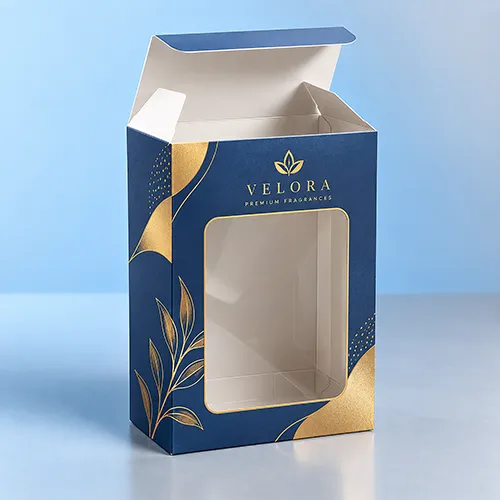
A die-cut opening can reveal the bottle or label where sufficient panel area remains.
Plan the window as:
Bottle Orientation → Visible Product Area → Window Geometry → Remaining Information / Structural Area
Coordinate it with:
-
bottle position;
-
required text areas;
-
tuck flaps;
-
folds and scores;
-
internal support;
-
and artwork.
Do not let the window consume panel space required for essential product information.
For broader viewing-window packaging, explore Boxes With Window.
Printing Options for Tuck-End E-Liquid Boxes
Custom printing can be developed across the approved carton panels.
Depending on the production setup, printing may include digital or offset methods with CMYK process color and Pantone/PMS references where applicable.
Keep the terminology separate:
Digital / Offset = Printing Methods
CMYK / Pantone = Color Systems / References
Buyer-approved artwork can include:
-
brand name;
-
product / flavor name;
-
variant information;
-
required product information;
-
warning text supplied and approved by the buyer;
-
barcode;
-
SKU;
-
QR code;
-
lot or batch area where applicable;
-
and other approved content.
Inside printing can also be considered where supported by the selected material and production method.
Finishing Options for Tuck-End E-Liquid Boxes
Printing and finishing should remain separate production decisions.
Compatible project-specific options may include:
-
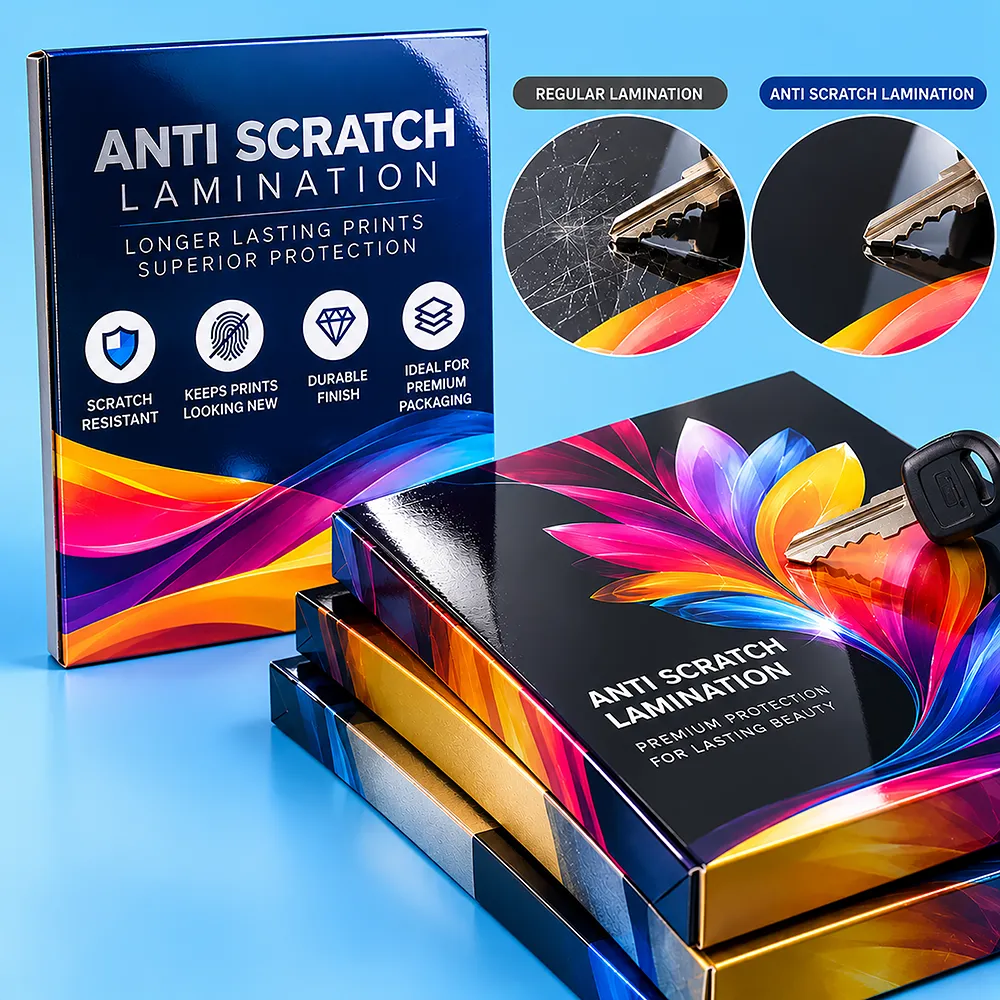
matte lamination;
-
gloss lamination;
-
soft-touch treatment;
-
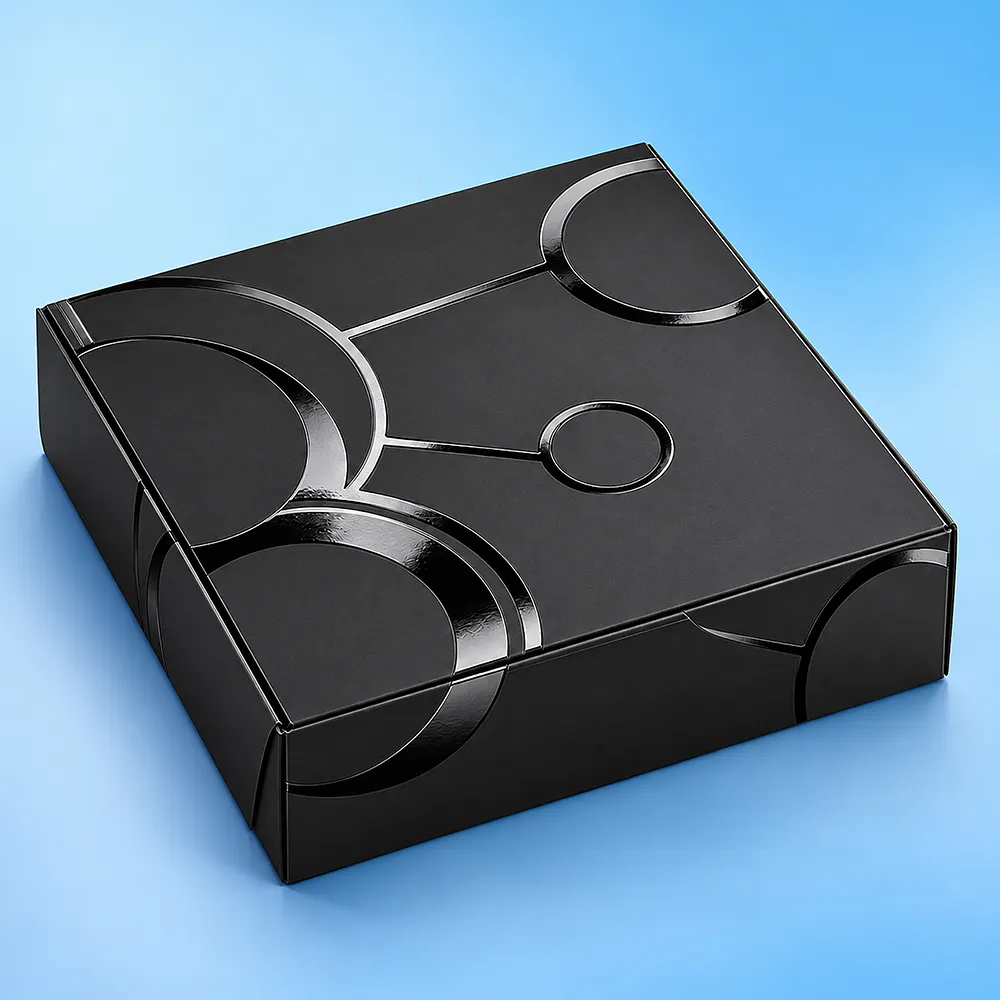
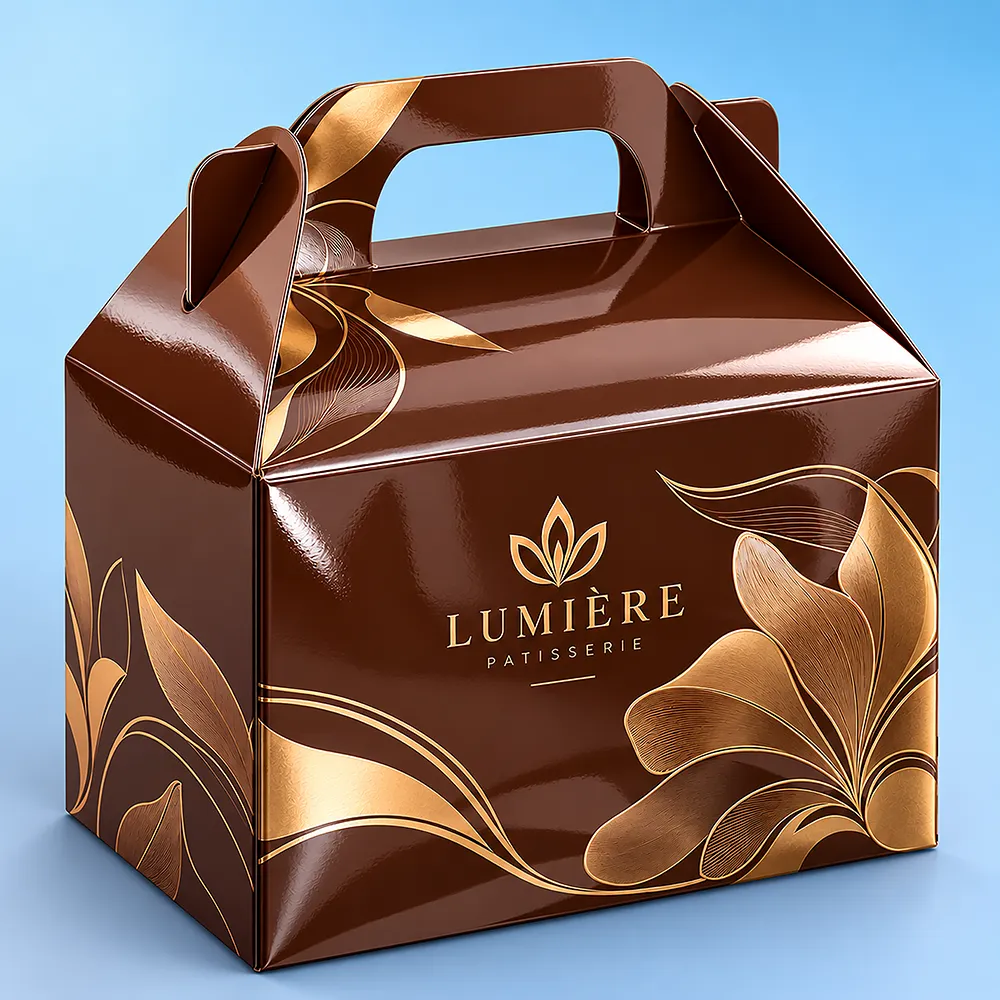
foil stamping;
-
embossing;
-
debossing;
-
and Spot UV.
Finish placement should account for:
Required Information Areas + Tuck Flaps + Scores + Folds + Barcode Areas + Artwork
Decorative effects should not interfere with legibility or functional folding zones.
Foil and Spot UV for E-Liquid Cartons
Foil or Spot UV can highlight selected branding areas such as:
-
logos;
-
product names;
-
borders;
-
or decorative graphics.
Use:
Required Information First → Artwork Hierarchy → Finish Placement
Do not place decorative effects over important warning, barcode or product-information areas where they can reduce readability.
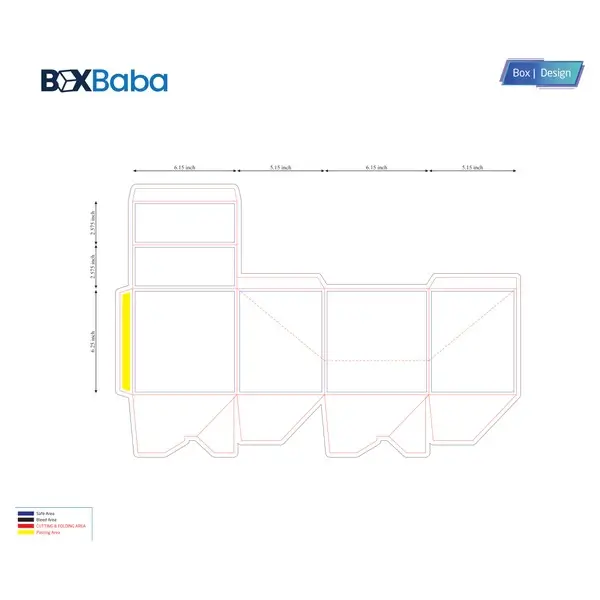
Tuck-End E-Liquid Box Dielines
The production dieline maps how the flat paperboard becomes the completed secondary carton.
Depending on the approved Tuck configuration, it can define:
Use:
Finished Bottle → Tuck Orientation → Required Panel Space → Board → Complete Dieline → Artwork
Do not substitute a generic bottle-carton dieline without confirming the actual bottle and closure geometry.
For deeper structural-file guidance, review BoxBaba Packaging Dieline Guide.
What Should Be Validated Before Production?
Use the approval method that matches the unresolved question.
A digital proof or 3D mockup can help review:
artwork + panel orientation + information areas + text + window placement + finish locations
A physical structural sample is more useful for:
bottle fit + closure clearance + loading + removal + tuck engagement + support position + window alignment
Use:
Artwork Question → Digital Proof
and:
Physical Bottle / Structure Question → Representative Sample
A digital mockup cannot validate physical bottle fit, liquid-container performance or legal compliance.
Check Both Bottle Loading and Removal
Do not approve fit only because the bottle can be inserted.
Review:
Insertion + Removal + Cap Clearance + Shoulder Clearance
A bottle that requires excessive force during loading may also be difficult for the customer to remove.
This is especially important for:
Tuck-End E-Liquid Carton vs Outer Shipping Packaging
The retail carton and the distribution package perform different functions.
For retail:
Finished Bottle → Tuck-End E-Liquid Carton
For ecommerce or courier distribution:
Completed Retail Carton / Order → Appropriate Outer Distribution Package
A standard paperboard Tuck End carton should not automatically be treated as parcel-qualified.
Where a stronger outer transport structure is required, compare Custom Corrugated Boxes.
What to Send for a Tuck-End E-Liquid Box Quote
If the carton dimensions are not yet known, send the measurements of the complete closed bottle rather than estimating an outside box size.
Custom Tuck-End E-Liquid Boxes Wholesale From BoxBaba
BoxBaba develops Tuck-End E-Liquid Boxes around the actual finished bottle, selected Tuck orientation, required artwork areas and approved board.
Custom packaging projects can start from 100 units.
Artwork and dieline support are available, along with digital proof or 3D mockup review. Ask about physical sample options where bottle fit, closure clearance, support position, window alignment or tuck engagement should be checked before bulk production.
Standard processing is typically 5–9 business days after final artwork approval, depending on the selected structure, board, printing, finishing and support requirements.
Free shipping is available across the USA.
Request Custom Tuck-End E-Liquid Boxes
A Tuck-End E-Liquid carton should be developed from the complete finished bottle and actual artwork requirements, not from liquid capacity alone.
Use:
Finished E-Liquid Bottle → Maximum Closed-Bottle Envelope + Filled Weight → Tuck-End Requirement → Flap Orientation → Internal Fit / Support → Required Label Space → Board + Dieline → Artwork → Physical Validation → Production
Share the maximum bottle width/depth or diameter, complete closed height, shoulder and closure profile, cap dimensions, base footprint, filled weight, orientation, required quantity by SKU, artwork status and any internal-support, window, inside-printing or finishing requirements.
Place your order by calling +1 305 574 4357 or emailing sales@boxbaba.com.