

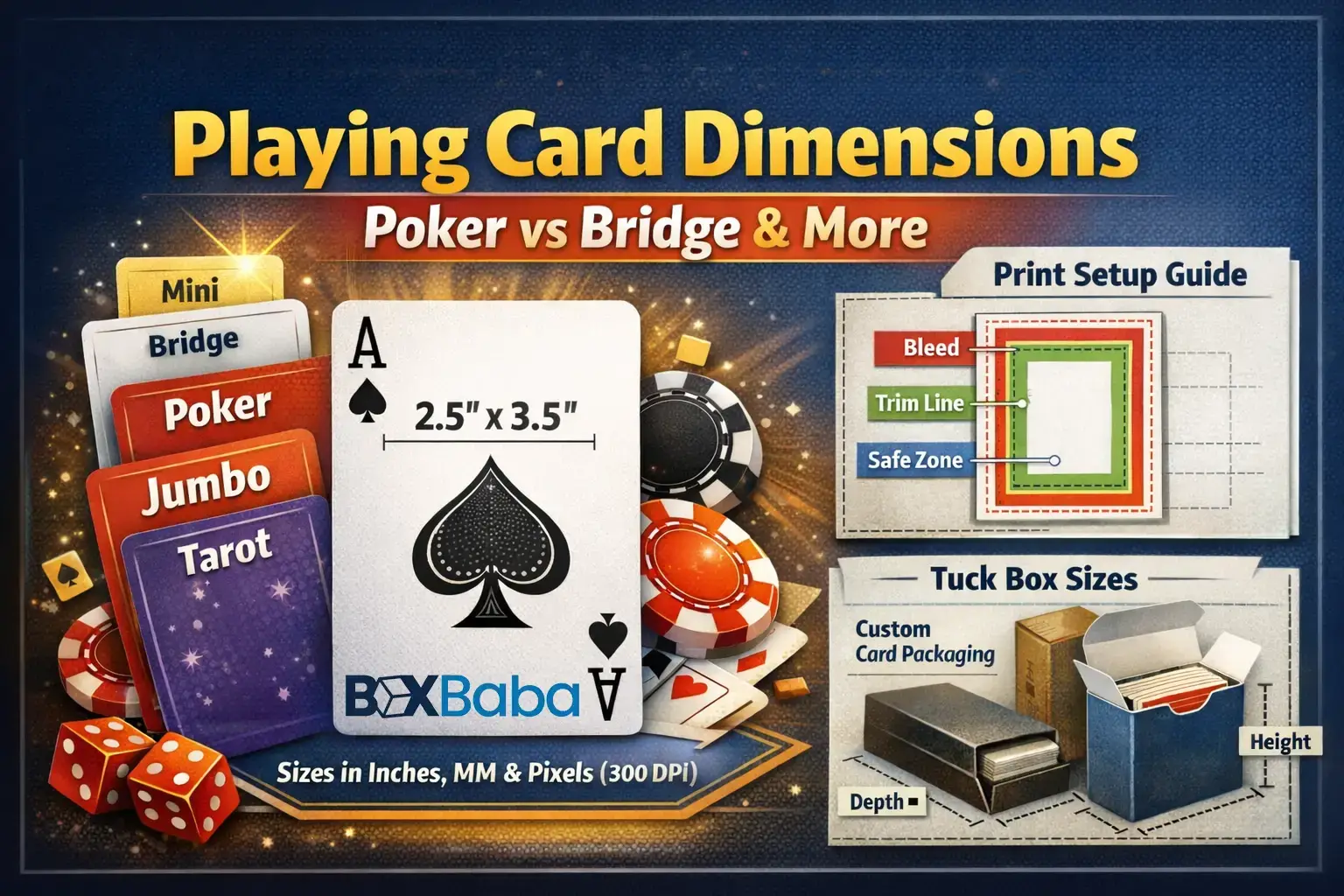
If you’re designing, printing, or packaging playing cards, getting the exact playing card dimensions matters. Whether you’re comparing poker vs bridge card size, creating a custom deck, or choosing the right tuck box dimensions, this guide gives you accurate sizes in:
- inches
- mm
- cm
- pixels (300 DPI)
Plus: bleed, safe zone, thickness, and box sizing—everything packaging buyers and designers need.
Standard playing card dimensions (poker size) are 2.5 × 3.5 inches (63.5 × 88.9 mm).
Bridge cards are narrower at 2.25 × 3.5 inches (57.15 × 88.9 mm), while mini, jumbo, and tarot cards follow different size ranges depending on use and printing.
Standard Playing Card Size
Poker size is the global standard for most playing cards and is used in:
- Poker & Blackjack
- Casino decks
- Bicycle decks (standard)
- Most custom playing card printing formats
Poker Size Dimensions
- 2.5 × 3.5 inches
- 63.5 × 88.9 mm
- 6.35 × 8.89 cm
Poker vs Bridge in One Sentence
Poker cards are wider; bridge cards are narrower but the same height.
Poker: 2.5 inches wide. Bridge: 2.25 inches wide. Both are 3.5 inches tall.
Poker vs Bridge in One Sentence
Bridge cards exist for comfort, especially when players hold many cards at once.
Bridge Size Dimensions
- 2.25 × 3.5 inches
- 57.15 × 88.9 mm
- 5.715 × 8.89 cm
Best for:
- Bridge, Rummy, Canasta
- Small hands / kids
- Long gameplay where grip matters
Playing Card Dimensions Table
Card Type | Size (inches) | Size (mm) | Common Uses |
Poker (Standard) | 2.5 × 3.5 | 63.5 × 88.9 | poker, blackjack |
Bridge | 2.25 × 3.5 | 57.15 × 88.9 | bridge, rummy |
Mini | 1.75 × 2.5 | 44.45 × 63.5 | travel decks |
Jumbo | 3.5 × 5 | 88.9 × 127 | teaching, visibility |
Tarot | 2.75 × 4.75 | 69.85 × 120.65 | tarot/oracle decks |
Square Cards | 2.5 × 2.5 | 63.5 × 63.5 | party games, trivia |
Playing Card Size in Pixels
If you’re designing cards for printing, pixel size is non-negotiable.
Poker Card Size in Pixels
At 300 DPI, a poker-size card (2.5 × 3.5 in) equals 750 × 1050 pixels (minimum).
Add bleed and margins to prevent trimming issues.
Pixel Dimensions
- Poker: 2.5 × 3.5 inches → 750 × 1050 px
- Bridge: 2.25 × 3.5 inches → 675 × 1050 px
Best practice:
- Use 300 DPI
- Use CMYK for print
- Include bleed + safe zone
Bleed & Safe Zone (Professional Card Design Specs)
This is one of the biggest gaps in competitor content, and one of your biggest ranking advantages.
Recommended Zones
- Bleed: 2mm–3mm
- Trim: final card size
- Safe Zone: keep text/images 3mm–5mm inside trim
Example (Poker: 63.5 × 88.9mm)
- Trim: 63.5 × 88.9mm
- With 3mm bleed: ~69.5 × 94.9mm
- Safe zone: keep important text inside ~57 × 82mm
Card Thickness + Deck Thickness
- Designers care about width/height.
Packaging buyers care about depth.
Typical Card Thickness
- 0.28mm to 0.35mm per card (varies by stock/coating)
Standard Deck Thickness
A deck of 52 cards + jokers often measures:
- 14mm to 18mm thick
- Premium decks can be thicker depending on coating and GSM.
Playing Card Box Dimensions
Tuck box size depends on card size + number of cards + card thickness.
A poker-size tuck box is taller/wider than the deck, while depth varies by material and coatings.
Standard Tuck Box Size
These are typical fit ranges (not a single universal number):
Poker Tuck Box
- Height: slightly above 88.9mm
- Width: slightly above 63.5mm
- Depth: usually 17mm–20mm (depends on deck thickness)
Bridge Tuck Box
- Same height
- Narrower width
- Similar depth range
Box Dimensions Table
Card Type | Deck Size (mm) | Typical Box Internal Fit Range |
Poker | 63.5 × 88.9 | ~66 × 91 × 17–20 |
Bridge | 57.15 × 88.9 | ~60 × 91 × 17–20 |
Mini | 44.45 × 63.5 | ~47 × 66 × 12–16 |
Jumbo | 88.9 × 127 | ~92 × 130 × 20–28 |
Tarot | 69.85 × 120.65 | ~73 × 124 × 20–28 |
Inner vs Outer Dimensions + Tolerance Tips
This is a strong expert signal, and your competitors don’t explain it clearly.
Inner vs Outer
- Inner dimensions = space inside the box (deck must fit here)
- Outer dimensions = final box size after material thickness
Packaging Tolerance Rule
When ordering packaging, allow:
- +1mm to +2mm tolerance on width/height
- +2mm to +4mm tolerance on depth (depends on material)
Sleeve Compatibility
This is an underrated but high-intent semantic topic.
Will sleeves fit poker cards?
- Yes, poker-size sleeves fit 2.5 × 3.5 inches.
Will bridge sleeves fit poker cards?
- No — bridge sleeves are narrower.
Bicycle Playing Card Dimensions
A lot of people search for Bicycle playing card dimensions. Including this improves relevance.
Bicycle Playing Cards Size
Most Bicycle decks use standard poker-size cards:
- 2.5 × 3.5 inches
- 63.5 × 88.9 mm
This answers branded intent fast.
Boxbaba Packaging Tip
If you’re ordering custom packaging from Boxbaba, use this checklist to avoid sizing mistakes:
- Card size (poker/bridge/tarot)
- Number of cards (52, 54, 78, etc.)
- Card thickness/material (linen, matte, gloss, UV)
- Deck thickness (stack height)
- Insert needs (dividers, foam, cardboard)
- Whether you need premium finishes (foil, emboss, spot UV)
FAQs
1) What are standard playing card dimensions?
Standard poker-size playing cards are 2.5 × 3.5 inches or 63.5 × 88.9 mm.
2) What’s the difference between poker and bridge cards?
Bridge cards are narrower (2.25 inches wide) but the same height (3.5 inches) as poker cards.
3) What is a poker card size in pixels?
At 300 DPI, poker cards are at least 750 × 1050 pixels (without bleed).
4) What is bleed for playing cards?
Bleed is the extra border area (usually 2mm–3mm) that gets trimmed during printing to prevent white edges.
5) How thick is a deck of cards?
A standard deck is typically 14mm–18mm thick, depending on stock and coating.
6) What are standard tuck box dimensions?
Tuck boxes vary by deck thickness, but poker tuck boxes often fit around 66 × 91 × 17–20mm internal.
7) Are Bicycle cards standard size?
Yes. Most Bicycle decks are standard poker size: 2.5 × 3.5 inches.
8) What size playing cards are best for small hands?
Bridge cards are best because they’re narrower and easier to hold.