
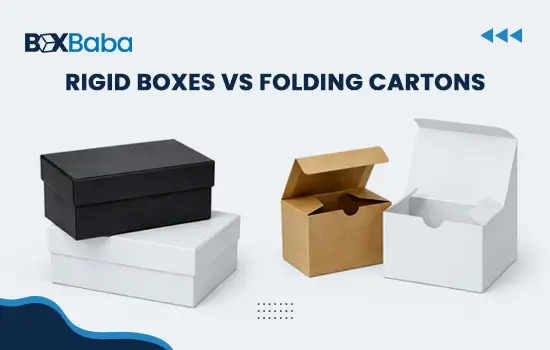
Packaging decisions rarely fail because teams picked the wrong box. They fail because teams price the box but ignore the system: packing labor, storage cube, shipping damage, and the moment a customer opens it.
If you’re deciding between rigid boxes and folding cartons, this guide is built to help you choose faster, and avoid expensive surprises. If you’re already leaning premium and want to explore options, start with custom rigid boxes.
Rigid vs Folding Cartons: The 30-Second Answer
Rigid boxes win when presentation and protection materially affect conversions, retention, or returns. Folding cartons win when scale efficiency, freight, storage, replenishment speed, and SKU flexibility, matters most.
The mistake that costs brands money: comparing only unit price. The right choice usually becomes obvious once you look at total landed cost and damage risk together.
Rigid Boxes vs Folding Cartons: Which Should You Choose?
Choose Rigid Boxes If You Need Premium Unboxing Higher Protection
- Your product is premium-positioned and packaging must feel like part of the value
- You’re shipping fragile items or kits where immobilization matters
- You’re selling gifts, sets, PR kits, or limited drops where unboxing is marketing
- You can support higher cost and (often) higher shipping/storage cube
Choose Folding Cartons If You Need Scale Efficiency Shelf Messaging
- You’re scaling retail or DTC and need efficient production and replenishment
- Your product is lightweight or moderately durable
- You want flat shipping, low warehouse cube, and frequent artwork updates
- You’re willing to add inserts and/or an outer shipper when needed
Best Hybrid Packaging Strategy: Rigid for Premium Drops, Cartons for Core SKUs
Use rigid for marketing moments (PR, gifting, seasonal bundles) and cartons for core SKUs. You get premium impact where it matters, without paying rigid logistics costs on every unit.
Rigid Boxes vs Folding Cartons Comparison (Cost, Strength, MOQ & Lead Time)
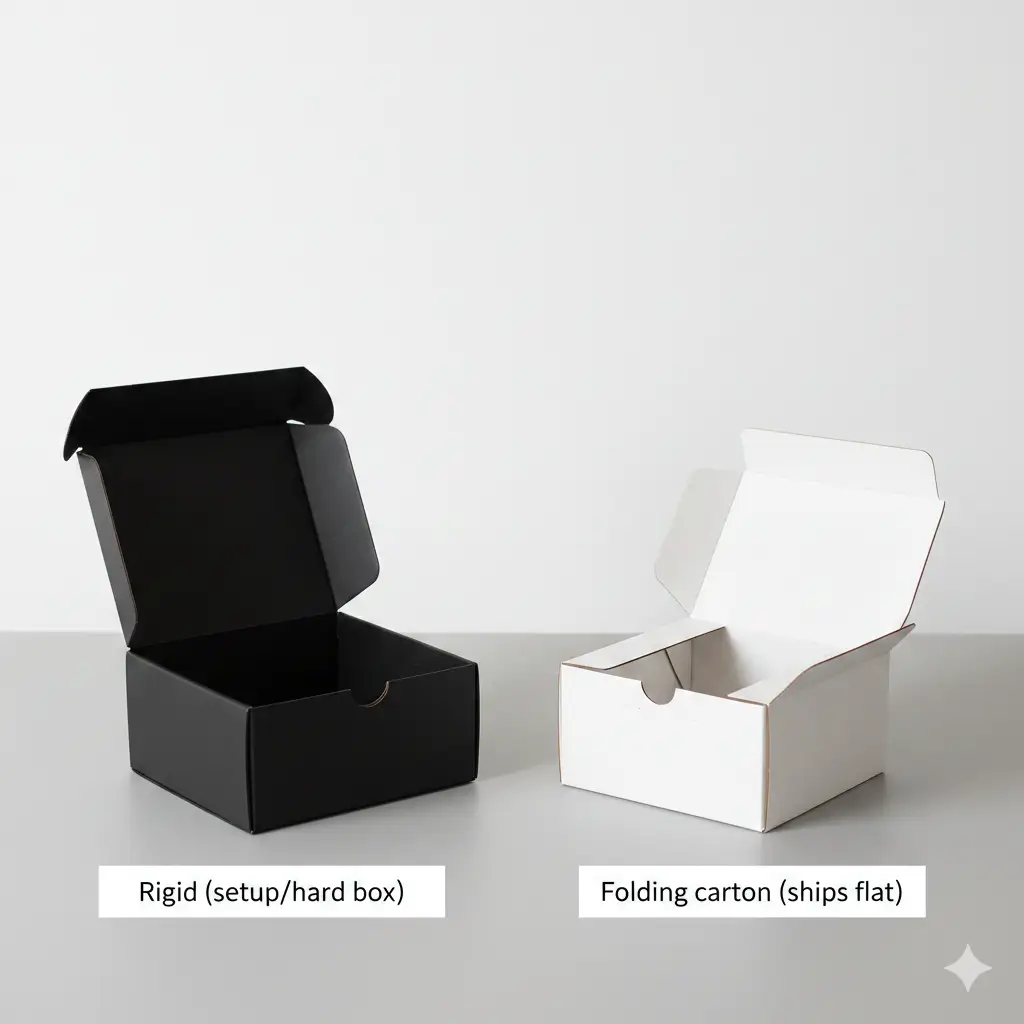
| Factor | Rigid Boxes (Setup/Hard Boxes) | Folding Cartons (Paperboard Boxes) | What buyers miss |
|---|---|---|---|
| Unit cost | Higher | Lower | Rigid cost is driven by board + wrap + labor; cartons scale efficiently. |
| Protection | Strong shell + insert-friendly | Varies by board + structure + insert | Cartons can protect well, but often need inserts and an outer shipper. |
| Print & finishes | Excellent (wrap-based luxury finishes) | Excellent (direct print, crisp graphics) | Both can look premium—structure and durability differ. |
| Logistics | Often bulky (many ship assembled) | Efficient (ships flat) | Storage cube can decide profitability more than unit price. |
| MOQ | Often higher | Often lower | Supplier model matters more than the material itself. |
| Lead time | Often longer | Often faster | Sampling + assembly steps extend rigid timelines. |
| Best use | Premium, gifting, fragile, sets | Retail, high-volume, lightweight SKUs | Most brands benefit from a hybrid packaging system. |
Ecommerce Packaging System: Carton or Rigid + Shipper

Most products don’t ship as just a rigid box or just a carton. They ship as a system:
Product → Insert → Retail pack (rigid or carton) → Corrugated shipper → Void fill (if needed)
If your folding carton is getting crushed in e-commerce, the fix is not always upgrade to rigid. Often the smarter fix is:
- better insert immobilization
- a right-sized corrugated shipper
- and a quick test plan before scaling
Choose the retail pack for branding and customer experience, then choose the shipper for the supply chain reality.
When Rigid Boxes Make More Sense
Rigid boxes are the right call when packaging must feel premium in-hand, protect fragile items cleanly, or create a keepsake unboxing moment.
If shipping and storage are your main objections, don’t default to standard assembled rigid. Consider formats designed to reduce cube while keeping the rigid experience, like foldable rigid boxes so you get premium presentation without paying unnecessary freight and warehouse penalties.
Common mistake: going rigid for everything. If only 10–20% of your orders truly need the premium moment, use rigid strategically and keep the rest scalable.
When Folding Cartons Make More Sense
Folding cartons are often the best choice when you need efficient production, strong shelf messaging, and low storage cube, especially across many SKUs.
For lightweight electronics and accessories, a well-designed carton can be both protective and premium—especially with the right insert. Here’s a relevant example format: folding carton electronic box.
Common mistake: using a thin carton and trying to save it with expensive finishes. Structure and fit should come first.
What Exactly Is a Rigid Box vs a Folding Carton?
Rigid boxes (setup/hard boxes)
Rigid boxes are pre-formed structures that don’t collapse. Most are built as paper-over-board: a thick board core wrapped with printed or specialty paper.
Common rigid styles
- 2-piece (lid + base)
- magnetic/book-style
- drawer/slide-out
- shoulder/neck box
- collapsible rigid (for logistics efficiency)
Folding cartons
Folding cartons are paperboard boxes that ship flat, then fold/glue into shape during packing.
Common Carton Styles
- reverse tuck end (RTE) / straight tuck end (STE)
- auto/crash bottom (stronger base + faster packing)
- sleeves (often paired with an inner tray)
- tray + sleeve combinations (popular “premium carton” strategy)
Packaging Cost Breakdown: Total Landed Cost
If you only compare unit price, you’ll make the wrong decision surprisingly often. Compare total landed packaging cost.
Materials + labor
- Rigid drivers: thick board + wrap + more assembly steps (forming/wrapping/setting), often more handwork
- Carton drivers: board grade + print coverage + die cutting + folding/gluing; typically scales faster
Finishes that Spike Cost
Foil, emboss/deboss, spot UV, soft-touch, specialty papers, magnets, and complex inserts can raise costs quickly. If you want premium without premium chaos, pick one hero finish and keep everything else clean.
Shipping + Storage Savings
If your quote looks fine until you factor in warehousing and freight, cube is usually the culprit. Consider rigid formats engineered to pack flatter—like collapsible rigid boxes to reduce storage and shipping burden while keeping a premium rigid presentation.
Total Landed Cost Formula
Total landed packaging cost per unit =
Unit price + (inbound freight ÷ units) + (storage allocation ÷ units) + (assembly labor ÷ units) + (expected damage/returns cost ÷ units)
Rule: if your product is high value or fragile, protection improvements can pay back fast. If you run many SKUs at scale, logistics efficiency often wins.
Sampling & QC Checklist: What to Approve Before You Order 1,000+ Units
A gorgeous sample can still be a production headache. Use this checklist before approving mass production.
Universal QC (rigid + cartons):
- Dimensions: confirm internal/external L×W×H and expected tolerances
- Dieline function: closures work naturally; no forced bends or tearing
- Color consistency: compare to approved proof (use consistent lighting)
- Registration: inspect thin borders, small type, barcodes
- Finish alignment: spot UV/foil placement; emboss depth consistency
- Scuff resistance: rub test dark solids and soft-touch surfaces
- Fold cracking (cartons): inspect creases under heavy ink coverage
- Glue integrity (cartons): seams hold; no squeeze-out; box stays square
- Wrap seams (rigid): clean seam placement; keep off hero faces
- Insert fit: product doesn’t rattle; removal isn’t forced
- Barcode scan test (retail): scan from realistic angles
- Pack-out time: time assembly and filling; labor cost is real
BoxBaba tip: keep a signed golden sample and require first-article photos matched against it.
Protection & Inserts: The Damage-Prevention Playbook
Protection isn’t thicker walls. It’s immobilization plus realistic shipping hazards.
Weight/fragility Bands
- Light + non-fragile: folding carton is usually enough
- Medium weight / moderate fragility: strong carton + insert, or rigid if premium perception matters
- Heavy or fragile (glass/electronics/kits): rigid + insert is often the cleanest path
| Insert type | Best for | Strengths | Trade-offs |
|---|---|---|---|
| Foam | very fragile, no movement | maximum protection, precision fit | disposal/sustainability perception |
| Molded pulp | eco-forward, moderate fragility | cushioning + sustainability story | tooling lead time, shape limits |
| Paperboard tray | retail-friendly, scalable SKUs | recyclable-friendly, cost efficient | less shock absorption than foam |
Mistake to avoid: an insert that looks good but allows rattle. If the product moves, your damage rate will expose it.
Shipping Tests That Prove It Works (ISTA, Compression, ECT)
If you ship DTC, export, or stack inventory, don’t rely on assumptions. Build a basic test plan.
| Test type | What it checks | When to request | Failure looks like |
|---|---|---|---|
| ISTA-style shipping simulation | handling hazards like drops/vibration | parcel shipping, subscription, cross-border | damaged product, crushed corners, popped closures, scuffing |
| Compression (stacking strength) | resistance to warehouse/pallet loads | tall cartons, heavy products, long storage | panel bowing, corner collapse, lid fit failure |
| ECT for shippers | corrugated edge crush strength | choosing an outer shipper | shipper buckles; stacks fail early |
Best practice: define pass as product arrives undamaged and packaging looks acceptable for the channel. Luxury DTC has stricter cosmetic standards than bulk retail.
Shelf Billboard vs Keepsake Unboxing
Packaging is a communication channel—your job is to decide where it needs to win.
Folding cartons: shelf billboard advantage
Cartons are great when you need:
- clear front-panel messaging
- consistent visual identity across SKUs
- frequent artwork updates
- retail compliance and barcode space
Rigid boxes: keepsake unboxing advantage
- Rigid shines when you need:
- premium tactile cues (weight, stiffness, structure)
- gifting-ready presentation
- a reveal moment that supports conversion
Premium carton playbook
If full rigid is too expensive for every unit:
- upgrade structure first (board/closure)
- use tray + sleeve combos for a premium reveal
- choose one hero finish
- keep fit and alignment tight
Packaging Print Problems: Scuffing, Cracking, Foil, Wrap Seams
| Issue | Shows up most on | Why it happens | Prevention |
|---|---|---|---|
| Fold cracking (white cracks) | cartons | heavy ink on folds | keep heavy ink off creases; plan artwork around folds |
| Scuffing (dark solids/soft-touch) | both | friction/handling | specify anti-scuff options; protect in shipping |
| Foil/emboss misalignment | both | registration drift | simplify foil shapes; allow tolerances; approve proofing process |
| Wrap seam visibility | rigid | seam placement choice | approve seam location on the sample; keep it off hero faces |
Rule: structure + one hero finish beats all the finishes on a weak foundation.
Sustainability & Recyclability: Design Choices That Actually Change the Outcome
Sustainability isn’t a label—it’s a build decision.
Rigid: keep it simple to keep it recyclable
- minimize non-paper elements where possible
- design components for easy separation
- align insert material with your sustainability goals
Cartons: strong baseline, watch the extras
- plastic windows and heavy laminations can complicate end-of-life
- barrier coatings may be required in some categories—use them intentionally
- avoid over-packaging that adds no performance
Mistake to avoid: vague green claims. Be specific about materials and design choices.
MOQ & Lead Time Benchmarks
MOQs and lead times vary by supplier model, structure complexity, and finishes.
Typical patterns
- rigid often trends higher MOQ and longer lead time due to labor/assembly
- cartons often scale faster and store/ship more efficiently
How to reduce risk fast
- start with a pilot run (especially for new SKUs)
- simplify finishes on run #1
- lock structure and insert fit before “luxury upgrades”
- use hybrid strategy: rigid for PR/limited drops; cartons for core volume
Best Packaging by Industry
Cosmetics & fragrance
- Rigid for premium sets/gifting; cartons for everyday SKUs. Watch scuffing, fit, and insert behavior.
Food & supplements
- Cartons are common for retail and compliance-heavy packaging. Watch barrier needs, labeling, stacking.
Electronics & accessories
- Rigid for fragile/premium; cartons for lighter accessories. Prioritize immobilization.
Gifts & seasonal sets
- Rigid often wins (presentation sells the gift). Control costs with one hero finish + smart inserts.
Subscription & e-commerce
Cartons + corrugated shipper systems often win at scale. Use rigid when AOV and unboxing justify it.
Packaging Specs for Accurate Quotes: GSM, Caliper, Thickness
If two suppliers quote the same box but silently change board grade or thickness, your comparison breaks.
For folding cartons, specify:
- board grade (SBS / kraft/other)
- GSM/caliper (if available)
- style (RTE/STE/auto-bottom/sleeve)
- print + finishes
- insert type
For rigid boxes, specify:
- style (2-piece/magnetic/drawer/shoulder/collapsible)
- board thickness (mm)
- wrap stock (printed/specialty)
- finishes (top 1–2 priorities)
- insert material + fit requirements
- whether it must ship flat (logistics requirement)
Tip: approve a golden sample and use it as the production reference.
Get Custom Rigid Boxes or Folding Cartons from BoxBaba
Rigid boxes optimize premium feel + protection. Folding cartons optimize scale + logistics + shelf messaging. Many brands win by using both—then validating performance with a simple test plan before scaling.
BoxBaba CTA: Share your product dimensions, weight, sales channel, and quantity tiers, and we’ll recommend the best structure, insert approach, and RFQ specs so your packaging performs in the real world. If you’re ready, reach out via our contact us.
FAQs
What is the main difference between rigid boxes and folding cartons?
Rigid is pre-formed and premium-feeling; cartons ship flat and scale efficiently. The better choice depends on fragility, price point, and the role of unboxing.
Are rigid boxes stronger than folding cartons?
Often yes for crush resistance, but a carton with proper immobilization and an outer shipper can outperform a rigid box with poor fit.
Are folding cartons cheaper than rigid boxes?
Usually cheaper on unit price. Compare total landed cost to account for freight, storage, labor, and damage.
When should I choose rigid?
When premium perception, gifting value, and protection are essential—especially for fragile items and sets.
When is a folding carton premium enough?
When structure + graphics + one hero finish hit your brand goal, and product risk is manageable with inserts and shipper strategy.
Can I use both in one product line?
Yes—often the best move: rigid for PR/gifting/limited drops, cartons for core SKUs.