
If you sell jewelry, your packaging has two jobs that matter more than anything else: make the product feel more valuable and make sure it arrives perfect. Rigid boxes are the go-to for premium jewelry brands because they deliver the this is special feeling fast—while giving you the structure you need for inserts, protection, and a clean unboxing moment. If you’re sourcing custom rigid boxes with logo, start by exploring formats and finishes that fit your product and channel. custom rigid boxes with logo.
But best rigid box isn’t one style. The best choice depends on what you sell (rings vs necklaces), how you ship (retail vs e-commerce), and what your brand promises (minimal vs ultra-luxe). This guide turns that into decisions you can use—and into specs you can send for quotes without surprises.
What are Rigid Jewelry Boxes?
Rigid jewelry boxes (also called setup or hard boxes) are pre-formed paperboard boxes that keep their shape and feel premium in-hand. Jewelry brands use them because they support high-end finishes (matte, foil, emboss), precise inserts that prevent movement and scratches, and a gift-ready unboxing experience—typically with higher cost and shipping/storage volume than folding cartons.
The Best Rigid Boxes for Jewelry Brands
- Rings / engagement: small drawer or two-piece with a snug ring slot insert
- Necklaces: book-style or magnetic with an anti-tangle insert (anchor points matter)
- Earrings: compact two-piece with foam/velvet pad or card-style insert
- Gift sets / bundles: magnetic or two-piece with a multi-cavity tray
- E-commerce shipping: rigid box still needs an outer corrugated shipper to prevent scuffs/crushed corners
- Luxury on a budget: choose one hero finish (foil OR emboss OR soft-touch), not all three
- Lowest risk: prioritize insert fit + lid fit before you upgrade finishes
- Before scaling: do a quick rattle/scuff test with real shipping handling
Best by Jewelry Type
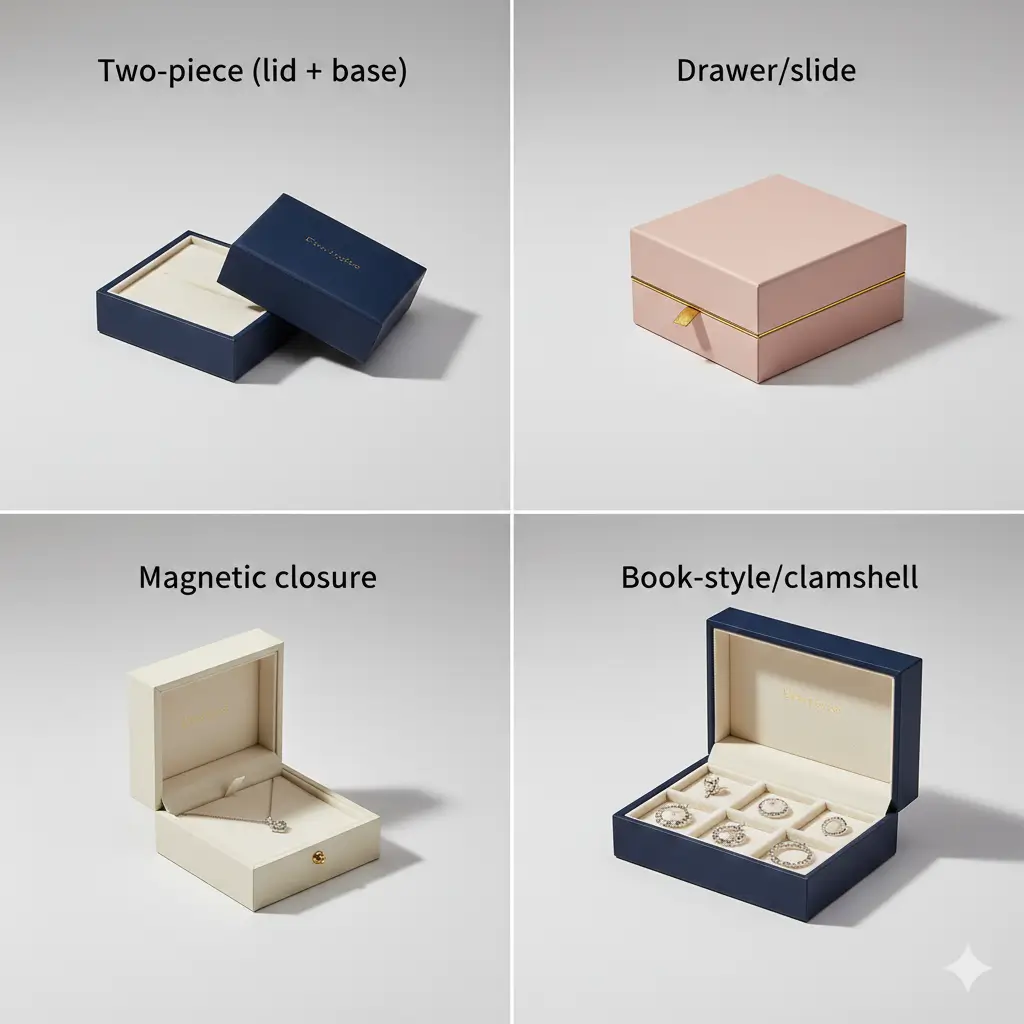
If you only use one table from this guide, use this one. It’s the fastest way to choose correctly, and it’s the easiest format for AI summaries to quote.
| Jewelry type | Best rigid box style | Best insert approach | Best channel | What to watch (real-world risk) |
|---|---|---|---|---|
| Rings / engagement | Drawer or two-piece | Tight ring slot + clean lift | Retail + gifting + premium DTC | Slot too wide → ring rotates/tilts (looks cheap) |
| Necklaces | Book-style or magnetic | Anti-tangle anchors + pendant pocket | Premium DTC + boutique retail | Chain movement → tangles; insert geometry matters |
| Earrings | Small two-piece or drawer | Velvet/foam pad or card-style holder | Retail + gifting | Posts snag on insert; removal must be clean |
| Bracelets | Magnetic or two-piece | Contoured cavity + stabilizer tab | DTC + gifting | Bracelet shifts → surface scratches |
| Sets / bundles | Magnetic (best) or two-piece | Multi-cavity tray + spacing | DTC + gifting + PR kits | Components touch → scuffs; “floating tray” feels wasteful |
| PR kits / influencer | Magnetic (signature reveal) | Tray + message card + camera-ready layout | PR + launches | Matte scuffs; shipper protection is mandatory |
Rule: For jewelry, insert design decides performance more than the outer style. Pick the style for the moment—then design the insert for the reality.
Best Rigid Box Styles for Jewelry
Best means best for your product + channel + unboxing goal. If you want a ready-made starting point for sourcing, browse purpose-built rigid jewelry boxes and use the guidance below to match the right style to your SKU.
Which Rigid Box is Best for Rings and Engagement Jewelry?
- Best styles: drawer (slide), two-piece (lid + base)
- Why: controlled reveal + compact size feels dense and valuable
- Insert must-have: a ring slot that’s tight enough to hold position
Common mistake: a slot that’s too soft or too wide—rings rotate, tilt, and instantly look cheaper.
Which Rigid Box is Best for Necklaces
- Best styles: book-style or magnetic closure
- Why: flat presentation lets you anchor the chain in a controlled layout
- Insert must-have: anti-tangle geometry (see inserts guide below)
Common mistake: relying on a generic cavity insert. The necklace still shifts, tangles, and arrives messy.
Which Rigid Box is Best for Earrings and Small Accessories?
- Best styles: compact two-piece, small drawer
- Insert must-have: pad insert (velvet/foam) or card-style insert
Common mistake: inserts that look premium but snag posts/backs during removal.
Which Rigid Box is Best for Jewelry Gift Sets and Bundles?
- Best styles: magnetic closure, two-piece
- Insert must-have: multi-cavity tray that keeps components from touching
Common mistake: too much empty space. A large box with a floating tray feels like wasted packaging, not luxury.
Premium Option: Magnetic Closure
For high-AOV sets, PR kits, and gifting, magnetic closure boxes are often the premium default because they create a clean, controlled opening moment—if alignment and shipping protection are handled properly.
Best Rigid Boxes for Jewelry Brands
Use this table to choose fast—and to make supplier quotes easier to compare.
| Rigid box style | Best for jewelry type | Best insert choice | Best channel | What jewelry brands often miss |
|---|---|---|---|---|
| Two-piece (lid + base) | rings, earrings, small pendants | velvet/foam pad + snug slots | retail + gifting | lid fit tolerance matters (too loose feels cheap) |
| Drawer / slide | rings, small sets, premium add-ons | structured tray with finger notch | gifting + premium DTC | drawer friction must be consistent (not sticky/loose) |
| Magnetic closure | sets, premium collections, PR kits | multi-cavity tray + message card | DTC + gifting + PR | alignment must be perfect; adds recyclability complexity |
| Book-style / clamshell | necklaces, curated stories | anti-tangle insert + anchor points | retail + premium DTC | chain anchoring beats “more padding” |
| Shoulder/neck | high-end collections | premium tray with tight margins | boutique retail | beautiful reveal, but can be costly and slower to produce |
| Collapsible rigid | larger boxes, high shipping volume | same tray as standard rigid | DTC at scale | solves cube costs; must be engineered to avoid flimsy feel |
What Insert Works Best for Jewelry and why?
A rigid box without the right insert is like a luxury store with messy shelves. Inserts control three things: scratch protection, movement, and presentation.
In practice, the fastest way to reduce damage and returns is to get immobilization right—especially for e-commerce orders. If you need tight-fit protection for fragile or high-value pieces, consider custom foam inserts early in the design process so the structure and insert work together (instead of trying to fix movement after the box is finalized).
Velvet vs Foam vs Molded Pulp vs Paperboard: What Should you Choose?
| Insert type | Best for | Pros | Trade-offs |
|---|---|---|---|
| Velvet / flocked | premium jewelry, boutique feel | luxury tactile cue, strong presentation | can attract lint/dust; sustainability perception |
| Foam | maximum immobilization | excellent protection, snug fit | disposal perception; can look cheap if not finished well |
| Molded pulp | eco-forward positioning | strong protection story, sturdy | shape constraints; tooling/lead times can be longer |
| Paperboard tray | scalable SKUs, clean merchandising | recyclable-friendly, good structure | less shock absorption; needs smart geometry |
Best practice: match insert material to your brand promise. If you claim eco-luxury, a plastic-heavy build can create trust friction, even if it protects well.
How to Design Anti-tangle Necklace Inserts
Anti-tangle insert blueprint
- Two anchor points at the top (left/right) to hold chain ends
- A center channel (shallow groove) to guide chain path
- A pendant pocket or snug cavity to stop swinging
- Optional: a soft strap/tab that lightly holds the chain
Quick test: pack a necklace and shake gently for 10 seconds. If the pendant swings freely, it will tangle in real shipping.
The Rattle Test Every Jewelry Brand Should do Before Scaling
- Pack the product exactly as you plan to ship it
- Close the rigid box and shake lightly
- If you hear movement, fix insert fit first
- Then place the rigid box in an outer shipper and repeat
What Jewelry Packaging must Do
Before you obsess over finishes, remember the job-to-be-done:
- Protect the product and presentation
- Support perceived value
- Ship reliably without looking handled
- Scale without operational chaos
If you’re also deciding whether folding cartons could work for your lower-priced SKUs, this comparison helps clarify where each format wins: rigid boxes vs folding cartons.
What Finishes Look Luxury on Jewelry, and What Fails in Shipping?
Finishes can elevate perceived value quickly, but they’re also where premium gets ruined by scuffs and misalignment.
If you’re building a luxury presentation system across SKUs, the principles here align closely with how premium brands design tactile cues and restraint: how luxury brands use rigid packaging.
Which Finish is the Safest Luxury Upgrade?
Matte/soft-touch + one small logo detail (foil or emboss). It photographs well and doesn’t require complex multi-effect execution.
What fails most often
- Scuffing on matte/soft-touch: protect in transit (tissue, sleeves, outer shipper)
- Foil/emboss misalignment: keep foil shapes simple; allow tolerances
- Visible wrap seams: approve seam placement on samples (keep off hero faces)
- Over-finished designs: too many effects compete and look busy
Rule: structure + a single hero finish beats all the finishes on a weak foundation.
Do Jewelry Brands need an Outer Shipper for Rigid Boxes?
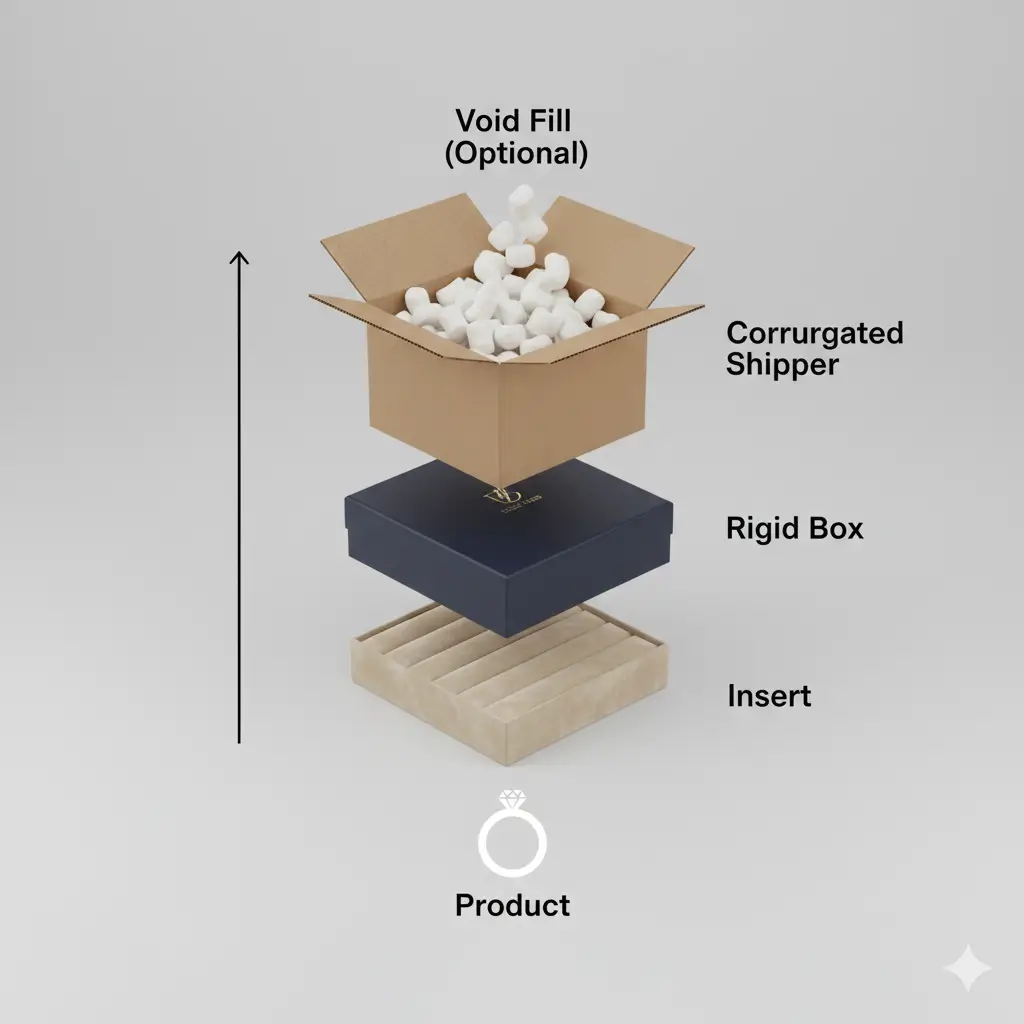
If you ship e-commerce, yes, almost always. A rigid box is a premium retail pack. Shipping is a different job.
The Packaging System Jewelry Brands Actually Ship
Product → Insert → Rigid box → Corrugated shipper → (Optional) void fill
Why it matters: most damage isn’t product breakage, it’s scuffed boxes, crushed corners, or shifted lids that reduce perceived value.
How Much do Rigid Jewelry Boxes Cost
Cost is typically driven by:
- style complexity (magnetic/book/shoulder often higher than two-piece)
- insert complexity (multi-cavity trays add steps)
- finish stack (foil + emboss + soft-touch + specialty wrap adds quickly)
- sampling rounds (more revisions = longer timeline)
- shipping/storage cube (bigger boxes cost more to move and store)
| Style | Cost tier (relative) | Lead time risk (relative) | Why |
|---|---|---|---|
| Two-piece | Low–Medium | Low | simpler build, fewer alignment points |
| Drawer / slide | Medium | Medium | tray + friction consistency matters |
| Magnetic closure | Medium–High | Medium–High | alignment + closures add complexity |
| Book-style / clamshell | Medium–High | Medium–High | hinges/layout precision + insert anchoring |
| Shoulder/neck | High | High | premium structure + more steps |
| Collapsible rigid | Medium–High | Medium | engineering needed for strength + flat shipping |
How to Choose a Rigid Box Supplier for Jewelry Brands
- Ensure samples match production reality (not just one perfect mock-up)
- Confirm insert capability (anti-tangle, multi-cavity, tight tolerances)
- Ask about QC tolerances (lid fit, logo placement, seam placement)
- Verify shipping protection approach (outer shipper sizing)
- Clarify what changes increase lead time most (finishes, magnets, insert tooling)
What Should you Check on a Jewelry Rigid Box Sample?
12-point QC Checklist
- Lid fit: not too tight, not too loose
- Corner quality: no bubbling, wrinkling, crushed edges
- Wrap seams: consistent, kept off hero faces
- Logo alignment: centered and level across samples
- Foil/emboss registration: crisp edges, consistent depth
- Scuff resistance: rub test the most handled areas
- Color consistency: check under consistent lighting
- Insert fit: no rattle; product centered and stable
- Removal experience: product lifts out cleanly (no snagging)
- Interior cleanliness: no glue marks, dust, visible defects
- Pack-out time: your team can pack it consistently and fast
- Shipping readiness: test with an outer shipper (corners + scuffing)
Get a Jewelry Rigid Box Recommendation
Rigid boxes increase perceived value, but the best choice comes down to your jewelry type, insert fit, and shipping reality. Share a few details and we’ll recommend the best structure, insert approach, and finish stack so your packaging arrives premium—not scuffed.
Send your details via our contact page and we’ll reply with a suggested structure + RFQ specs you can use to compare quotes.
FAQs
What are the best rigid boxes for jewelry brands?
The best rigid boxes depend on what you sell and how you ship. Drawer and two-piece boxes work well for rings and small items, magnetic/book-style boxes are great for premium sets and necklace presentation, and collapsible rigid helps when shipping/storage cube becomes expensive. Insert fit and shipping protection matter more than the outer style alone.
Are magnetic rigid boxes worth it for jewelry?
They’re worth it when you need a controlled premium reveal (gift sets, PR kits, high-AOV launches). They require careful alignment and usually need an outer shipper in e-commerce to prevent scuffs and corner damage.
What rigid box is best for necklaces?
Book-style or magnetic boxes paired with an anti-tangle insert are usually best. The insert should anchor the chain and prevent the pendant from swinging during shipping.
Velvet vs foam inserts: which is better for jewelry?
Velvet feels more luxurious and elevates presentation, while foam often immobilizes products better. If protection is the top priority, foam can win; if tactile luxury is key, velvet or a premium-finished tray is often preferred.
Do rigid jewelry boxes need an outer shipper?
For e-commerce shipments, yes. Rigid boxes are premium retail packs, but an outer shipper protects the box from scuffs, crushed corners, and lid shift that can reduce perceived value.
How do I prevent scuffing on matte or soft-touch boxes?
Protect the surface during shipping (tissue/sleeve + outer shipper), keep heavy handling off high-friction areas, and test samples under real shipping conditions before scaling.
What should I check before approving production?
Check lid fit, seam placement, logo alignment, scuff resistance, insert stability (no rattle), and shipping readiness with an outer shipper. Jewelry customers notice tiny flaws.