
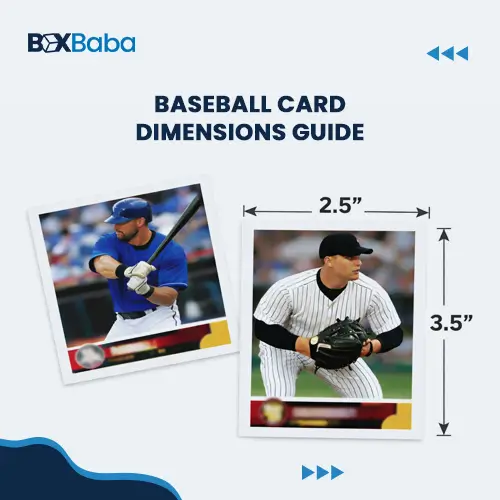
Most people searching for baseball card dimensions want one answer first: a standard modern baseball card measures 2.5 inches by 3.5 inches. That is the core dimension collectors use for sleeves, top loaders, binders, display cases, and most modern storage products. According to Topps, that standard trading card size is 2.5 x 3.5, which is also about 6.4 x 8.9 cm.
The standard size is only the starting point because thickness, holder fit, and vintage exceptions also affect how a card is stored and protected. Some older baseball sets are smaller or larger than the modern standard, and thick relic or patch cards need different protection even when the card face is still standard width and height. If you are choosing retail-ready packaging for sports collectibles, it also helps to start with the correct card format before moving into a custom sports box or display solution.
At BoxBaba, understanding the exact card format is the first step toward choosing packaging that protects, displays, and ships sports collectibles properly.
Baseball card dimensions usually refer to a card’s width and height. For most modern cards, the standard size is 2.5 inches x 3.5 inches.
Card thickness is a separate measurement, usually shown in points (pt), where 1 point = 0.001 inch. Important distinction: a standard-size card can still need a different sleeve, top loader, or case if it is thicker than a normal base card.
- Standard modern baseball card dimensions: 2.5 x 3.5.
- In metric, that is about 63.5 x 88.9 mm or 6.4 x 8.9 cm.
- Thickness matters too. Sports card thickness is measured in points, and 1 pt = 0.001 inch.
- Some baseball cards are not standard size, especially vintage issues like T206 and oversized sets like 1954 Topps.
- A useful baseball card dimensions guide should show what fits a standard card and when that standard advice stops applying.
What are the standard baseball card dimensions?
The standard modern baseball card size is 2.5 inches by 3.5 inches. That is the short answer most collectors need, and it is the dimension most modern supplies are built around. Topps defines the standard card size at 2.5 x 3.5, and that standard carries across most modern trading cards used in collecting today.
In metric terms, standard baseball card dimensions are 63.5 x 88.9 mm. Many sites round that to 6.4 x 8.9 cm, which is fine for general reference. For practical collecting, the inch measurement is usually the one that matters most because sleeves, top loaders, and holders are commonly sold around that format.
Baseball card dimensions for most modern cards are 2.5 inches by 3.5 inches, or 63.5 x 88.9 mm.
Quick fit guide for standard baseball cards
Here is the practical version most readers need.
| Item | Starting point for standard baseball cards |
|---|---|
| Card size | 2.5″ x 3.5″ |
| Metric size | 63.5 x 88.9 mm |
| Sleeve fit | Standard trading card sleeve |
| Top loader fit | Depends on thickness in pt |
| Binder fit | Most standard 9-pocket pages fit modern cards |
| Exception alert | Vintage, mini, oversized, relic, and slabbed cards may need different storage |
This quick-fit view is what many competing pages miss. Readers usually want one clear size answer, but they also want to know what actually fits that card in real use.
Baseball card dimensions in inches, mm, cm, and pixels
If you are comparing products or building a design file, it helps to see the same dimensions in several units.
Standard baseball card size conversions
- Inches: 2.5 x 3.5
Millimeters: 63.5 x 88.9 mm - Centimeters: about 6.4 x 8.9 cm
- Pixels at 300 DPI: about 750 x 1050 px
The pixel figure matters mostly for design, mockups, or custom print planning. It is less important for storage and protection, where the physical size and thickness are what matter.
If you need baseball card dimensions in pixels, a standard 2.5 x 3.5 card is about 750 x 1050 pixels at 300 DPI.
Why baseball card dimensions matter
Baseball card dimensions matter because size affects protection, storage, and fit. The width and height tell you whether a card is standard size, but the thickness tells you whether it will fit a normal sleeve, a standard top loader, or a thicker holder. The same sizing logic also affects how cards are packed for display, storage, or transit inside a sports shipping box.
Many pages explain the standard size but do not explain which sleeves, top loaders, or binders fit it. Users often want to know:
- what size sleeve fits it
- what top loader they need
- whether it fits a 9-pocket binder page
- whether a thick relic card needs a different case
- whether a vintage card is non-standard or possibly trimmed
Baseball card dimensions matter because size affects protection, storage, and fit. The width and height tell you whether a card is standard size, but the thickness tells you whether it will fit a normal sleeve, a standard top loader, or a thicker holder. The same sizing logic also matters when cards are packed for display or retail presentation inside a sports product box with window.
What is the right baseball card sleeve size?
For most modern baseball cards, standard trading card sleeves are the right starting point because they are designed around the 2.5 x 3.5 format. That is why the standard card size became so practical in the hobby: it fits easily into albums and sleeves.
For standard baseball cards:
- A standard penny sleeve is usually the right starting point for normal base cards.
- Standard-size cards that are thicker than normal may still need a different sleeve or a roomier holder.
- Vintage cards, mini cards, and oversized cards should never be assumed to fit standard sleeves without checking their dimensions first.
The biggest mistake collectors make is treating width-and-height fit and thickness fit as the same problem.
What is the right baseball card top loader size?
The right baseball card top loader size depends on two things: the standard 2.5 x 3.5 face size and the card’s thickness in points. BCW’s point gauge materials make this easy to understand: thickness is measured in points, and 1,000 points = 1 inch, so 1 point = 0.001 inch.
That means a card can be standard in face size and still need:
- a regular top loader for thinner cards
- a thicker top loader for relic, patch, or premium stock cards
- a one-touch or specialty holder for unusually thick cards
PSA separates standard card face size from holder thickness limits in its holder guidance. In the draft research, PSA’s standard sports card holder is described around 2.5 x 3.5 x 0.04 inches, with 40 pt max thickness in that standard configuration.
Width and height tell you whether the card is standard size. Thickness tells you which holder actually fits.
What does card thickness mean?
Card thickness is the depth of the card from front to back. It is usually measured in points (pt).
- BCW’s printable thickness gauge states:
- 1,000 points = 1 inch
therefore 1 point = 0.001 inch
This matters because not all baseball cards have the same stock thickness. Base cards, chrome cards, relic cards, and patch cards can all differ. Even when their face dimensions stay close to the standard 2.5 x 3.5, the wrong holder can still cause damage, pressure, or corner wear.
Baseball card thickness is measured in points, and 1 point equals 0.001 inch.
Are all baseball cards the same size?
No. Not all baseball cards use the standard modern size. That is one of the most important caveats in any article about baseball card dimensions.
Some cards are:
- smaller, especially certain vintage tobacco issues
- larger, especially some mid-century sets
- mini
- oversized
- standard face size but unusually thick
Two useful examples:
- T206 cards are widely listed at 1-7/16 x 2-5/8, which is much smaller than the modern standard. Specialty T206 references also note that natural size variance can exist in unaltered examples.
- 1954 Topps cards measure 2-5/8 x 3-3/4, which is larger than the modern standard. PSA CardFacts lists that size directly.
This is why collectors should avoid blanket advice like all baseball cards are 2.5 by 3.5. That is true for most modern cards, not all cards across the hobby’s history.
Important vintage baseball card size exceptions
Vintage cards are where baseball card dimensions become more interesting and more confusing.
T206
T206 cards are commonly cited at 1-7/16 x 2-5/8. They are notably smaller than modern cards and should not be treated as standard-size cards for sleeves or holders. Specialty T206 references also mention that authentic examples can show some natural variation from the nominal size.
1954 Topps
PSA CardFacts lists 1954 Topps at 2-5/8 x 3-3/4. That makes it a useful example of an oversized vintage baseball format compared with modern standard cards.
1955 Topps
Step 1 research identified 1955 Topps in the same oversized family at 2-5/8 x 3-3/4 from PSA CardFacts. That is a good reminder that even major Topps sets did not always follow the modern size collectors expect.
Mini formats
Some mini issues, including Topps Mini examples surfaced in Step 1 research, use smaller dimensions than standard cards. These are exactly the kinds of cards that create sleeve and top loader confusion if a page only repeats the modern standard and stops there.
Vintage baseball cards are where standard-size advice starts to break down.
How to measure a baseball card safely
If you need to confirm baseball card dimensions, measure the card carefully and avoid rough tools or unnecessary handling.
Measure width and height
Use a ruler or caliper to check:
- width across the short side
- height across the long side
For modern cards, you are usually checking whether the card is close to 2.5 x 3.5. For vintage cards, you may be confirming whether the card belongs to a known non-standard format.
Measure thickness separately
Use a thickness gauge or a tool designed for card protection decisions. This matters most for:
- relic cards
- patch cards
- chrome or premium-stock cards
- cards going into one-touch holders or top loaders
Do not jump to conclusions from minor size differences
Some authentic vintage cards show natural production variation. A card being slightly off from a textbook size does not automatically prove trimming. That topic needs careful handling, and a simple size mismatch alone is not enough for a confident conclusion. T206 references specifically note natural variation in unaltered cards.
Measure width and height to identify the format, then measure thickness to choose the holder.
Do baseball cards fit standard binder pages?
Most modern standard-size baseball cards are designed to work with standard 9-pocket storage formats, because the 2.5 x 3.5 size became the hobby norm partly due to album and sleeve compatibility.
But there are limits:
- thick cards may not fit comfortably in some binder-page setups
- vintage oversized cards may not fit standard pockets
- mini cards can fit loosely unless the page is designed for them
- slabbed cards are a different storage category entirely
So yes, most modern standard baseball cards fit standard binder systems, but non-standard vintage cards and thick cards need separate attention.
Baseball card dimensions vs graded-card dimensions
A raw baseball card and a graded card are not the same size in practice. The raw card may be standard, but the slab is larger and behaves more like a different storage object.
PSA’s holder materials show that slab standards depend on both the raw card dimensions and the holder design. PSA also notes that holder sizing can vary by item type and insert category. That means collectors should not assume that all graded cards use one identical external slab dimension.
This matters for:
- storage boxes
- display stands
- travel cases
- slab binder systems
A standard baseball card can become a non-standard storage problem the moment it goes into a slab.
Common mistakes people make with baseball card dimensions
Confusing card size with holder size
A card can be standard size and still need a thicker holder.
Assuming every baseball card is modern standard
Vintage issues like T206 and oversized sets like 1954 Topps prove otherwise.
Ignoring thickness
A 2.5 x 3.5 relic card is still not the same fit as a thin base card.
Using one answer for sleeves, top loaders, binders, and slabs
Those are related fit questions, but they are not identical.
Treating slight vintage variation as automatic evidence of trimming
Real production variance exists in some older issues.
Final Thoughts
Baseball card dimensions are simple at the top level and more nuanced in real use. For most modern cards, the answer is 2.5 inches by 3.5 inches. But a complete, trustworthy answer also has to account for thickness, holder fit, vintage exceptions, and graded-card storage. That is what makes a baseball card dimensions page genuinely useful: it tells readers not just how big the card is, but what that size means in practice.
Frequently Asked Questions
What are the standard dimensions of a baseball card?
The standard modern baseball card size is 2.5 inches by 3.5 inches. In metric, that is about 63.5 x 88.9 mm.
Are all baseball cards 2.5 x 3.5?
No. Most modern cards follow that standard, but some vintage, mini, and oversized cards do not. T206 cards are smaller, while 1954 Topps cards are larger.
What size sleeves fit baseball cards?
Most modern baseball cards fit standard trading card sleeves, but thickness still matters. Thick cards may need a different sleeve or holder even when the face size is standard.
What size top loader do I need for a baseball card?
A standard baseball card usually uses a standard-width top loader, but the correct choice depends on thickness in points. BCW’s gauge makes that clear by separating face dimensions from thickness.
What does 35 pt mean on a sports card holder?
It refers to card thickness. 1 point equals 0.001 inch, so a 35 pt card is about 0.035 inch thick.
What size are vintage baseball cards?
There is no single vintage baseball card size. For example, T206 cards are commonly listed at 1-7/16 x 2-5/8, while 1954 Topps cards measure 2-5/8 x 3-3/4.
What are baseball card dimensions in pixels?
At 300 DPI, a standard 2.5 x 3.5 baseball card is about 750 x 1050 pixels.
Do baseball cards fit standard binders?
Most modern standard-size baseball cards do, but thick cards, mini cards, oversized vintage cards, and slabbed cards may need different storage solutions.